
Liquid Solution - JEE Main Previous Year Question of with Solutions

eSaral Academic and Editorial Team
Summary
Liquid Solution is a key JEE Chemistry chapter covering ideal and non-ideal solutions, Raoult’s law, colligative properties, vapour pressure, osmotic pressure, freezing point depression, and van’t Hoff factor, with extensive JEE Main and Advanced problem practice.
eSaral › JEE › JEE Main ›Liquid Solution

🚀 Checkout eSaral Courses
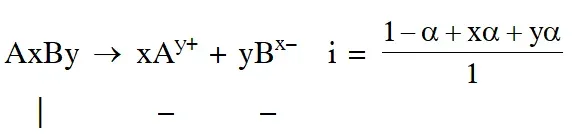
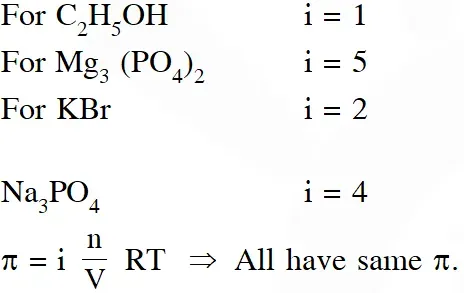
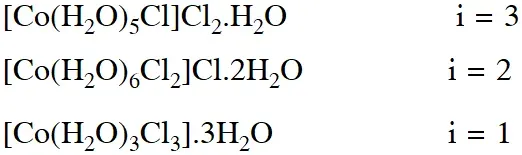
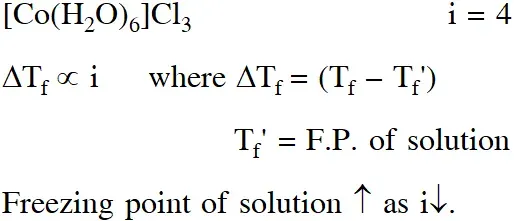
Download eSaral app for free study material and video tutorials. Simulator Previous Years AIEEE/JEE Mains Questions [esquestion] A binary liquid solution is prepared by mixing n-heptane and ethanol. Which one of the folloowing statements is correct regarding the behaviour of the solution ? (1) The solution is non-ideal, showing –ve deviation from Raoult's law (2) n-heptane shows +ve deviation while ethanol shows –ve deviation from Raoult's law (3) The solution formed is an ideal solution. (4) The solutionis non-ideal, showing +ve deviation from Raoult's law #tag# [AIEEE-2009] #sol# (4) (A) n–heptone : Non Polar (B) Ethanol : Polar $\mathrm{F}_{\mathrm{A}-\mathrm{B}}<\mathrm{F}_{\mathrm{A}-\mathrm{A}}, \mathrm{F}_{\mathrm{B}-\mathrm{B}} \Rightarrow+$ deviation [/esquestion] [esquestion] Two liquids X and Y form an ideal solution. At 300K, vapour pressure of the solution containing 1 mol of X and 3 mol of Y is 550 mm Hg. At the same temperature, if 1 mol of Y is further added to this solution, vapour pressure of the solution increases by 10 mm Hg. Vapour pressure (in mmHg) of X and Y in their pure states will be, respectively :- (1) 400 and 600 (2) 500 and 600 (3) 200 and 300 (4) 300 and 400 #tag# [AIEEE-2009] #sol# (1) $550=\mathrm{P}_{\mathrm{A}}^{\circ} \times \frac{1}{4}+\mathrm{P}_{\mathrm{B}}^{\circ} \times \frac{3}{4}$ $560=\mathrm{P}_{\mathrm{A}}^{\circ} \times \frac{1}{5}+\mathrm{P}_{\mathrm{B}}^{\circ} \times \frac{4}{5}$ $\mathrm{P}_{\mathrm{A}}^{\circ}=400 \quad \mathrm{P}_{\mathrm{B}}^{\circ}=600$ torr [/esquestion] [esquestion] On mixing, heptane and octane form an ideal solution. At 373 K, the vapour pressures of the two liquid components (heptane and octane) are 105 kPa and 45 kPa respectively. Vapour pressure of the solution obtained by mixing 25.0 of heptane and 35 g of octane will be (molar mass of heptane = 100 g $\mathrm{mol}^{-1}$ and of octane = 114 g $\mathrm{mol}^{-1}$) :- (1) 144.5 kPa (2) 72.0 kPa (3) 36.1 kPa (4) 96.2 kPa #tag# [AIEEE-2010] #sol# (2) $\mathrm{P}_{\mathrm{A}}=\mathrm{P}_{\mathrm{A}}^{\circ} \mathrm{X}_{\mathrm{A}}=105 \times \frac{1 / 4}{1 / 4+0.307}$ $=105 \times 0.449=47.13 \mathrm{K} \mathrm{Pa}$ $\mathrm{P}_{\mathrm{B}}=\mathrm{P}_{\mathrm{B}}^{\circ} \mathrm{X}_{\mathrm{B}}=45 \times 0.551=24.795$ $\mathrm{P}_{\mathrm{T}}=\mathrm{P}_{\mathrm{A}}+\mathrm{P}_{\mathrm{B}}=71.925 \mathrm{atm}$ [/esquestion] [esquestion] If sodium sulphate is considered to be completely dissociated into cations and anions in aqueous solution, the change in freezing point of water $\left(\Delta \mathrm{T}_{\mathrm{f}}\right)$, when 0.01 mol of sodium sulphate isdissolved in 1 kg of water, is $\left(\mathrm{K}_{\mathrm{f}}=1.86 \mathrm{K} \mathrm{kg} \mathrm{mol}^{-1}\right):$ :- (1) 0.0186 K (2) 0.0372 K (3) 0.0558 K (4) 0.0744 K #tag# [AIEEE-2010] #sol# (3) $\Delta \mathrm{T}_{\mathrm{f}}=\mathrm{i} \mathrm{k}_{\mathrm{f}} \cdot \mathrm{m}$ $=3 \times 1.86 \times 0.01 / 1$ $=0.0558 \mathrm{K}$ [/esquestion] [esquestion] The molality of a urea solution in which 0.0100g of urea, $\left.\left[\mathrm{NH}_{2}\right)_{2} \mathrm{CO}\right]$ is added to 0.3000 $\mathrm{dm}^{3}$ of water at STP is :- (1) 0.555 m (2) $5.55 \times 10^{-4} \mathrm{m}$ (3) 33.3 m (4) $3.33 \times 10^{-2} \mathrm{m}$ #tag# [AIEEE-2011] #sol# (2) $\mathrm{m}=\frac{\mathrm{n}}{\mathrm{W}(\mathrm{kg})}=\frac{0.01 / 60}{0.3 \mathrm{kg}}=5.55 \times 10^{-4} \mathrm{mol} / \mathrm{kg}$ [/esquestion] [esquestion] A 5% solution of cane sugar (molar mass 342) is isotonic with 1% of a solution of an unknown solute. The molar mass of unknown solute in g/mol is :- (1) 136.2 (2) 171.2 (3) 68.4 (4) 34.2 #tag# [AIEEE-2011] #sol# (3) $\pi_{\mathrm{c.s}}=\pi_{\mathrm{Unk}}$ $\left(\frac{\mathrm{n}}{\mathrm{V}}\right)_{\mathrm{c.s.}} \mathrm{RT}=\left(\frac{\mathrm{n}}{\mathrm{V}}\right)_{\mathrm{unk} .} \mathrm{RT}$ $\frac{5 \times 10}{342}=\frac{1 \times 10}{\mathrm{M}}$ M = 68.4 gm/mol [/esquestion] [esquestion] Ethylene glycol is used as an antifreeze in a cold climate. Mass of ethylene glycol which should be added to 4 kg of water to prevent it from freezing at – $6^{\circ} \mathrm{C}$ will be : $\left(\mathrm{K}_{\mathrm{f}} \text { for water }=1.86 \mathrm{K} \mathrm{kgmol}^{-1}, \text { and molar mass of ethylene glycol }=62 \mathrm{gmol}^{-1}\right)$ (1) 400.00 g (2) 304.60 g (3) 804.32 g (4) 204.30 g #tag# [AIEEE-2011] #sol# (3) $6=1.86 \times \frac{\mathrm{w} / 62}{4} \Rightarrow \mathrm{w}=800 \mathrm{gm}$ [/esquestion] [esquestion] The degree of dissociation () of a weak electrolyte, AxBy is related to van't Hoff factor (i) by the expression :- $(1) \alpha=\frac{\mathrm{x}+\mathrm{y}-1}{\mathrm{i}-1}$ (2) $\alpha=\frac{\mathrm{x}+\mathrm{y}+1}{\mathrm{i}-1}$ (3) $\alpha=\frac{\mathrm{i}-1}{(\mathrm{x}+\mathrm{y}-1)}$ (4) $\alpha=\frac{\mathrm{i}-1}{\mathrm{x}+\mathrm{y}+1}$ #tag# [AIEEE-2011] #sol# (3) [/esquestion] [esquestion] $\mathrm{K}_{\mathrm{f}}$ for water is 1.86 K kg $\mathrm{mol}^{-1}$. If your automobile radiator holds 1.0 kg of water, how many grams of ethylene glycol $\left(\mathrm{C}_{2} \mathrm{H}_{6} \mathrm{O}_{2}\right)$ must you add to get the freezing point of the solution lowered to –$-2.8^{\circ} \mathrm{C} ?$ (1) 27 g (2) 72 g (3) 93 g (4) 39 g #tag# [AIEEE-2012] #sol# (3) $2.8=1.86 \times \frac{\mathrm{w} / 62}{1} \Rightarrow \mathrm{w}=93.33 \mathrm{gm}$ [/esquestion] [esquestion] A solution containing 0.85 g of $\mathrm{ZnCl}_{2}$ in 125.0 g of water freezes at $-0.23^{\circ} \mathrm{C}$ . The apparent degree of dissociation of the salt is : ($\mathbf{k}_{f}$ for water = 1.86 K kg $\mathrm{mol}^{-1}$, atomic mass ; Zn = 65.3 and Cl = 35.5) (1) 1.36% (2) 2.47% (3) 73.5% (4) 7.35% #tag# [Jee (Main)-2012 online] #sol# (3) $0.23=(1+2 \alpha) \times 1.86 \times \frac{0.85 / 134.5}{0.125}$ $\alpha=0.735=73.5 \%$ [/esquestion] [esquestion] Liquids A and B form an ideal solution. At $30^{\circ}$C, the total vapour pressure of a solution containing 1 mol of A and 2 moles of B is 250 mm Hg. The total vapour pressure becomes 300 mm Hg when 1 more mol of A is added to the first solution. The vapour pressures of pure A and B at the same temperature are (1) 450, 150 mm Hg (2) 250, 300 mm Hg (3) 125, 150 mm Hg (4) 150, 450 mm Hg #tag# [Jee (Main)-2012 online] #sol# (1) $250=\mathrm{P}_{\mathrm{A}}^{0} \times \frac{1}{3}+\mathrm{P}_{\mathrm{B}}^{0} \times \frac{2}{3}$ $300=\mathrm{P}_{\mathrm{A}}^{0} \times \frac{1}{2}+\mathrm{P}_{\mathrm{B}}^{0} \times \frac{1}{2}$ $\mathrm{P}_{\mathrm{A}}^{0}=450 \mathrm{mm}$ $\mathrm{P}_{\mathrm{B}}^{0}=150 \mathrm{mm}$ [/esquestion] [esquestion] The freezing point of a 1.00 m aqueous solution of HF is found to be $-1.91^{\circ} \mathrm{C}$. The freezing point constant of water, $\mathrm{K}_{\mathrm{f}}$, is 1.86 K kg $\mathrm{mol}^{-1}$. The percentage dissociation of HF at this concentration is (1) 2.7% (2) 30% (3) 10% (4) 5.2% #tag# [Jee (Main)-2012 online] #sol# (1) $\Delta \mathrm{T}_{\mathrm{f}}=\mathrm{i} \times \mathrm{K}_{\mathrm{f}} \times \mathrm{m}$ $1.91=(1+\alpha) \times 1.86 \times 1$ $\alpha=0.027$ [/esquestion] [esquestion] How many grams of methyl alcohol should be added to 10 litre tank of water to prevent its freezing at 268 K ? $\left(\mathrm{K}_{f} \text { for water is } 1.86 \mathrm{K} \mathrm{kg} \mathrm{mol}^{-1}\right)$ (1) 899.04 g (2) 886.02 g (3) 868.06 g (4) 880.07 g #tag# [Jee (Main)-2013 online] #sol# (2) $\Delta \mathrm{T}_{\mathrm{f}}=\mathrm{T}_{\mathrm{f}}^{0}-\mathrm{T}_{\mathrm{f}}=\mathrm{K}_{\mathrm{f}} \times \mathrm{m}$ $273.15-268=1.86 \times \frac{\mathrm{w} / 32}{10}$ $\mathrm{w}=886.02 \mathrm{g}$ [/esquestion] [esquestion] Vapour pressure of pure benzene is 119 torr and that of toluene is 37.0 torr at the same temperature. Mole fraction of toluene in vapour phase which is in equilibrium with a solution of benzene and toluene having a mole fraction of toluene 0.50, will be : (1) 0.137 (2) 0.205 (3) 0.237 (4) 0.435 #tag# [Jee (Main)-2013 online] #sol# (3) Benzen $\rightarrow 4$ Toluene $\rightarrow B$ y $_{B}=\frac{P_{B}^{0} \times X_{B}}{P_{B}^{0} X_{B}+P_{A}^{0} X_{A}}=\frac{37 \times 0.5}{37 \times 0.5+119 \times 0.5}=0.237$ [/esquestion] [esquestion] A molecule M associates in a given solvent according to the equation M $(\mathrm{M})_{\mathrm{n}}$. For a certain concentration of M, the van’t Hoff factor was found to be 0.9 and the fraction of associated molecules was 0.2. The value of n is : (1) 2 (2) 4 (3) 5 (4) 3 #tag# [Jee (Main)-2013 online] #sol# (1) $\mathrm{M}=\mathrm{M}_{\mathrm{n}}$ $1-0.2 \quad 0.2 / \mathrm{n}$ $0.9=\frac{1-0.2+0.2 / \mathrm{n}}{1}$ $0.9=0.8+\frac{0.2}{\mathrm{n}}$ $0.1=\frac{0.2}{\mathrm{n}}$ $\mathrm{n}=2$ [/esquestion] [esquestion] 12g of a nonvolatile solute dissolved in 108g of water produces the relative lowering of vapour pressure of 0.1. The molecular mass of the solute is : (1) 60 (2) 80 (3) 40 (4) 20 #tag# [Jee (Main)-2013 online] #sol# (4) $\frac{\Delta \mathrm{P}}{\mathrm{P}^{0}}=0.1=\frac{12 / \mathrm{m}}{108 / 18} \Rightarrow \mathrm{m}=20$ [/esquestion] [esquestion] The molarity of a solution obtained by mixing 750 mL of 0.5(M)HCl with 250 mL of 2(M)HCl will be :- (1) 0.875 M (2) 1.00 M (3) 1.75 M (4) 0.975 M #tag# [Jee (Main)-2013] #sol# (1) $\mathrm{M}_{\mathrm{f}}=\frac{\mathrm{M}_{1} \mathrm{V}_{1}+\mathrm{M}_{2} \mathrm{V}_{2}}{\mathrm{V}_{1}+\mathrm{V}_{2}}=0.875 \mathrm{M}$ [/esquestion] [esquestion] The observed osmotic pressure for a 0.10 M solution of Fe$\left(\mathrm{NH}_{4}\right)_{2}\left(\mathrm{SO}_{4}\right)_{2}$ at $25^{\circ} \mathrm{C}$ is 10.8 atm. The expected and experimental (observed) values of Van't Hoff factor (i) will be respectively : $\left(\mathrm{R}=0.082 \mathrm{L} \mathrm{atm} \mathrm{k}^{-} \mathrm{mol}^{-1}\right)$ (1) 3 and 5.42 (2) 5 and 3.42 (3) 4 and 4.00 (4) 5 and 4.42 #tag# [Jee (Main)-2014 online] #sol# (4) $\pi_{\mathrm{ob}}=\mathrm{i} \frac{\mathrm{n}}{\mathrm{V}} \mathrm{RT}$ $10.8=\mathrm{i} \times 0.1 \times 0.082 \times 298$ $\mathrm{i}=4.42$ [/esquestion] [esquestion] For an ideal Solution of two components A and B, which of the following is true ? (1) $\Delta \mathrm{H}_{\text {mixing }}<0$ (zero) (2) $\mathrm{A}-\mathrm{A}, \mathrm{B}-\mathrm{B}$ and $\mathrm{A}-\mathrm{B}$ interactions are identical (3) $\mathrm{A}-\mathrm{B}$ interaction is stronger than $\mathrm{A}-\mathrm{A}$ and $\mathrm{B}-\mathrm{B}$ interactions (4) $\Delta \mathrm{H}_{\text {mixing }}>0$ (zero) #tag# [Jee(Main)-2014 online] #sol# (2) $\Delta \mathrm{H}_{\operatorname{mix}}=0$ [/esquestion] [esquestion] Consider separate solution of $0.500 \mathrm{M} \mathrm{C}_{2} \mathrm{H}_{5} \mathrm{OH}(\mathrm{aq}), 0.100 \mathrm{MM} \mathrm{g}_{3}\left(\mathrm{PO}_{4}\right)_{2}(\mathrm{aq}), 0.250 \mathrm{M} \mathrm{KBr}(\mathrm{aq})$ and 0.125 M $\mathrm{Na}_{3} \mathrm{PO}_{4}(\mathrm{aq})$ at $25^{\circ} \mathrm{C}$. Which statement is true about these solutions, assuming all salts to be strong electrolytes ? (1) 0.125 M $\mathrm{Na}_{3} \mathrm{PO}_{4}$ (aq) has the highest osmotic pressure. (2) 0.500 M $\mathrm{C}_{2} \mathrm{H}_{5} \mathrm{OH}$ (aq) has the highest osmotic pressure. (3) They all have the same osmotic pressure. (4) 0.100 M $\mathrm{Mg}_{3}\left(\mathrm{PO}_{4}\right)_{2}$ (aq) has the highest osmotic pressure. #tag# [Jee (Main)-2014] #sol# (3) [/esquestion] [esquestion] Determination of the molar mass of acetic acid in benzene using freezing point depression is affected by : (1) association (2) dissociation (3) complex formation (4) partial ionization #tag# [Jee (Main)-2015 online] #sol# (1) Acetic acid in non polar solvent (benzene) associates. [/esquestion] [esquestion] A solution at $20^{\circ} \mathrm{C}$ is composed of 1.5 mol of benzene and 3.5 mol of toluene. If the vapour pressure of pure benzene and pure toluene at this temperature are 74.7 torr and 22.3 torr, respectively, then the total vapour pressure of the solution and the benzene mole fraction in equilibrium with it will be, respectively : (1) 38.0 torr and 0.589 (2) 30.5 torr and 0.389 (3) 35.8 torr and 0.280 (4) 35.0 torr and 0.480 #tag# [Jee (Main)-2015 online] #sol# (1) $\begin{aligned} \mathrm{P}_{\mathrm{T}} &=\mathrm{P}_{\mathrm{A}}^{0} \mathrm{X}_{\mathrm{A}}+\mathrm{P}_{\mathrm{B}}^{0} \mathrm{X}_{\mathrm{B}} \\ &=747 \times \frac{1.5}{5}+22.3 \times \frac{3.5}{5} \\ &=38 \mathrm{torr} \end{aligned}$ [/esquestion] [esquestion] The vapour pressure of acetone at $20^{\circ}$C is 185 torr. When 1.2 g of non-volatile substance was dissolved in 100 g of acetone at $20^{\circ}$$20^{\circ}$C, its vapour pressure was 183 torr. The molar mass $\left(\mathrm{g} \mathrm{mol}^{-1}\right)$ of the substance is : (1) 128 (2) 488 (3) 32 (4) 64 #tag# [Jee (Main)-2015] #sol# (4) $\begin{array}{rl}{\frac{185-183}{185}} & {=\frac{1.2 / \mathrm{m}}{100 / 58}} \\ {\mathrm{m}=64} & {\mathrm{gm} / \mathrm{mol}}\end{array}$ [/esquestion] [esquestion] For 1 molal aqueous solution of the following compounds, which one will show the highest freezing point ? (1) $\left[\mathrm{Co}\left(\mathrm{H}_{2} \mathrm{O}\right)_{5} \mathrm{Cl}\right] \mathrm{Cl}_{2} \cdot \mathrm{H}_{2} \mathrm{O}$ (2) $\left[\mathrm{Co}\left(\mathrm{H}_{2} \mathrm{O}\right)_{4} \mathrm{Cl}_{2}\right] \mathrm{Cl} .2 \mathrm{H}_{2} \mathrm{O}$ (3) $\left[\mathrm{Co}\left(\mathrm{H}_{2} \mathrm{O}\right)_{3} \mathrm{Cl}_{3}\right] \cdot 3 \mathrm{H}_{2} \mathrm{O}$ (4) $\left[\mathrm{Co}\left(\mathrm{H}_{2} \mathrm{O}\right)_{6}\right] \mathrm{Cl}_{3}$ #tag# [Jee (Main)-2018] #sol# (3) [/esquestion]

Solutions is one chapter in the larger syllabus, so students can browse the JEE Mains PYQ chapter wise collection for the complete chapter-wise set.
Solved a few Solutions problems here? The complete JEE Main PYQ has full, year-wise papers so you can see how Solutions questions actually show up in the real exam.
Frequently Asked Questions
How many questions come from Liquid Solution in JEE Main?
JEE Main typically includes 1 to 3 questions from Liquid Solution per session. Based on NTA papers from 2009–2026, this chapter contributes roughly 4–12 marks per attempt. Colligative properties and Raoult's law account for the majority of these questions.
What is the van't Hoff factor for Na₂SO₄?
The van't Hoff factor for Na₂SO₄ is 3, assuming complete dissociation. Na₂SO₄ dissociates into 2 Na⁺ and 1 SO₄²⁻ ions, giving a total of 3 particles per formula unit. This value of i = 3 is used in all colligative property calculations for this salt
is the difference between positive and negative deviation from Raoult's law?
Positive deviation occurs when A–B intermolecular forces are weaker than A–A and B–B forces, causing higher vapour pressure than predicted (example: ethanol + n-heptane). Negative deviation occurs when A–B forces are stronger, lowering vapour pressure below the ideal value (example: chloroform + acetone).
How do you calculate the degree of dissociation from van't Hoff factor?
For an electrolyte AxBy, the degree of dissociation α = (i – 1)/(x + y – 1). Here, x and y are the stoichiometric coefficients of the cation and anion respectively, and i is the experimentally determined van't Hoff factor from colligative property measurements.
What is the formula for depression of freezing point in JEE Main?
The formula is ΔTf = i × Kf × m, where i is the van't Hoff factor (1 for non-electrolytes), Kf is the cryoscopic constant of the solvent in K·kg·mol⁻¹ (1.86 for water), and m is the molality of the solution in mol/kg. This formula appears in nearly every session of JEE Main.
Team eSaral
eSaral Academic and Editorial Team
Team eSaral is the collective author profile for educational content created by eSaral’s teachers and academic contributors. The team draws on expertise from IIT graduates, doctors, experienced educators and subject specialists to develop resources for JEE, NEET and school students. Our articles aim to explain concepts clearly and help students study with confidence.
Related Posts
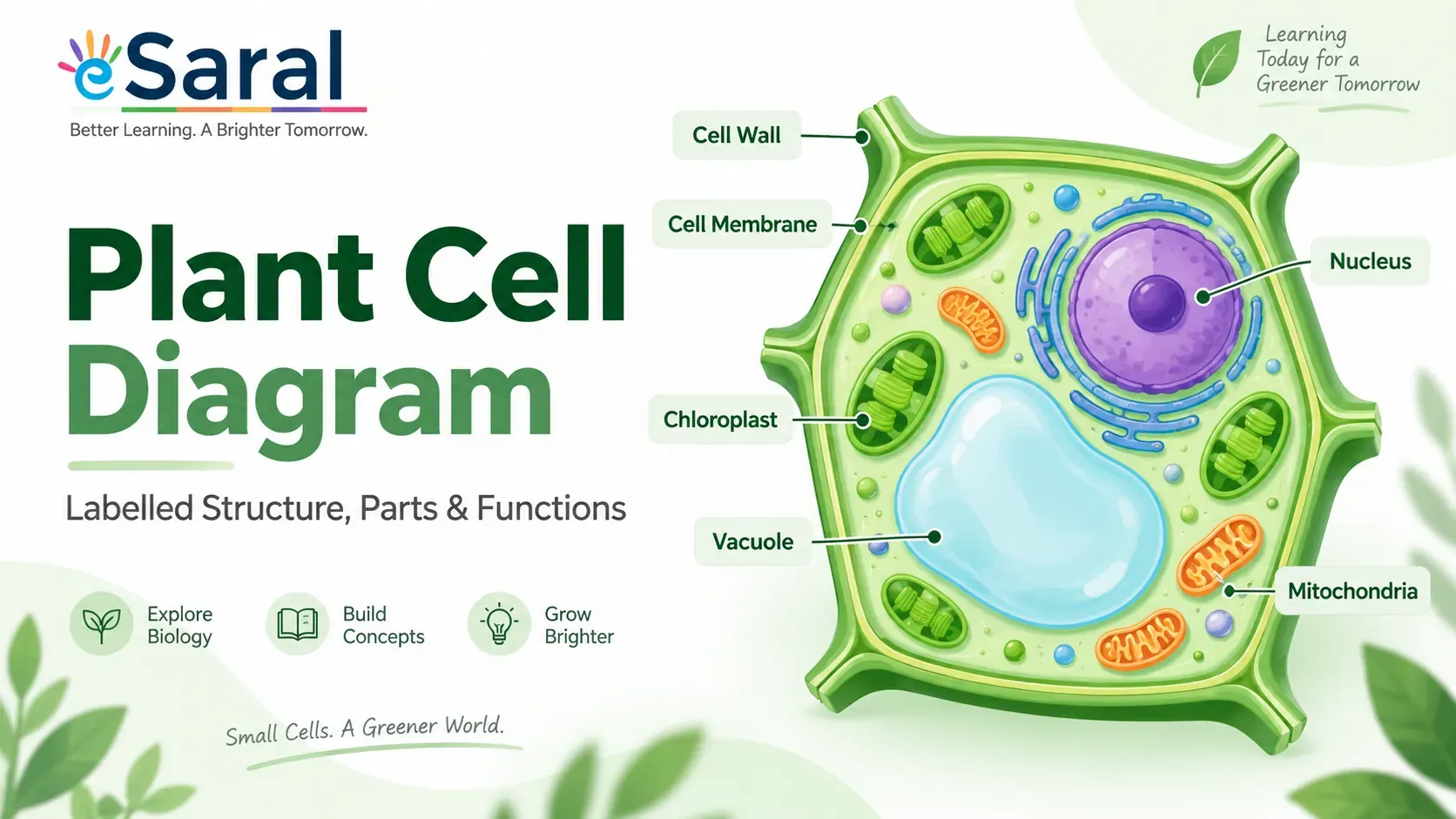
Plant Cell Diagram: Labelled Structure, Parts and Functions
Simple, labelled plant cell diagram with parts and functions. Covers plant cell structure for Class 6, 7, 8, 9, 10 and 11 students, CBSE-aligned.

Saransh Gupta Sir's Visit to IIT Patna: Hostel Life, Placements & Lessons for JEE Aspirants
Inside Saransh Gupta Sir's IIT Patna visit — hostel life, the library, placements, internships, and real advice for JEE aspirants from students living the IIT dream.
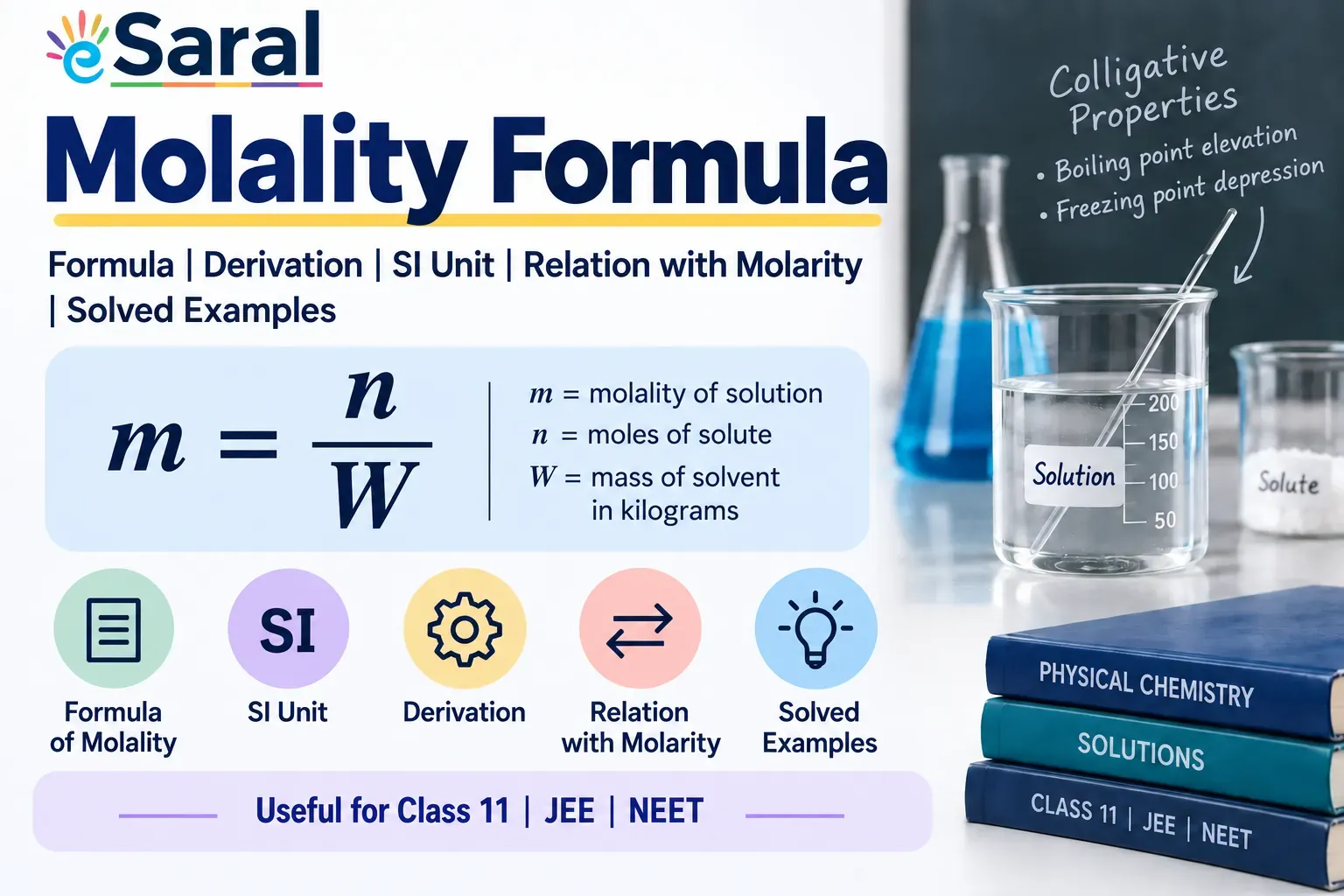
Molality Formula: Formula for Molality, Derivation & Solved Examples
Molality formula is $m = \dfrac{n}{W}$. Learn the formula of molality, its SI unit, derivation, relation with molarity, and solved examples for Class 11, JEE and NEET.
BITSAT Previous Year Question Paper PDF
Download BITSAT previous year question papers PDF. Get year-wise BITSAT PYQs, memory-based papers, exam pattern, and preparation tips to improve your BITSAT preparation.

Teachers’ Day 2026 at eSaral Gurukul: Celebrating the Bond Between Students, Teachers & Mentors
See how Teachers’ Day 2026 was celebrated at eSaral Gurukul, reflecting the bond among students, teachers, and mentors, and the role of guidance beyond academics.

JEE Advanced Attempts: Can You Give It a Third Time? Rules Explained
JEE Advanced attempts: current rule is 2 consecutive years only: full eligibility criteria, the 2025 third-attempt controversy, and the latest 2026 petition news.

Best JEE Preparation App
Best JEE preparation app for Main & Advanced: AI mock tests, live doubt-solving, thousands of practice questions. JEE preparation app for droppers & Class 11-12.
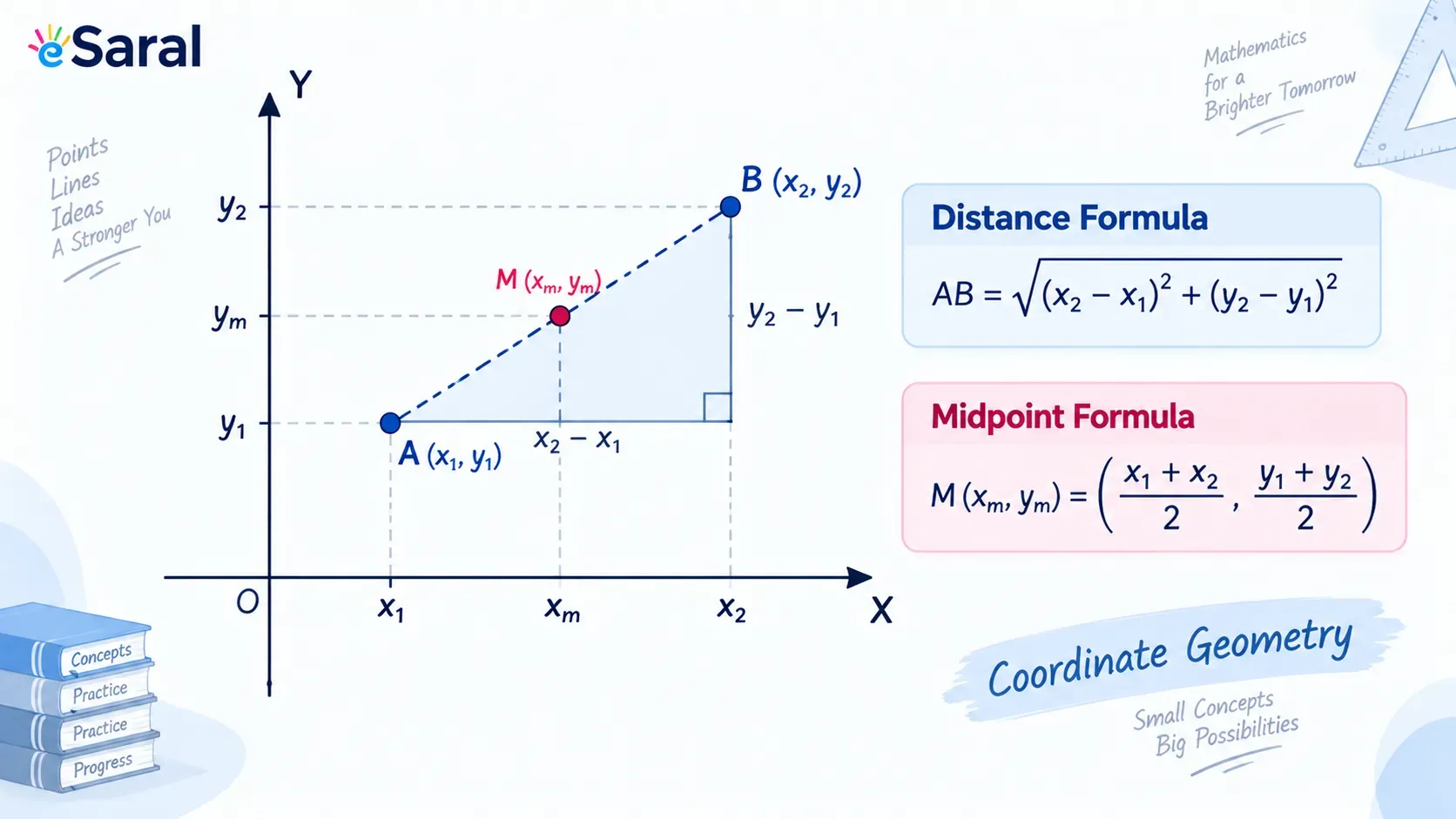
Coordinate Geometry Class 10: Formulas, Notes & Solved Examples
Coordinate geometry class 10: complete CBSE formulas — distance, section, midpoint and area of triangle — with derivation, notes and solved examples.
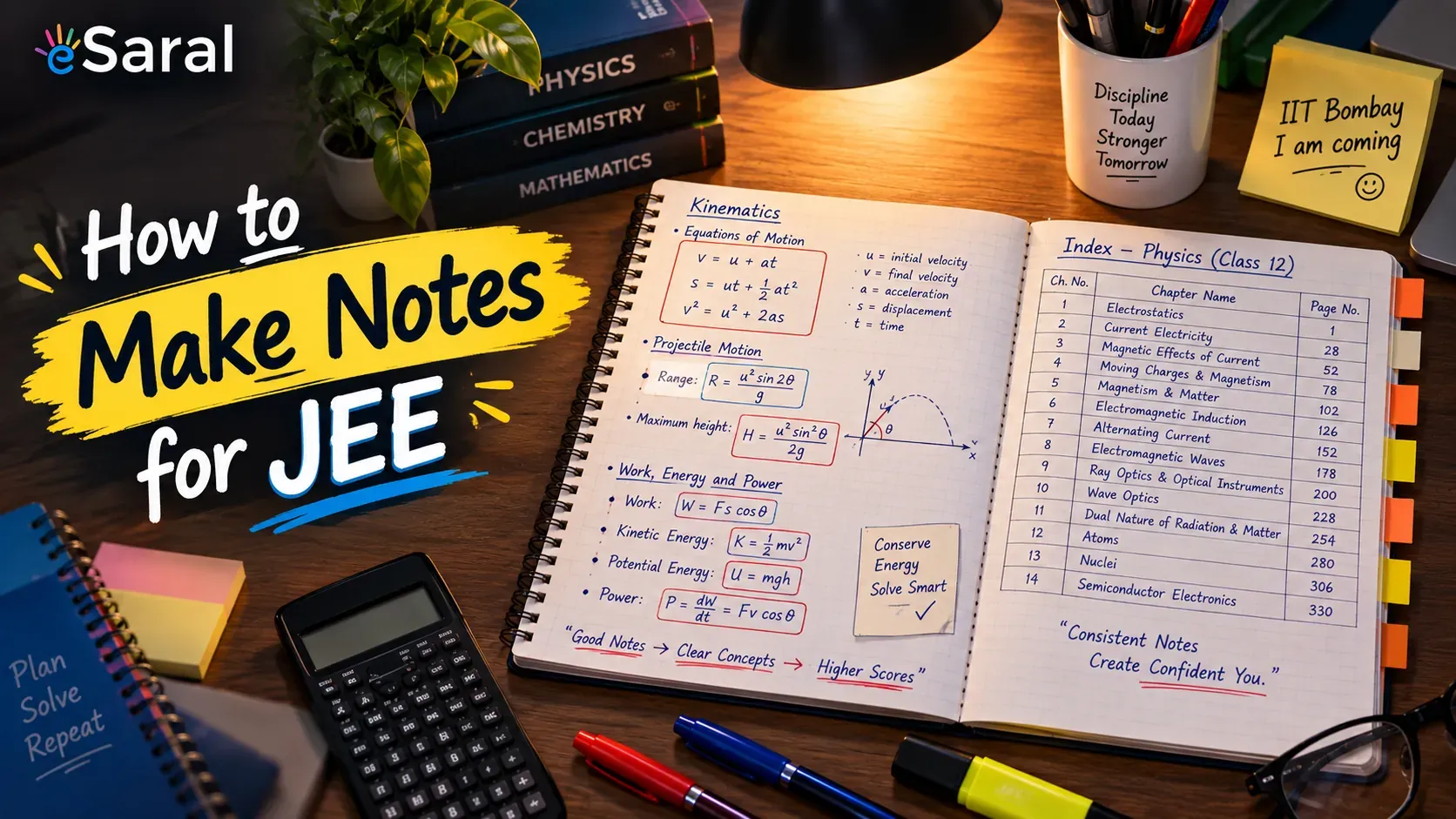
How to make Notes For JEE Smart Notes Strategy of an AIR 41
Learn how to make notes for JEE the way toppers do — indexing, shorthand, and smart short notes for JEE that cut revision time to just 5–7 days.
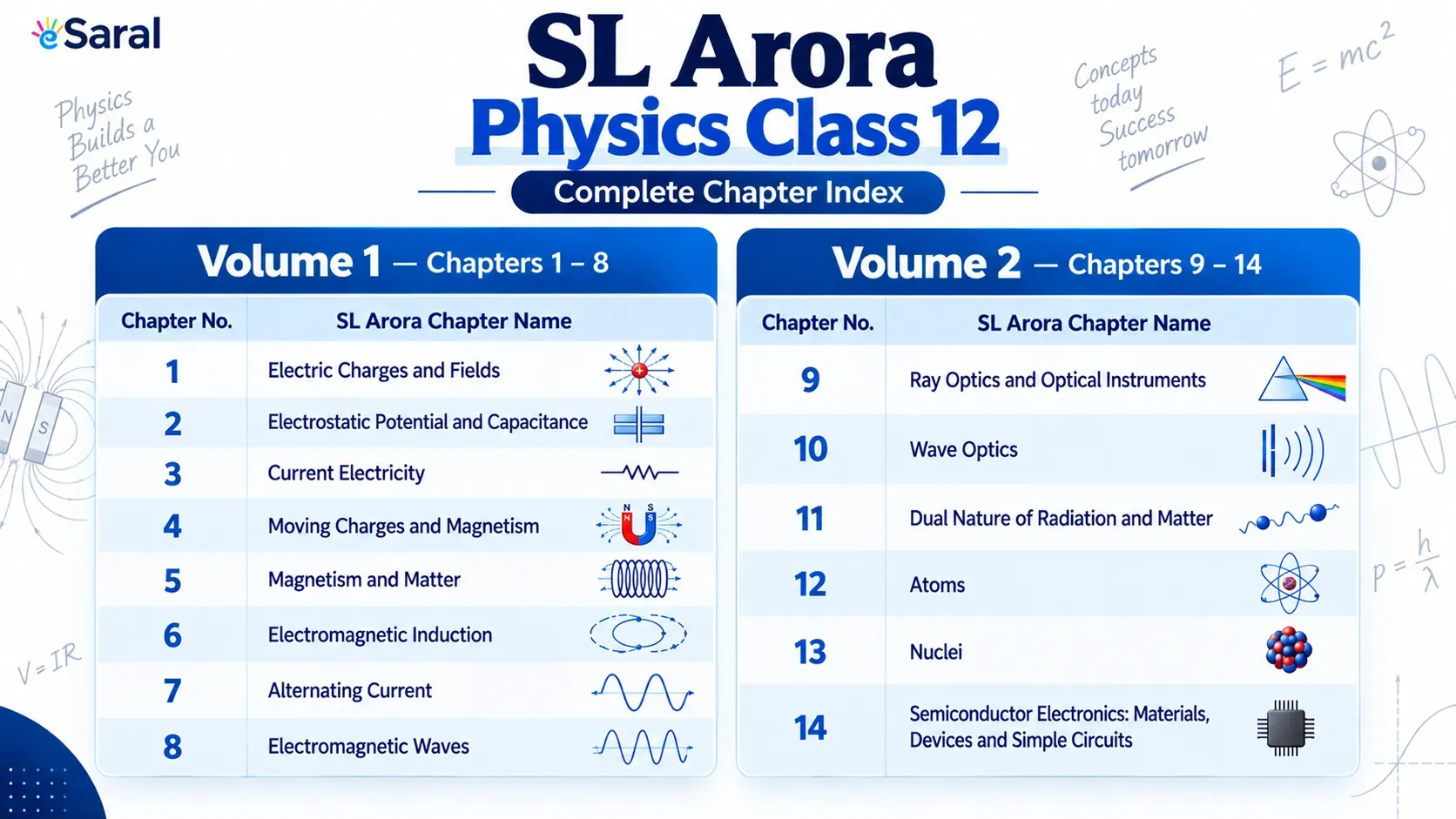
SL Arora Physics Class 12 Index – Chapter List for Volume 1 & 2
SL Arora Physics Class 12 index — complete chapter list for Volume 1 & 2, mapped to NCERT solutions for board, JEE Main, and NEET preparation.