
Liquid Solutions - NEET Previous Year Questions with Complete Solutions

eSaral Academic and Editorial Team
Summary
<p>Liquid Solutions is a high-scoring NEET Chemistry chapter that mainly focuses on colligative properties, Raoult’s law, Van’t Hoff factor, molality, mole fraction, Henry’s law, and osmotic pressure, with most questions based on direct formula-based numericals and common calculation mistakes.</p>
eSaral › NEET › Neet test-series›Liquid Solutions

Solutions Chapter in NEET: Weightage and Key Topics
How Many Questions Come from Liquid Solutions in NEET?
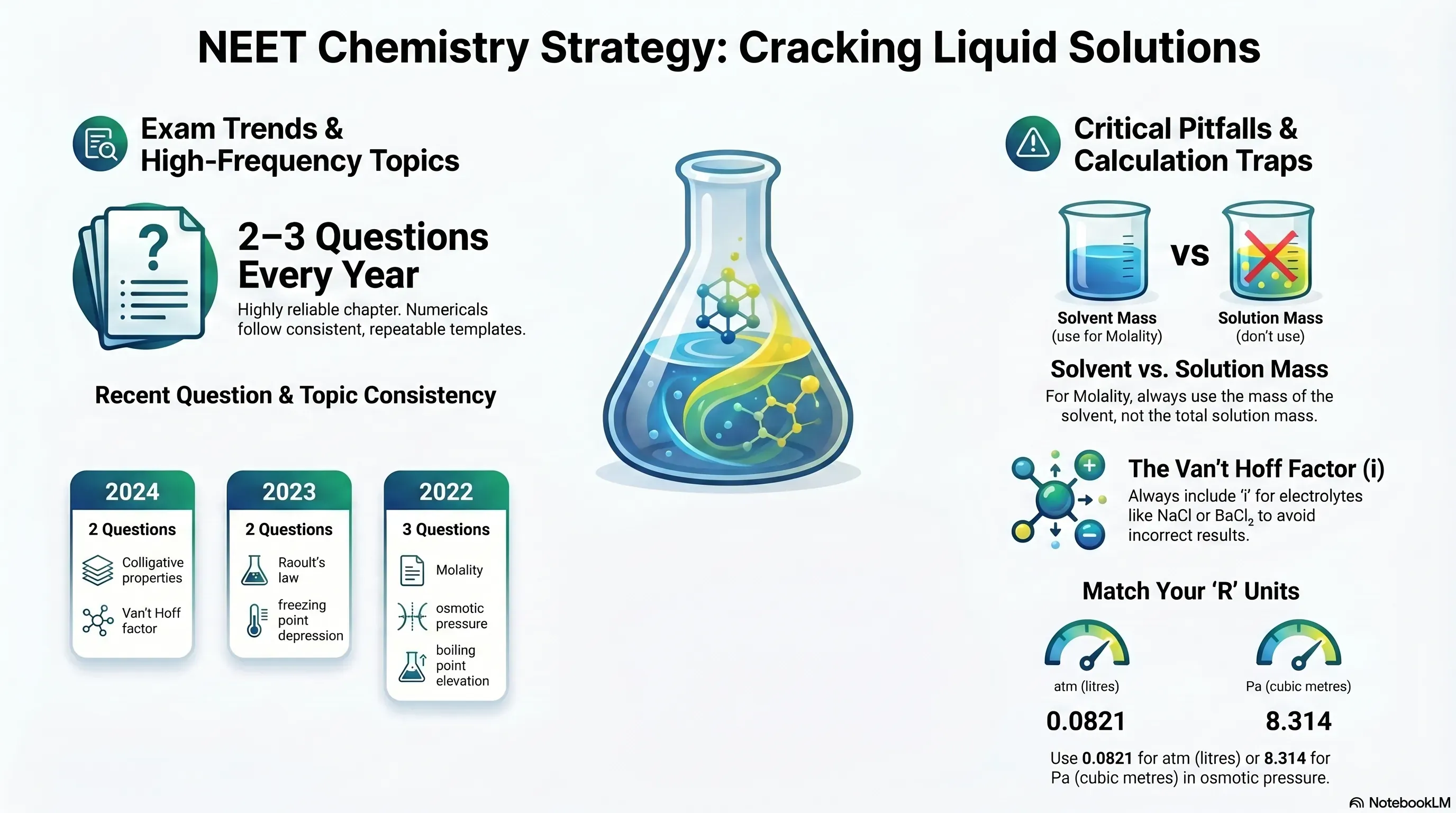
Liquid Solutions is one of the most reliably tested chapters in NEET Chemistry, contributing 2–3 questions every year. The questions are largely numerical — making this a high-scoring chapter for students who practise the formulas with PYQs.
Year | Questions from Solutions | Topics Tested |
|---|---|---|
NEET 2024 | 2 | Colligative properties, Van't Hoff factor |
NEET 2023 | 2 | Raoult's law, freezing point depression |
NEET 2022 | 3 | Molality, osmotic pressure, and boiling point elevation |
NEET 2021 | 2 | Mole fraction, Van't Hoff factor |
NEET 2020 | 2 | Raoult's law, depression in freezing point |
NEET 2019 | 3 | Colligative properties, Henry's law, osmosis |
NEET 2018 | 2 | Boiling point elevation, concentration terms |
Which Topics Are Most Frequently Tested?
Based on NEET papers from 2010 to 2024, the six highest-frequency topics in Liquid Solutions are:
- Colligative properties — ΔTb, ΔTf, and osmotic pressure numericals
- Raoult's law — vapour pressure lowering and ideal/non-ideal solutions
- Van't Hoff factor (i) — for electrolytes and association
- Molality and mole fraction — concentration term conversions
- Henry's law — solubility of gases in liquids
- Osmosis and osmotic pressure — isotonic, hypertonic, hypotonic solutions
💡 Expert Tip by eSaral IIT Faculty: Liquid Solutions numericals follow the same template year after year. The question gives you solute mass, solvent mass, and a Kb or Kf value — and asks for ΔTb or ΔTf. If you can solve 10 such numericals confidently, you will never drop marks from this chapter. The formula is always the same; only the numbers change.
NEET likes to test this chapter's concentration terms directly, without dressing them up — the base formula for the most common one is here: molarity formula.
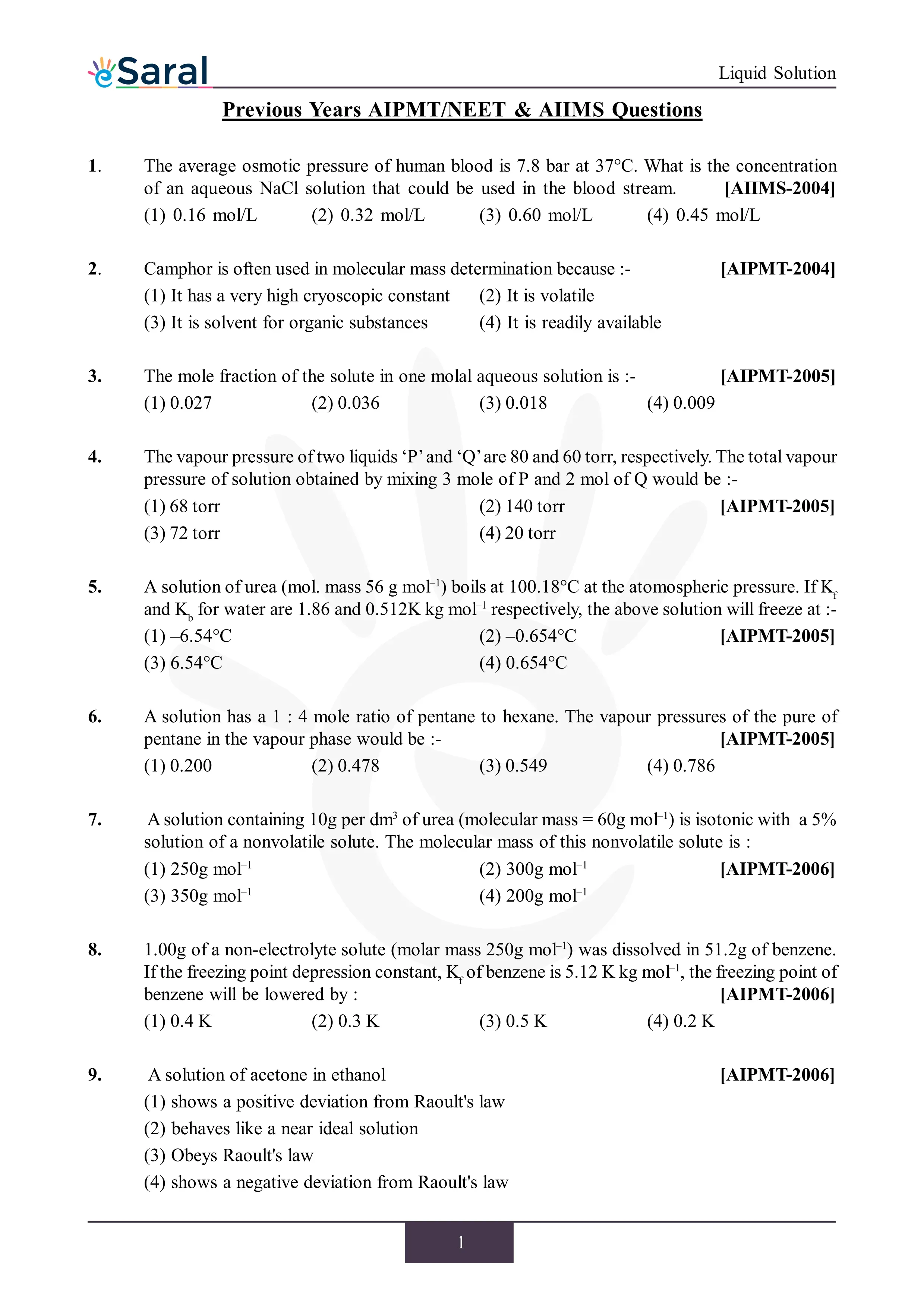
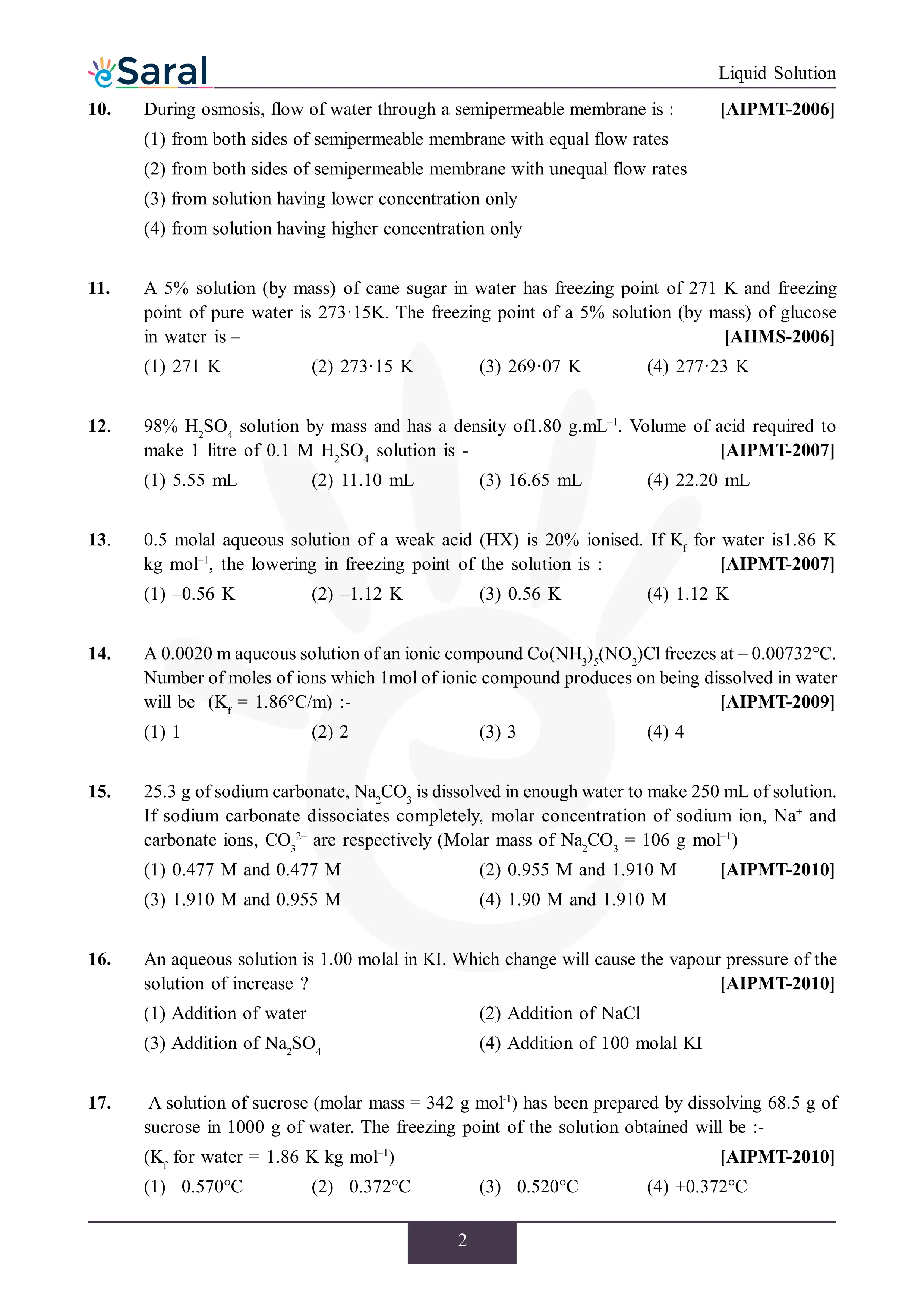
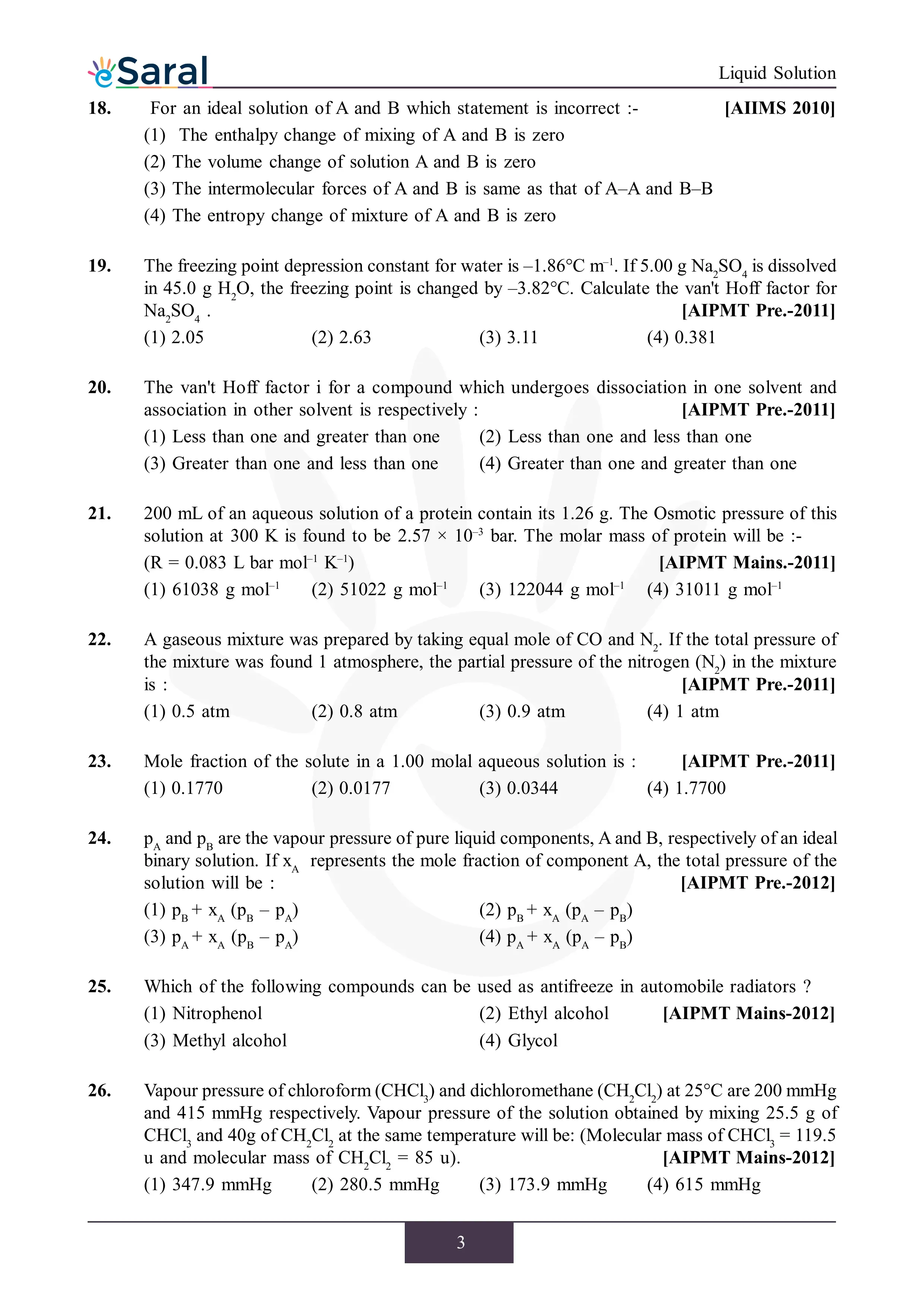
NEET PYQs: Concentration Terms
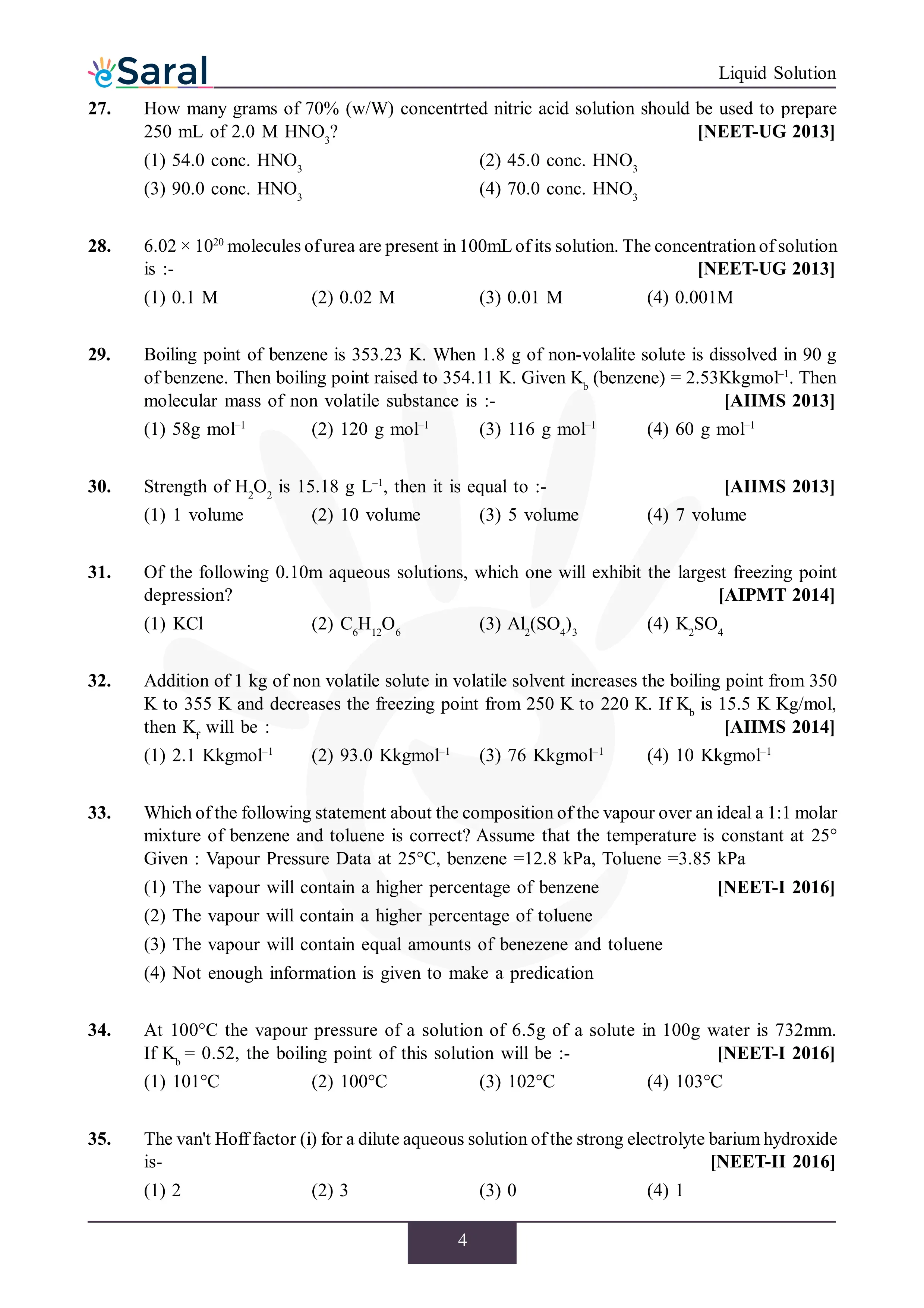
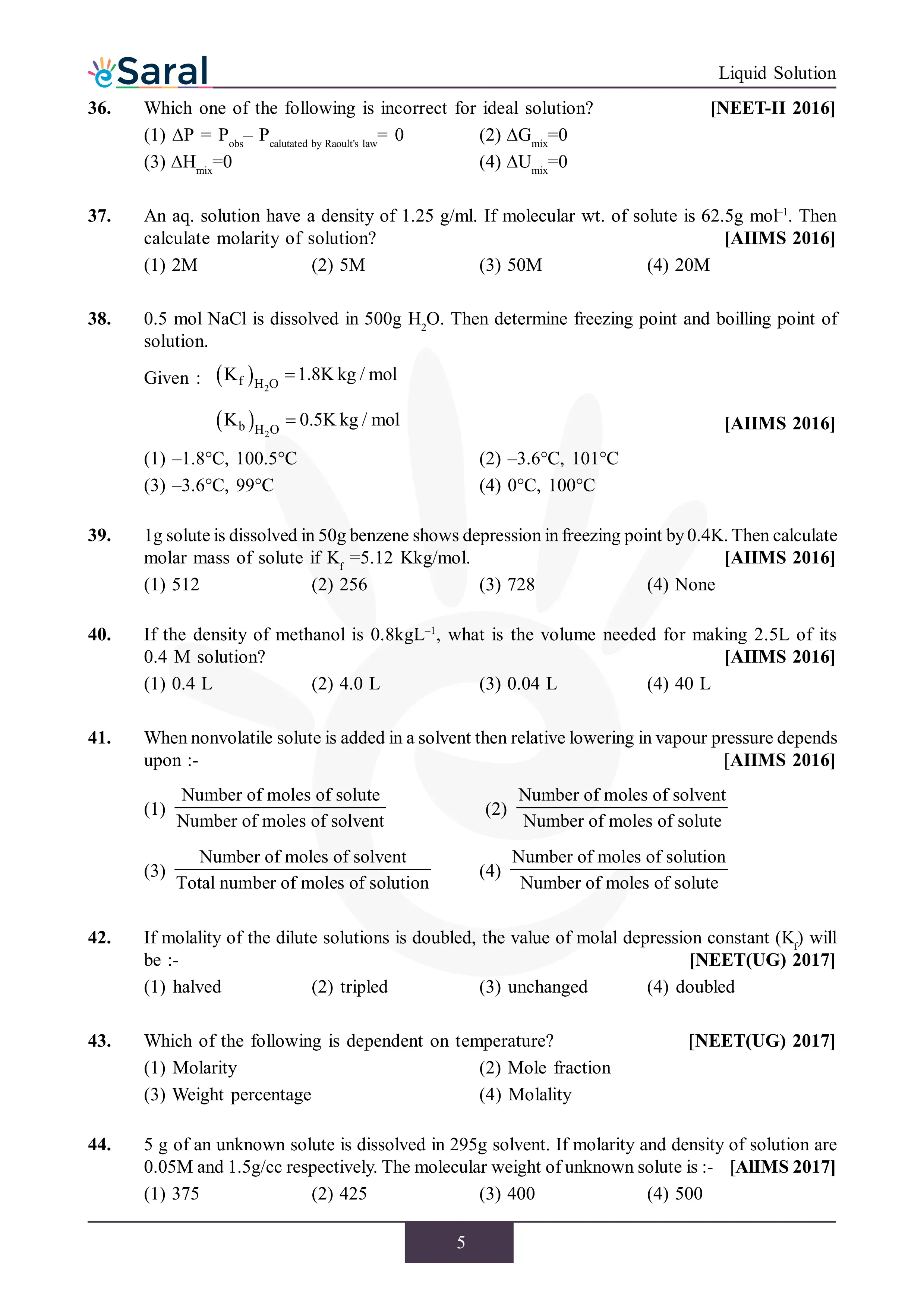
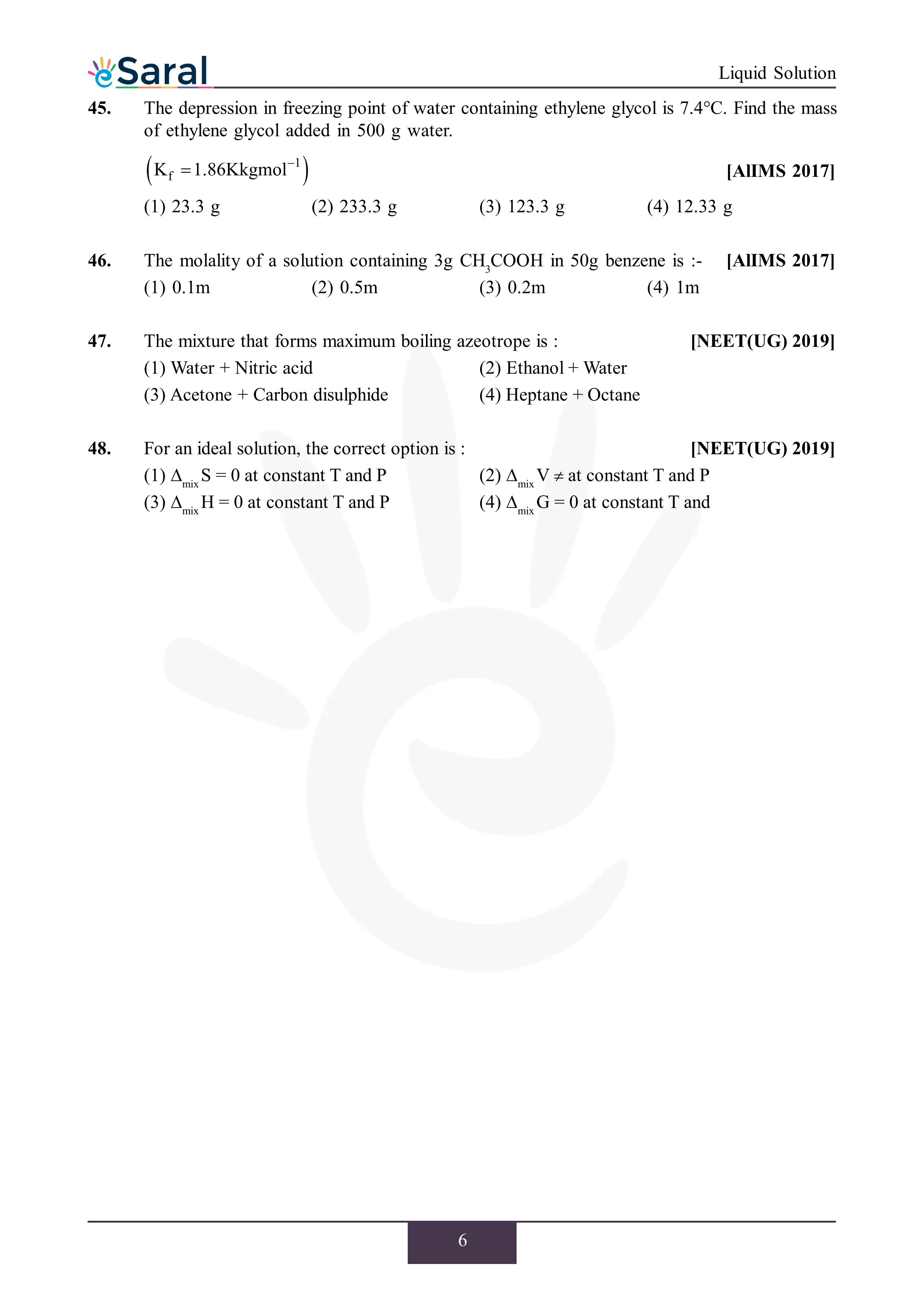

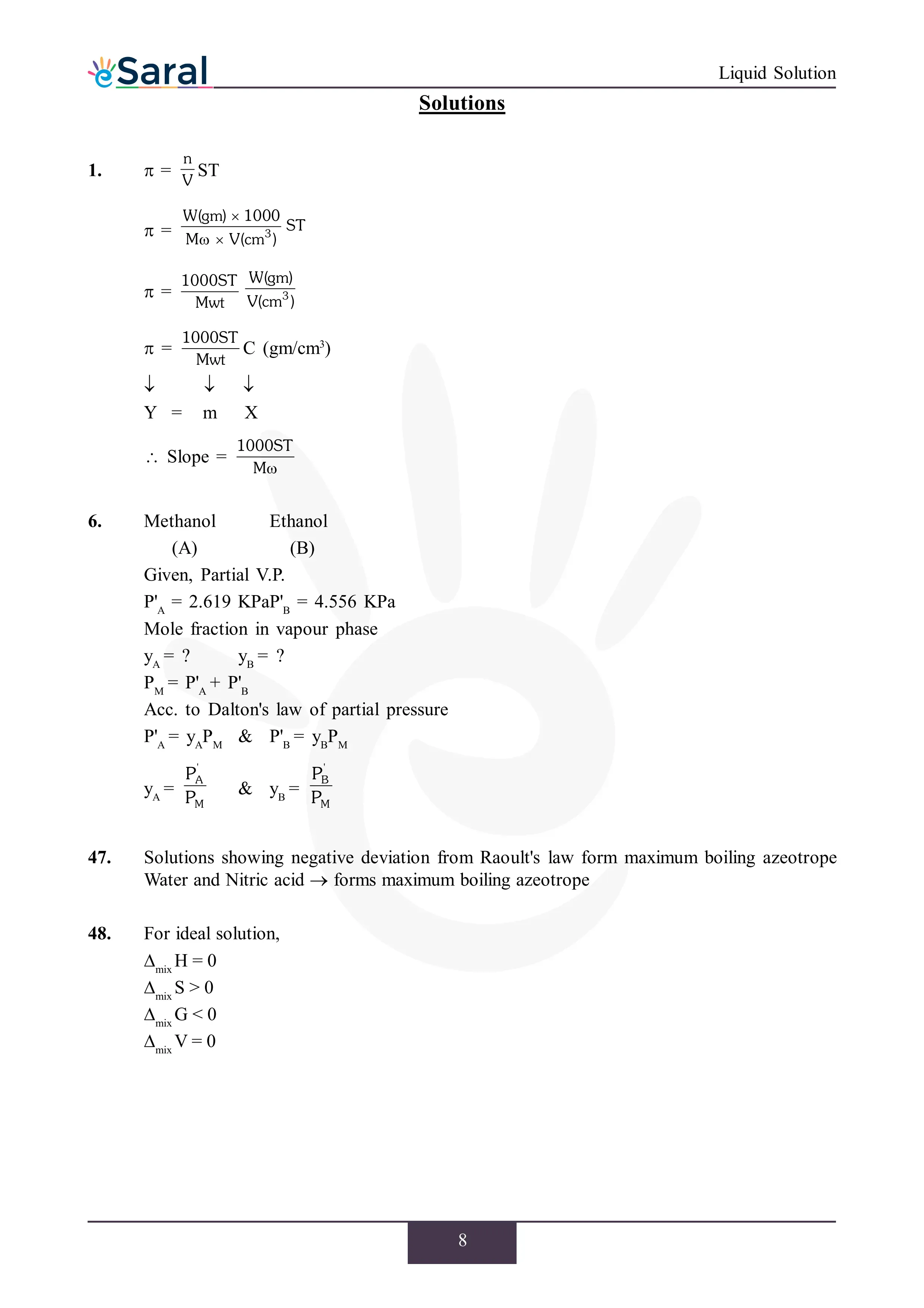
Common Mistakes in Solutions NEET Questions
Mistake 1 — Using Mass of Solution Instead of Mass of Solvent
Molality = moles of solute / kilograms of solvent — NOT kilograms of solution. Students who divide by total solution mass get the wrong answer. Always subtract solute mass from solution mass to get solvent mass if needed.
Mistake 2 — Forgetting Van't Hoff Factor for Electrolytes
For NaCl, KCl, BaCl₂ — always apply i in colligative property formulas: ΔTb = i × Kb × m. Forgetting i for electrolytes is the single most common error in NEET Solutions numericals.
Mistake 3 — Confusing Kb and Kf
Kb (ebullioscopic constant) is for boiling point elevation — water Kb = 0.52 K·kg/mol. Kf (cryoscopic constant) is for freezing point depression — water Kf = 1.86 K·kg/mol.
Swapping these two gives the wrong answer. Kf for water is always larger than Kb.
Mistake 4 — Wrong Units in Osmotic Pressure Formula
π = iMRT requires SI units: π in Pa, V in m³, R = 8.314 J/mol·K. If the question gives pressure in atm, use R = 0.0821 L·atm/mol·K with volume in litres. Always match R with the pressure unit given.
Mistake | How to Avoid |
|---|---|
Using solution mass instead of solvent mass for molality | Molality denominator = mass of solvent only |
Skipping i for electrolytes | Check: is the solute an electrolyte? Always include i |
Swapping Kb and Kf | Kf (1.86) > Kb (0.52) for water — always |
Wrong R in osmotic pressure | Match R to pressure unit: atm → 0.0821; Pa → 8.314 |
i < 1 vs i > 1 confusion | Dissociation → i > 1; Association → i < 1 |
Frequently Asked Questions
How many questions come from Liquid Solutions in NEET every year?
Liquid Solutions contributes 2–3 questions in NEET Chemistry almost every year, making it one of the highest-scoring chapters to prepare. Topics tested consistently include colligative properties (ΔTb, ΔTf, osmotic pressure), Raoult's law, mole fraction, molality, and the Van't Hoff factor for electrolytes and associated solutes.
What is the weightage of Liquid Solutions in NEET Chemistry?
Liquid Solutions carries approximately 5–8% weightage in NEET Chemistry, contributing 2–3 questions worth 8–12 marks. Along with Electrochemistry and Chemical Kinetics, it is one of the three most consistently tested chapters from Class 12 Chemistry in NEET.
What are the most important topics in Liquid Solutions for NEET?
The six highest-frequency topics based on NEET PYQ analysis from 2010–2024 are: colligative properties numericals (ΔTb, ΔTf, π), Raoult's law and vapour pressure lowering, Van't Hoff factor for dissociation and association, molality and mole fraction calculations, Henry's law for gas solubility, and isotonic/hypertonic/hypotonic solution definitions.
What is Raoult's law and how is it used in NEET questions?
Raoult's law states that the vapour pressure of a solution is proportional to the mole fraction of the solvent: p = p° × χ₁. For NEET, it is most often used as relative lowering of vapour pressure: (p° – p)/p° = χ₂, where χ₂ is the mole fraction of the solute. This formula directly gives vapour pressure of the solution when solute mole fraction is known.
What are the values of Kb and Kf for water?
For water, Kb (ebullioscopic constant) = 0.52 K·kg/mol and Kf (cryoscopic constant) = 1.86 K·kg/mol. These are the most frequently used constants in NEET Solutions numericals. Kf for water is always larger than Kb — a useful check to avoid swapping them.
Team eSaral
eSaral Academic and Editorial Team
Team eSaral is the collective author profile for educational content created by eSaral’s teachers and academic contributors. The team draws on expertise from IIT graduates, doctors, experienced educators and subject specialists to develop resources for JEE, NEET and school students. Our articles aim to explain concepts clearly and help students study with confidence.
Related Posts

Plant Cell Diagram: Labelled Structure, Parts and Functions
Simple, labelled plant cell diagram with parts and functions. Covers plant cell structure for Class 6, 7, 8, 9, 10 and 11 students, CBSE-aligned.

Saransh Gupta Sir's Visit to IIT Patna: Hostel Life, Placements & Lessons for JEE Aspirants
Inside Saransh Gupta Sir's IIT Patna visit — hostel life, the library, placements, internships, and real advice for JEE aspirants from students living the IIT dream.
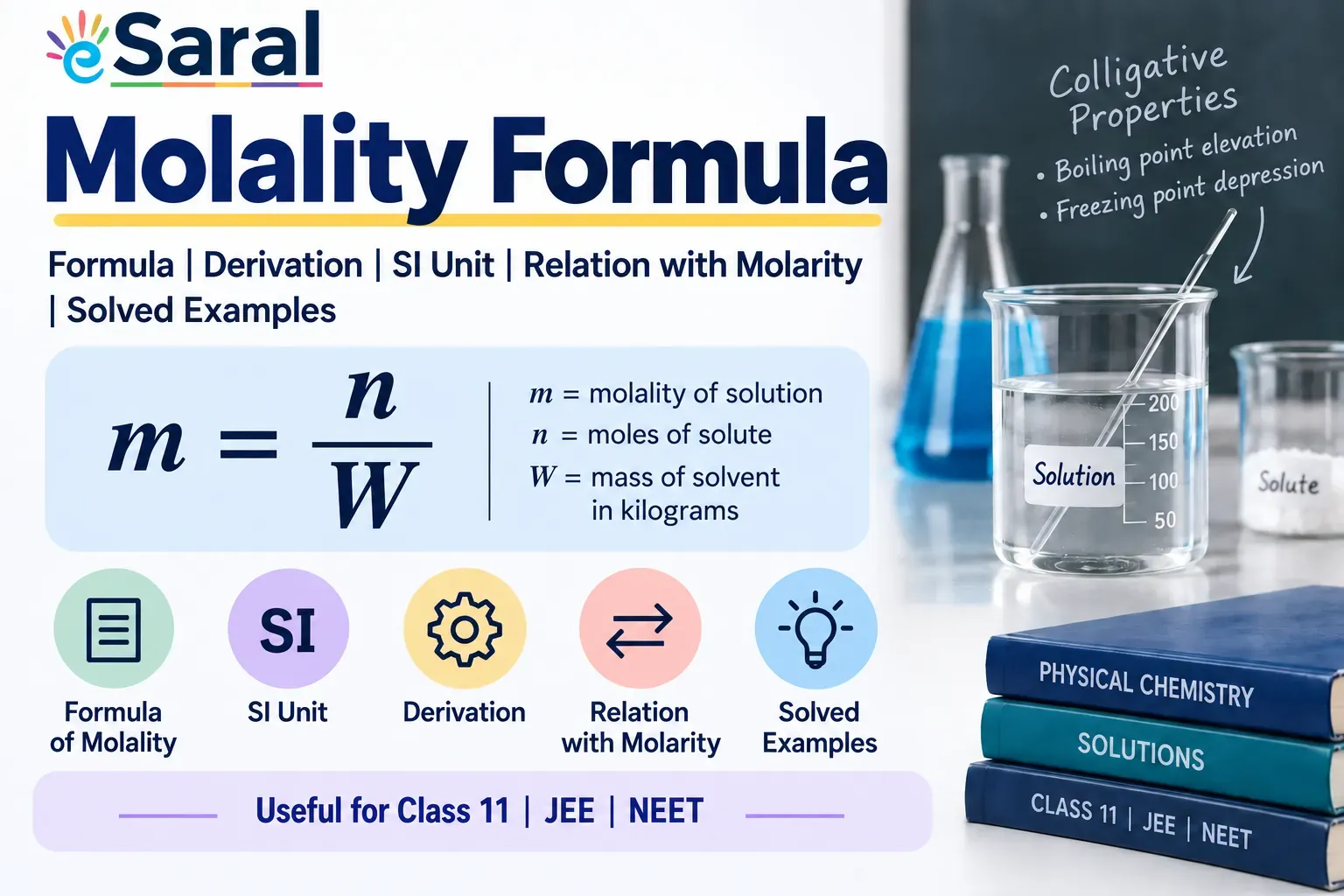
Molality Formula: Formula for Molality, Derivation & Solved Examples
Molality formula is $m = \dfrac{n}{W}$. Learn the formula of molality, its SI unit, derivation, relation with molarity, and solved examples for Class 11, JEE and NEET.
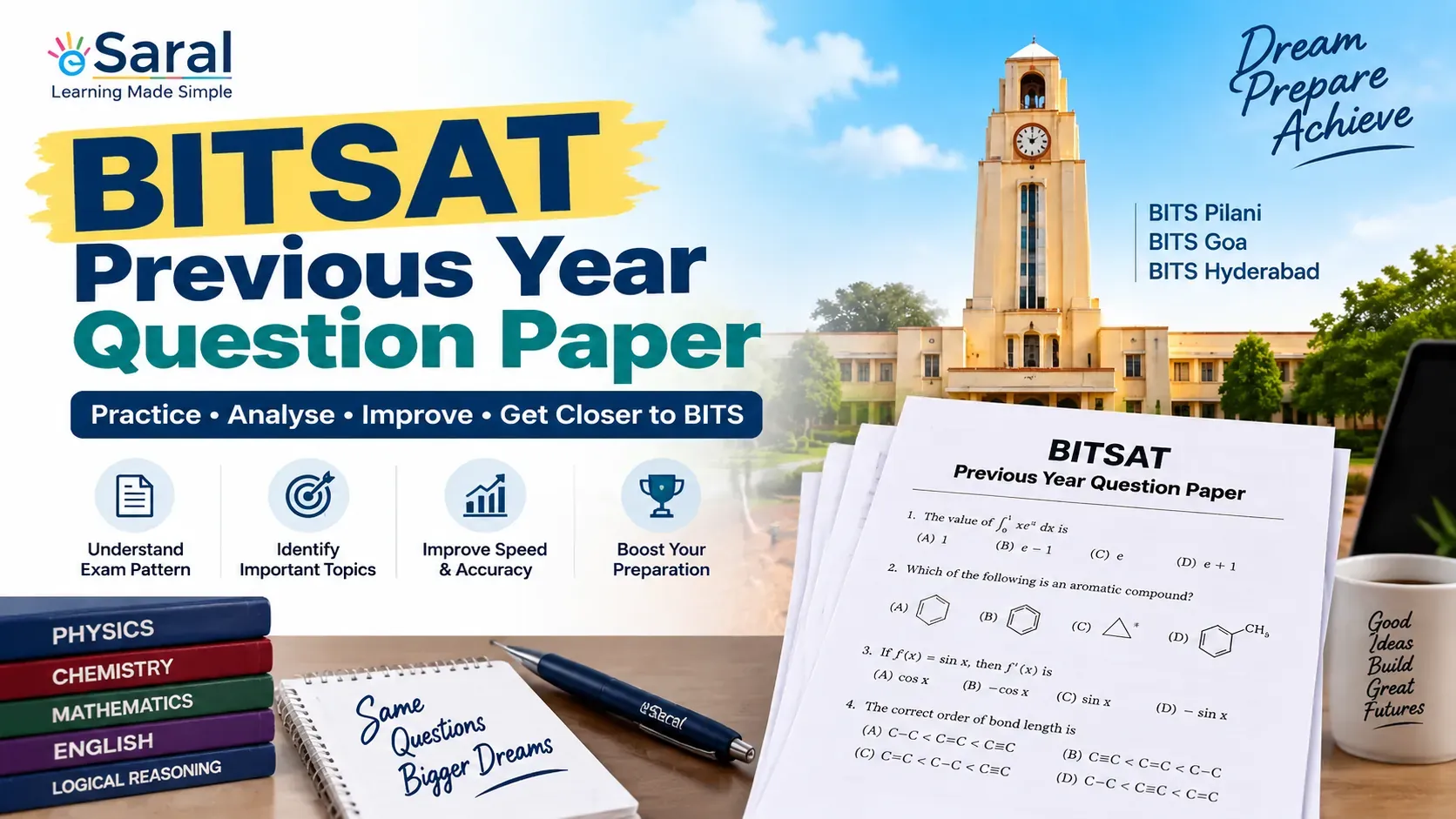
BITSAT Previous Year Question Paper PDF
Download BITSAT previous year question papers PDF. Get year-wise BITSAT PYQs, memory-based papers, exam pattern, and preparation tips to improve your BITSAT preparation.

Teachers’ Day 2026 at eSaral Gurukul: Celebrating the Bond Between Students, Teachers & Mentors
See how Teachers’ Day 2026 was celebrated at eSaral Gurukul, reflecting the bond among students, teachers, and mentors, and the role of guidance beyond academics.
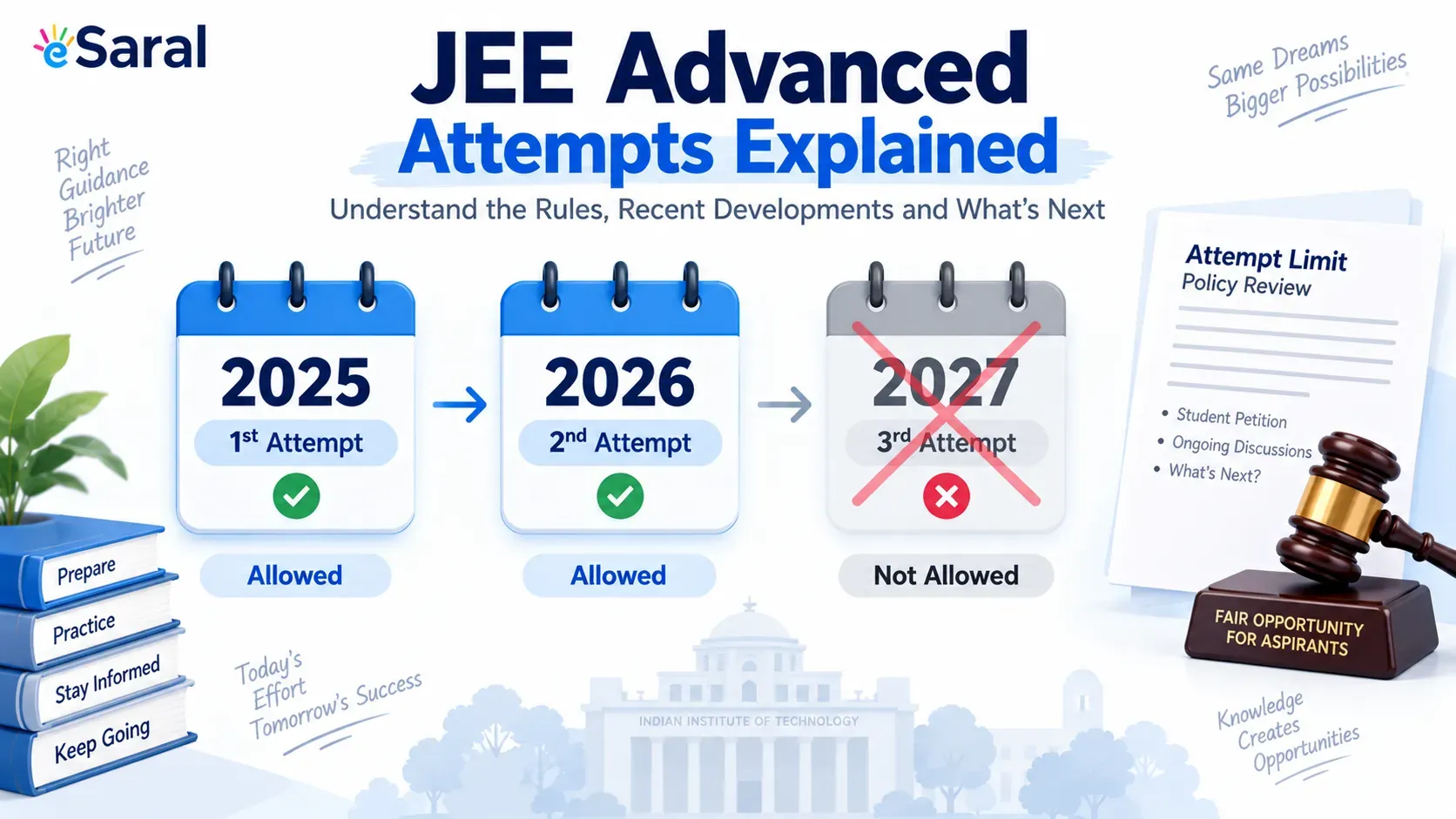
JEE Advanced Attempts: Can You Give It a Third Time? Rules Explained
JEE Advanced attempts: current rule is 2 consecutive years only: full eligibility criteria, the 2025 third-attempt controversy, and the latest 2026 petition news.

Best JEE Preparation App
Best JEE preparation app for Main & Advanced: AI mock tests, live doubt-solving, thousands of practice questions. JEE preparation app for droppers & Class 11-12.
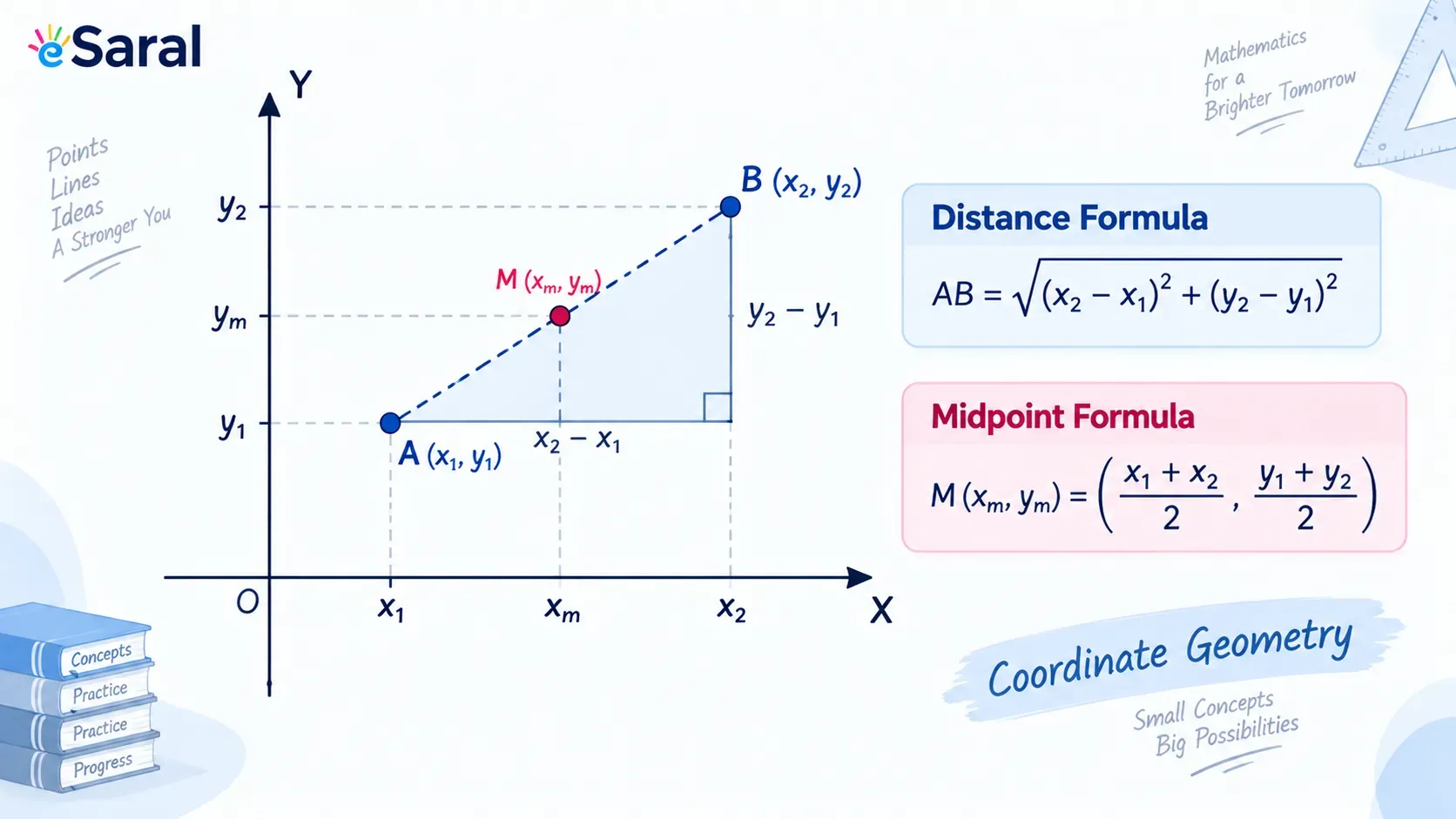
Coordinate Geometry Class 10: Formulas, Notes & Solved Examples
Coordinate geometry class 10: complete CBSE formulas — distance, section, midpoint and area of triangle — with derivation, notes and solved examples.

How to make Notes For JEE Smart Notes Strategy of an AIR 41
Learn how to make notes for JEE the way toppers do — indexing, shorthand, and smart short notes for JEE that cut revision time to just 5–7 days.
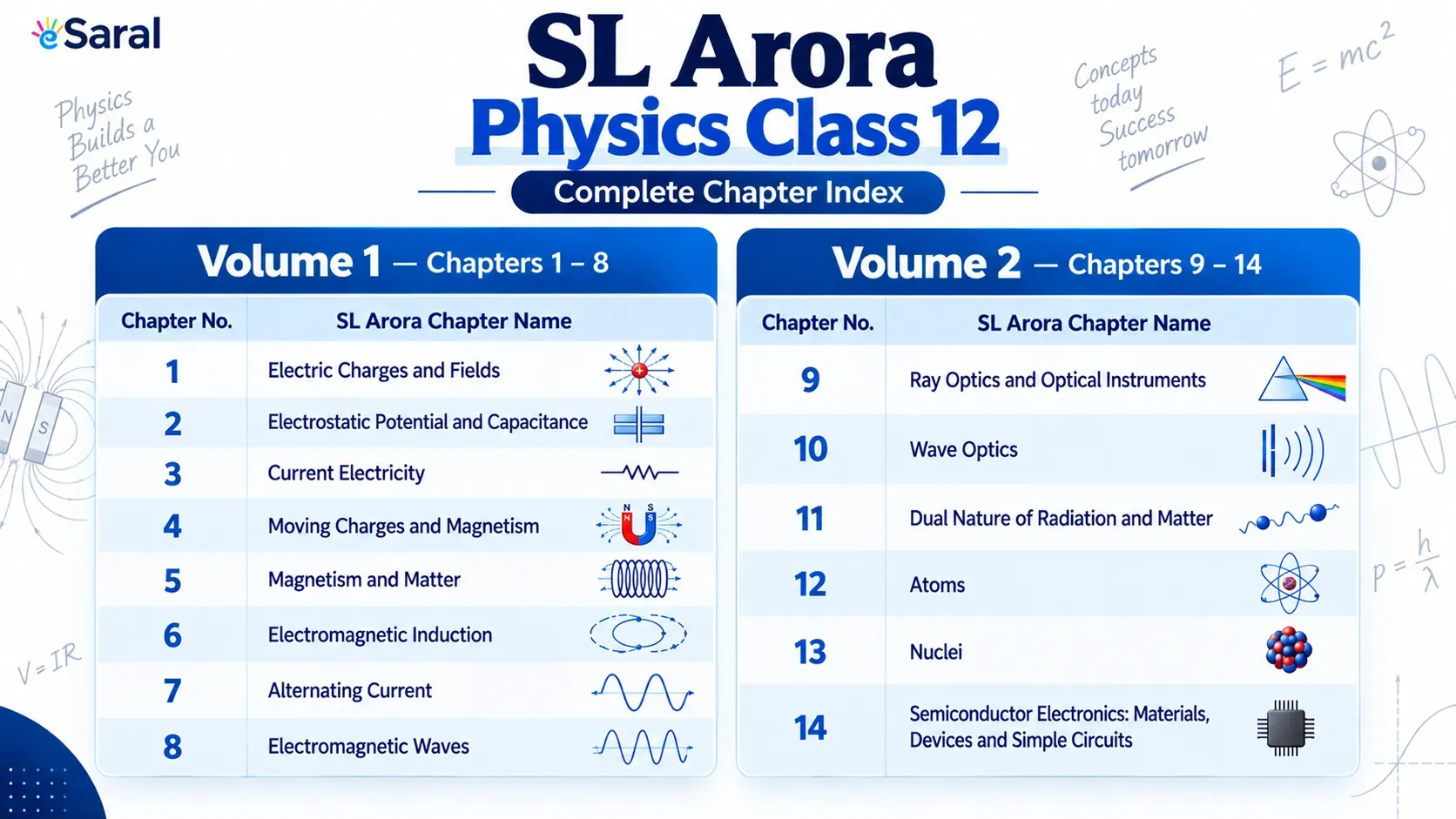
SL Arora Physics Class 12 Index – Chapter List for Volume 1 & 2
SL Arora Physics Class 12 index — complete chapter list for Volume 1 & 2, mapped to NCERT solutions for board, JEE Main, and NEET preparation.