
Method Of Differentiation - JEE Main Previous Year Question with Solutions

eSaral Academic and Editorial Team
Summary
Method of Differentiation covers essential JEE Main concepts such as implicit differentiation, inverse functions, chain rule, parametric differentiation, higher-order derivatives, and applications through previous year solved questions.
eSaral › JEE › JEE Main ›Method Of Differentiation

🚀 Checkout eSaral Courses
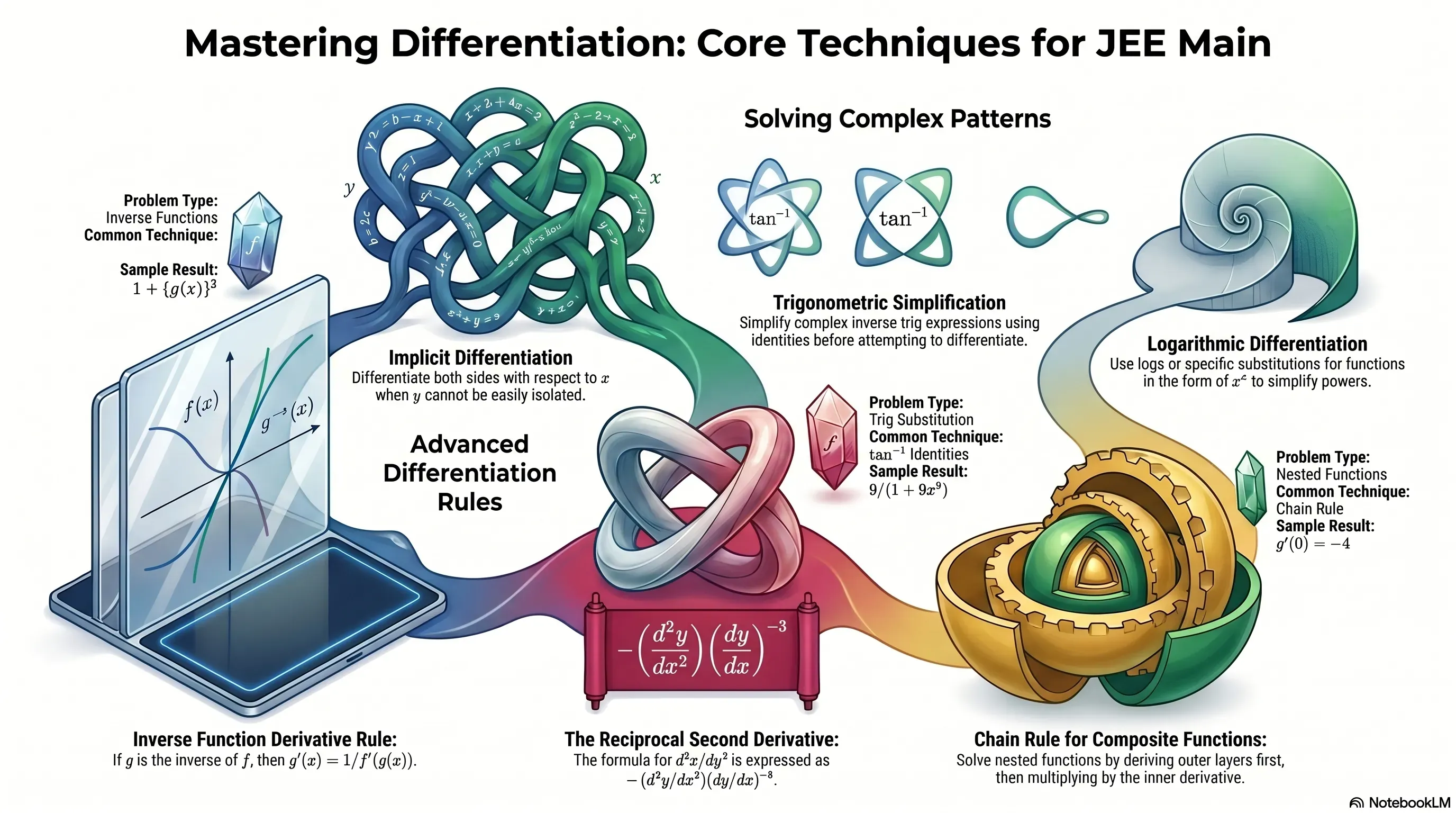
Download eSaral app for free study material and video tutorials. [esquestion] Let y be an implicit function of x defined by $x^{2 x}-2 x^{x}$ cot $y-1=0 .$ Then $y^{\prime}(1)$ equals : (1) $\log 2$ $(2)-\log 2$ (3) –1 (4) 1 #tag# [AIEEE-2009] #sol# (3) $\left(x^{x}\right)^{2}-2 \cot y x^{x}-1=0$ $\mathrm{x}^{\mathrm{x}}=\frac{2 \cot y \pm \sqrt{4 \cot ^{2} y+4}}{2}\left\{\begin{array}{l}{\text { at } \mathrm{x}=1} \\ {1=\cot y+\csc y} \\ {\Rightarrow y=\frac{\pi}{2}}\end{array}\right.$ $=\cot y \pm \csc y$ $\mathrm{x}^{\mathrm{x}}=\cot \mathrm{y}+\csc \mathrm{y}$ diff. w.r. to $\mathrm{x}$ $\mathrm{x}^{\mathrm{x}}(1+\log \mathrm{x})=\left[-\csc ^{2} \mathrm{y}-\csc \mathrm{y} \cot \mathrm{y}\right] \frac{\mathrm{d} y}{\mathrm{dx}}$ $1=-\csc y[\csc y+\cot y] \frac{d y}{d x}$ $\frac{\mathrm{dy}}{\mathrm{dx}}=-1$ [/esquestion] [esquestion] Let $\mathrm{f}:(-1,1) \rightarrow \mathrm{R}$ be a differentiable function with $\mathrm{f}(0)=-1$ and $\mathrm{f}(0)=1 .$ Let $\mathrm{g}(\mathrm{x})=[\mathrm{f}(2 \mathrm{f}(\mathrm{x})+$ $2)]^{2} .$ Then $\mathrm{g}^{\prime}(0):$ (1) 4 (2) –4 (3) 0 (4) –2 #tag# [AIEEE-2010] #sol# (2) $\mathrm{g}(\mathrm{x})=[\mathrm{f}(2 \mathrm{f}(\mathrm{x})+2)]^{2}$ $\mathrm{g}^{\prime}(\mathrm{x})=2 \mathrm{f}[2 \mathrm{f}(\mathrm{x})+2] \mathrm{f}^{\prime}[2 \mathrm{f}(\mathrm{x})+2] \cdot 2 \mathrm{f}^{\prime}(\mathrm{x})$ Put $\mathrm{x}=0$ $\mathrm{g}^{\prime}(0)=2 \mathrm{f}[2 \mathrm{f}(0)+2] \mathrm{f}^{\prime}[2 \mathrm{f}(0)+2] 2 \mathrm{f}^{\prime}(0)$ $=2 \mathrm{f}(2(-1)+2) \mathrm{f}^{\prime}(2(-1)+2) 2 \mathrm{f}^{\prime}(0)$ $=2 \mathrm{f}(0) \mathrm{f}^{\prime}(0) 2 \mathrm{f}^{\prime}(0)$ $=4(-1)(1)(1)=-4$ [/esquestion] [esquestion] $\frac{\mathrm{d}^{2} \mathrm{x}}{\mathrm{dy}^{2}}$ equals : (1) $\left(\frac{\mathrm{d}^{2} \mathrm{y}}{\mathrm{dx}^{2}}\right)\left(\frac{\mathrm{dy}}{\mathrm{dx}}\right)^{-2}$ (2) $-\left(\frac{\mathrm{d}^{2} \mathrm{y}}{\mathrm{dx}^{2}}\right)\left(\frac{\mathrm{dy}}{\mathrm{dx}}\right)^{-3}$ (3) $\left(\frac{\mathrm{d}^{2} \mathrm{y}}{\mathrm{dx}^{2}}\right)^{-1}$ $(4)-\left(\frac{\mathrm{d}^{2} \mathrm{y}}{\mathrm{dx}^{2}}\right)^{-1}\left(\frac{\mathrm{dy}}{\mathrm{dx}}\right)^{-3}$ #tag# [AIEEE-2011] #sol# (2) $\frac{\mathrm{d}}{\mathrm{dy}}\left(\left(\frac{\mathrm{d} y}{\mathrm{dx}}\right)^{-1}\right)=\frac{\mathrm{d}}{\mathrm{dy}}\left(\left(\frac{\mathrm{dy}}{\mathrm{dx}}\right)^{-1}\right) \cdot \frac{\mathrm{dx}}{\mathrm{dy}}$ $=-\left(\frac{\mathrm{dy}}{\mathrm{dx}}\right)^{-2} \cdot \frac{\mathrm{d}^{2} \mathrm{x}}{\mathrm{dx}^{2}} \cdot \frac{\mathrm{dx}}{\mathrm{dy}}=-\left(\frac{\mathrm{d}^{2} y}{\mathrm{dx}^{2}}\right)\left(\frac{\mathrm{dy}}{\mathrm{dx}}\right)^{-3}$ [/esquestion] [esquestion] If $\mathrm{y}=\sec \left(\tan ^{-1} \mathrm{x}\right),$ then $\frac{\mathrm{dy}}{\mathrm{dx}}$ at $\mathrm{x}=1$ is equal to : (1) $\frac{1}{\sqrt{2}}$ (2) $\frac{1}{2}$ (3) 1 (4) $\sqrt{2}$ #tag# [JEE-MAIN-2013] #sol# (1) $\mathrm{y}=\sec \left(\tan ^{-1} \mathrm{x}\right)=\sqrt{1+\mathrm{x}^{2}}$ $\frac{\mathrm{dy}}{\mathrm{dx}}=\frac{\mathrm{x}}{\sqrt{1+\mathrm{x}^{2}}}$ $\left.\frac{\mathrm{dy}}{\mathrm{dx}}\right|_{\mathrm{x}=1}=\frac{1}{\sqrt{2}}$ [/esquestion] [esquestion] If $\mathrm{g}$ is the inverse of a function $f$ and $f^{\prime}(\mathrm{x})=\frac{1}{1+\mathrm{x}^{5}},$ then $\mathrm{g}^{\prime}(\mathrm{x})$ is equal to : (1) $1+x^{5}$ (2) $5 x^{4}$ (3) $\frac{1}{1+\{\mathrm{g}(\mathrm{x})\}^{5}}$ (4) $1+\{\mathrm{g}(\mathrm{x})\}^{5}$ #tag# [JEE-MAIN-2014] #sol# (4) $\mathrm{f}(\mathrm{g}(\mathrm{x}))=\mathrm{x}$ $\Rightarrow \mathrm{f}^{\prime}(\mathrm{g}(\mathrm{x})) \cdot \mathrm{g}^{\prime}(\mathrm{x})=1$ $\therefore \mathrm{g}^{\prime}(\mathrm{x})=\frac{1}{\mathrm{f}^{\prime}(\mathrm{g}(\mathrm{x}))}=1+\{\mathrm{g}(\mathrm{x})\}^{5}$ [/esquestion] [esquestion] If for $x \in\left(0, \frac{1}{4}\right),$ the derivative of $\tan ^{-1}\left(\frac{6 x \sqrt{x}}{1-9 x^{3}}\right)$ is $\sqrt{x} \cdot g(x),$ then $g(x)$ equals : (1) $\frac{3}{1+9 x^{3}}$ (2) $\frac{9}{1+9 x^{3}}$ (3) $\frac{3 x \sqrt{x}}{1-9 x^{3}}$ (4) $\frac{3 \mathrm{x}}{1-9 \mathrm{x}^{3}}$ #tag# [JEE-MAIN-2017] #sol# (2) Let $\mathrm{y}=\tan ^{-1}\left(\frac{6 \mathrm{x} \sqrt{\mathrm{x}}}{1-9 \mathrm{x}^{3}}\right)$ where $\mathrm{x} \in\left(0, \frac{1}{4}\right)$ $=\tan ^{-1}\left(\frac{2 \cdot\left(3 \mathrm{x}^{3 / 2}\right)}{1-\left(3 \mathrm{x}^{3 / 2}\right)}\right)=2 \tan ^{-1}\left(3 \mathrm{x}^{3 / 2}\right)$ As $3 x^{3 / 2} \in\left(0, \frac{3}{8}\right)$ $\therefore \frac{d y}{d x}=2 \times \frac{1}{1+9 x^{3}} \times 3 \times \frac{3}{2} \times x^{1 / 2}$ $\begin{aligned} &=\frac{9}{1+9 \mathrm{x}^{3}} \sqrt{\mathrm{x}} \\ \therefore \mathrm{g}(\mathrm{x}) &=\frac{9}{1+9 \mathrm{x}^{3}} \end{aligned}$ [/esquestion] [esquestion] If $\mathrm{x}=\sqrt{2^{\cos \mathrm{c}^{-1} \mathrm{t}}}$ and $\mathrm{y}=\sqrt{2^{\mathrm{sc}-\mathrm{t}}}(|\mathrm{t}| \geq 1),$ then $\frac{\mathrm{dy}}{\mathrm{dx}}$ is equal to : (1) $-\frac{y}{x}$ ( 2)$\frac{\mathrm{x}}{\mathrm{y}}$ $(3)-\frac{x}{y}$ (4) $\frac{y}{x}$ #tag# [JEE-MAIN-2018] #sol# (1) [/esquestion] [esquestion] If $\mathrm{f}(\mathrm{x})=\sin ^{-1}\left(\frac{2 \times 3^{\mathrm{x}}}{1+9^{\mathrm{x}}}\right),$ then $\mathrm{f}^{\prime}\left(-\frac{1}{2}\right)$ equals : (1) $\sqrt{3} \log _{e} \sqrt{3}$ (2) $-\sqrt{3} \log _{e} 3$ (3) $-\sqrt{3} \log _{e} \sqrt{3}$ (4) $\sqrt{3} \log _{e} 3$ #tag# [JEE-MAIN-2018] #sol# (1) [/esquestion] [esquestion] If $\mathrm{f}(\mathrm{x})=\left|\begin{array}{cc}{\cos \mathrm{x}} & {\mathrm{x}} \\ {2 \sin \mathrm{x}} & {\mathrm{x}^{2} 2 \mathrm{x}} \\ {\tan \mathrm{x}} & {\mathrm{x}} & {1}\end{array}\right|,$ then $\lim _{\mathrm{x} \rightarrow 0} \frac{\mathrm{f}^{\prime}(\mathrm{x})}{\mathrm{x}}$ (1) exists and is equal to 0 (2) exists and is equal to –2 (3) exists and is equal to 2 (4) does not exist #tag# [JEE-MAIN-2018] #sol# (2) [/esquestion] [esquestion] If $x^{2}+y^{2}+\sin y=4,$ then the value of $\frac{d^{2} y}{d x^{2}}$ at the point $(-2,0)$ is (1) –34 (2) –32 (3) –2 (4) 4 #tag# #sol# (1) [/esquestion]
The Methods of Differentiation questions can be tracked alongside other topics through the JEE Mains PYQ chapter-wise PDF download index.
These Methods of Differentiation questions are pulled from real exams — see them in their original paper format on our JEE Main previous year paper page.
Frequently Asked Questions
How many questions come from Method of Differentiation in JEE Main?
NTA typically sets 1–2 questions directly from Method of Differentiation per session, carrying 4–8 marks. Indirect applications in Tangents and Normals, Rate of Change, and Maxima–Minima can bring the effective contribution to 10–12 marks. Consistent practice with PYQs from 2009 onwards gives the best preparation for this range.
What are the most important differentiation techniques for JEE Main?
The five most tested techniques are: (1) chain rule with inverse trigonometric functions, (2) implicit differentiation, (3) parametric differentiation, (4) logarithmic differentiation for expressions like x^x, and (5) differentiation of determinants. Questions on second-order derivatives frequently combine two of these techniques in a single problem.
How do I differentiate implicit functions for JEE Main?
Differentiate both sides of the equation with respect to x, treating y as a function of x and applying the chain rule wherever y appears. Then collect all dy/dx terms on one side and solve. Always substitute the given point back into the original equation first to find the exact value of y before computing the numerical answer.
Is Method of Differentiation in JEE Main syllabus 2025?
Yes. Method of Differentiation is explicitly listed under Calculus in the NTA JEE Main 2025 official syllabus. It falls under Unit 10 — Differential Calculus — and includes derivatives of all standard functions, rules of differentiation, higher-order derivatives, and implicit and parametric differentiation.
What is the trick for inverse function derivatives in JEE Main?
If g is the inverse of f, use the identity g′(x) = 1/f′(g(x)). This avoids computing g explicitly. In Q5 above, since f′(x) = 1/(1+x⁵), applying this identity directly gives g′(x) = 1 + {g(x)}⁵ in two lines — no complex algebra needed.
Team eSaral
eSaral Academic and Editorial Team
Team eSaral is the collective author profile for educational content created by eSaral’s teachers and academic contributors. The team draws on expertise from IIT graduates, doctors, experienced educators and subject specialists to develop resources for JEE, NEET and school students. Our articles aim to explain concepts clearly and help students study with confidence.
Related Posts
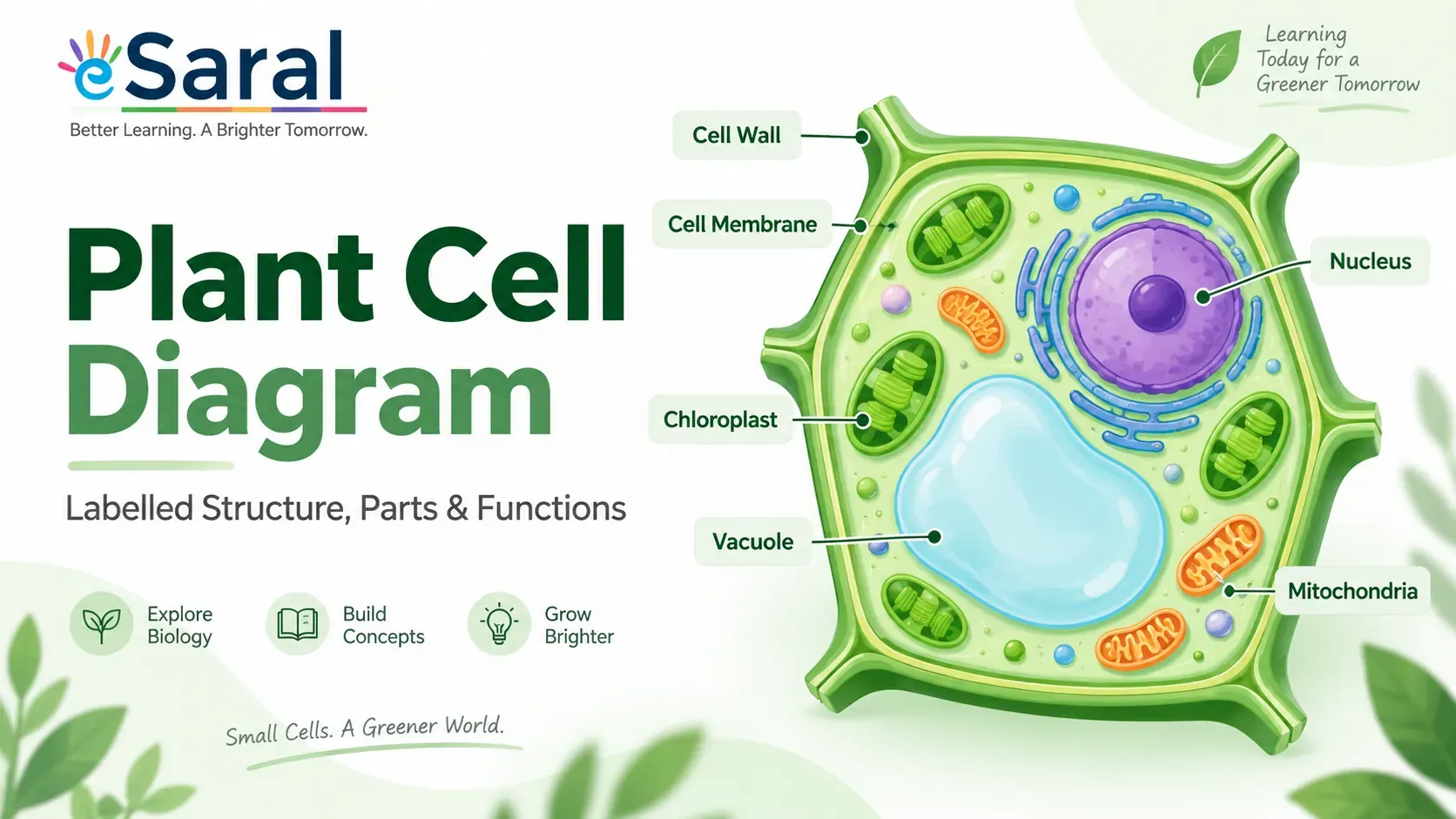
Plant Cell Diagram: Labelled Structure, Parts and Functions
Simple, labelled plant cell diagram with parts and functions. Covers plant cell structure for Class 6, 7, 8, 9, 10 and 11 students, CBSE-aligned.

Saransh Gupta Sir's Visit to IIT Patna: Hostel Life, Placements & Lessons for JEE Aspirants
Inside Saransh Gupta Sir's IIT Patna visit — hostel life, the library, placements, internships, and real advice for JEE aspirants from students living the IIT dream.
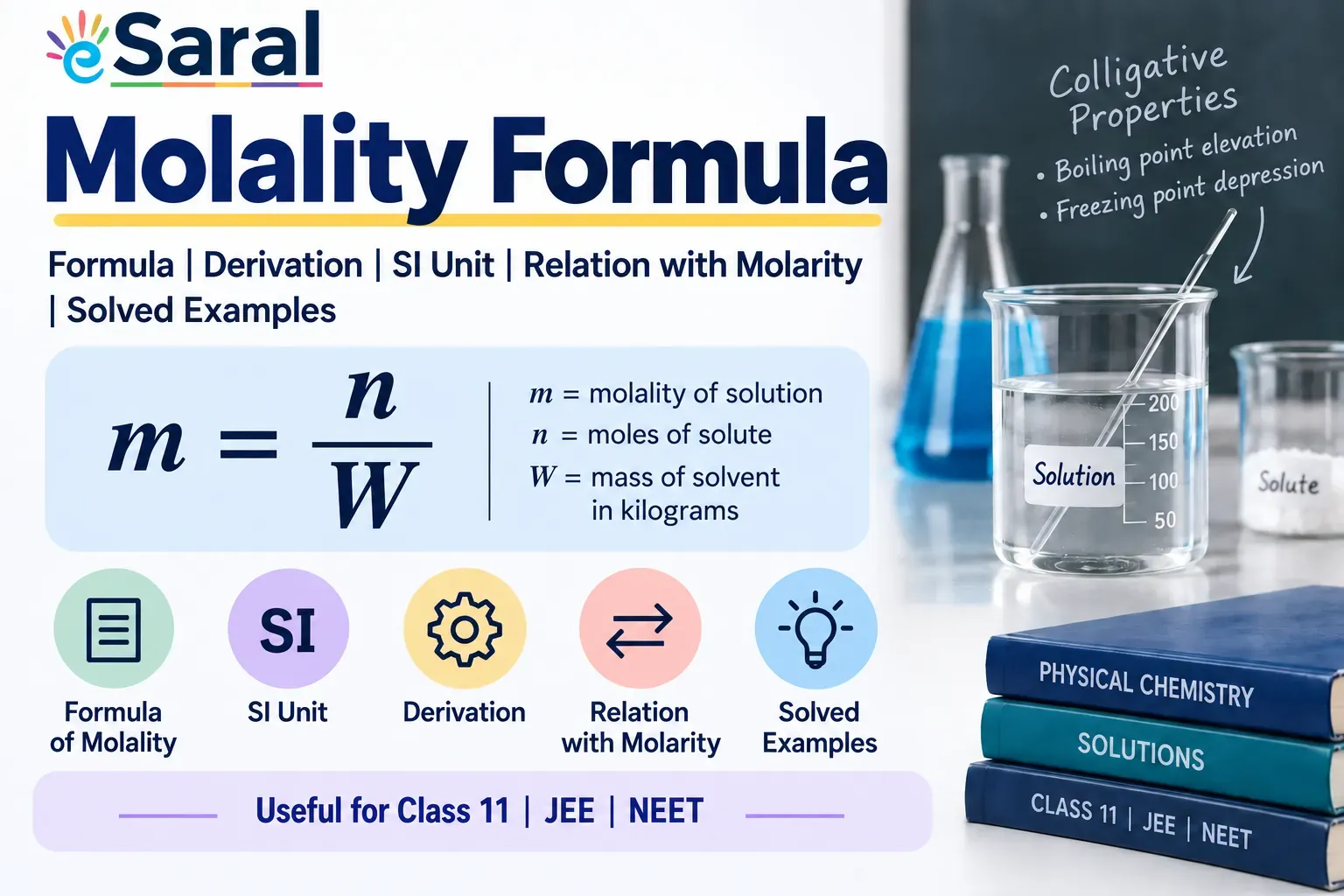
Molality Formula: Formula for Molality, Derivation & Solved Examples
Molality formula is $m = \dfrac{n}{W}$. Learn the formula of molality, its SI unit, derivation, relation with molarity, and solved examples for Class 11, JEE and NEET.
BITSAT Previous Year Question Paper PDF
Download BITSAT previous year question papers PDF. Get year-wise BITSAT PYQs, memory-based papers, exam pattern, and preparation tips to improve your BITSAT preparation.

Teachers’ Day 2026 at eSaral Gurukul: Celebrating the Bond Between Students, Teachers & Mentors
See how Teachers’ Day 2026 was celebrated at eSaral Gurukul, reflecting the bond among students, teachers, and mentors, and the role of guidance beyond academics.
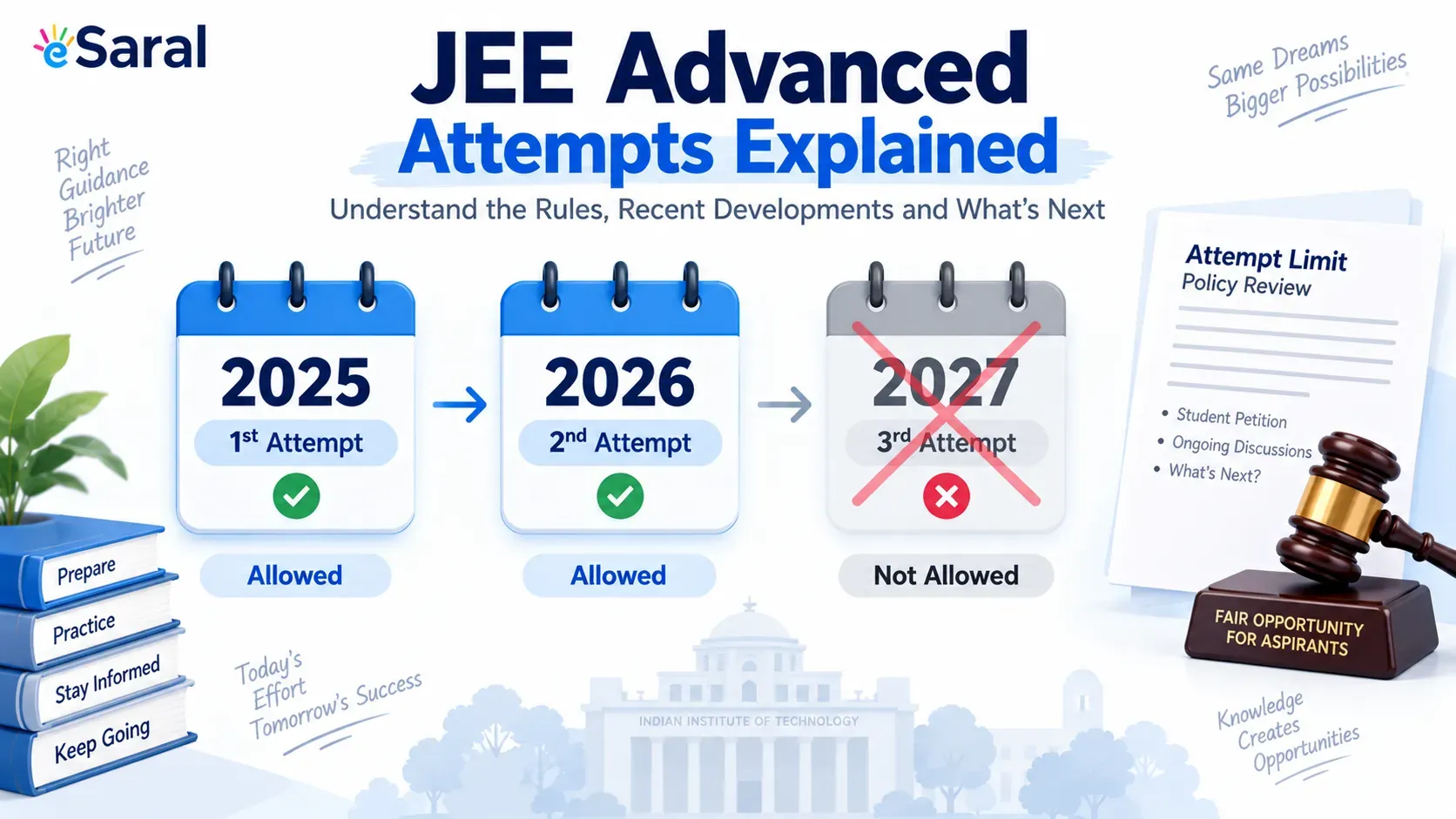
JEE Advanced Attempts: Can You Give It a Third Time? Rules Explained
JEE Advanced attempts: current rule is 2 consecutive years only: full eligibility criteria, the 2025 third-attempt controversy, and the latest 2026 petition news.

Best JEE Preparation App
Best JEE preparation app for Main & Advanced: AI mock tests, live doubt-solving, thousands of practice questions. JEE preparation app for droppers & Class 11-12.
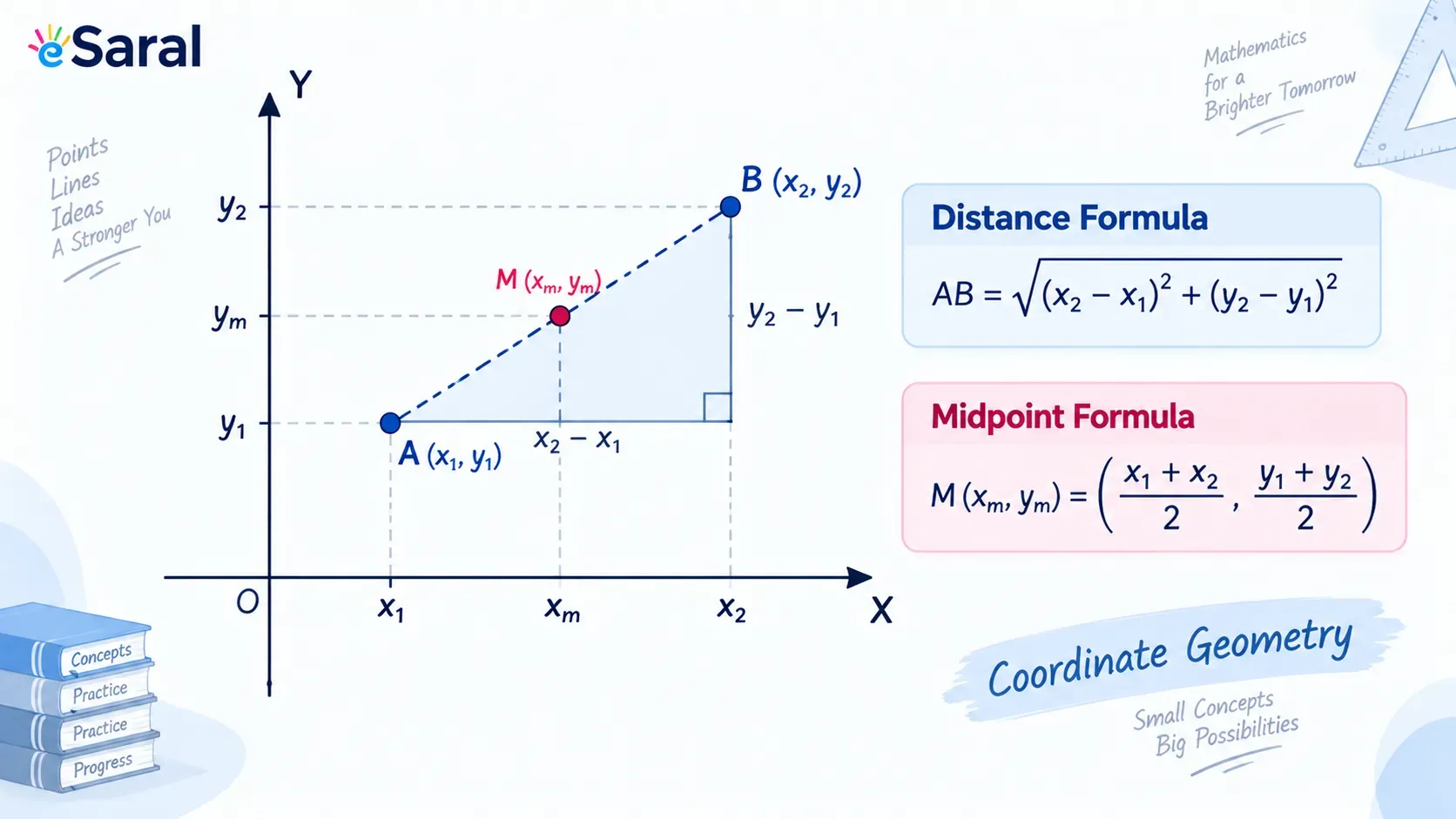
Coordinate Geometry Class 10: Formulas, Notes & Solved Examples
Coordinate geometry class 10: complete CBSE formulas — distance, section, midpoint and area of triangle — with derivation, notes and solved examples.
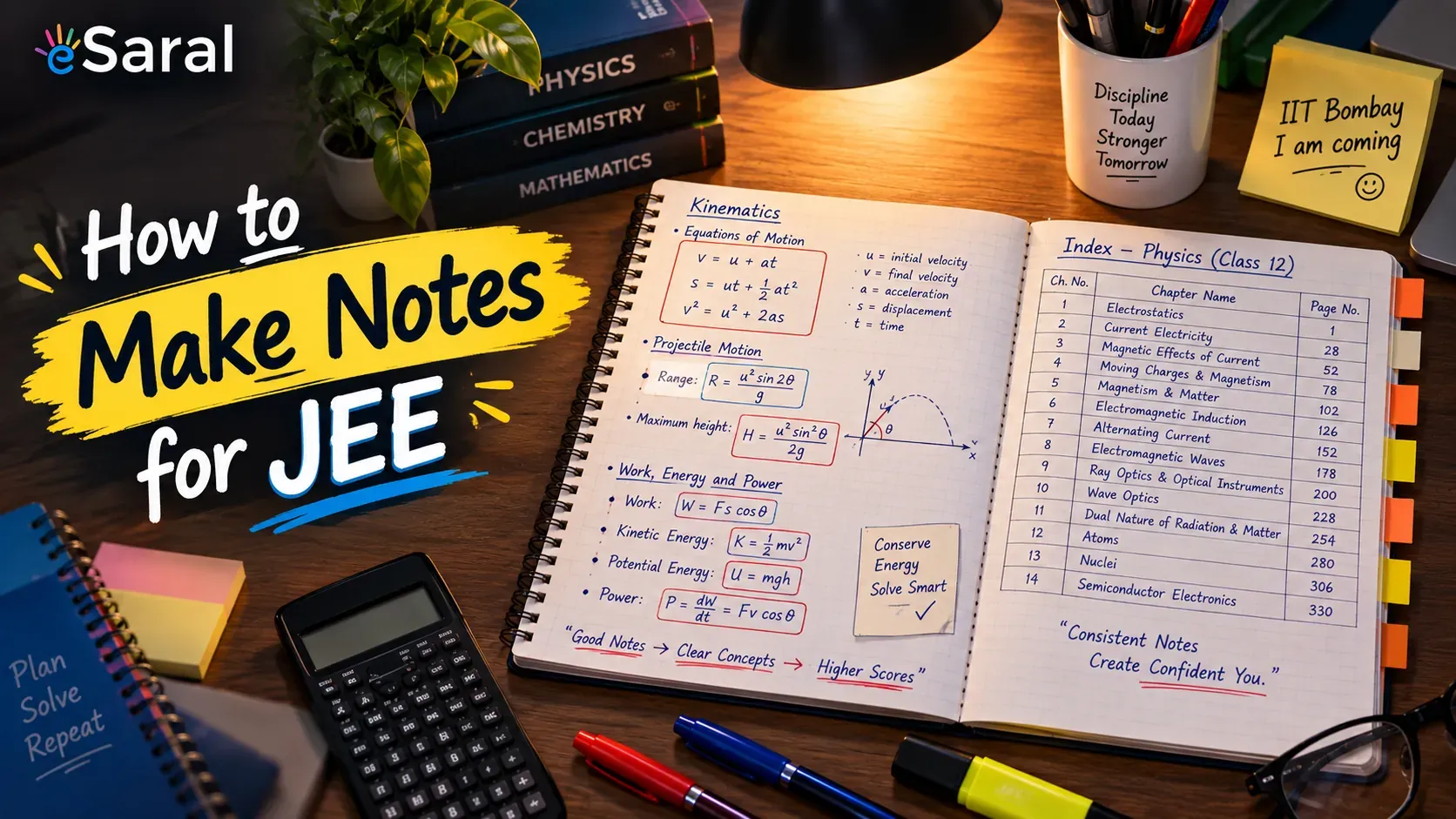
How to make Notes For JEE Smart Notes Strategy of an AIR 41
Learn how to make notes for JEE the way toppers do — indexing, shorthand, and smart short notes for JEE that cut revision time to just 5–7 days.
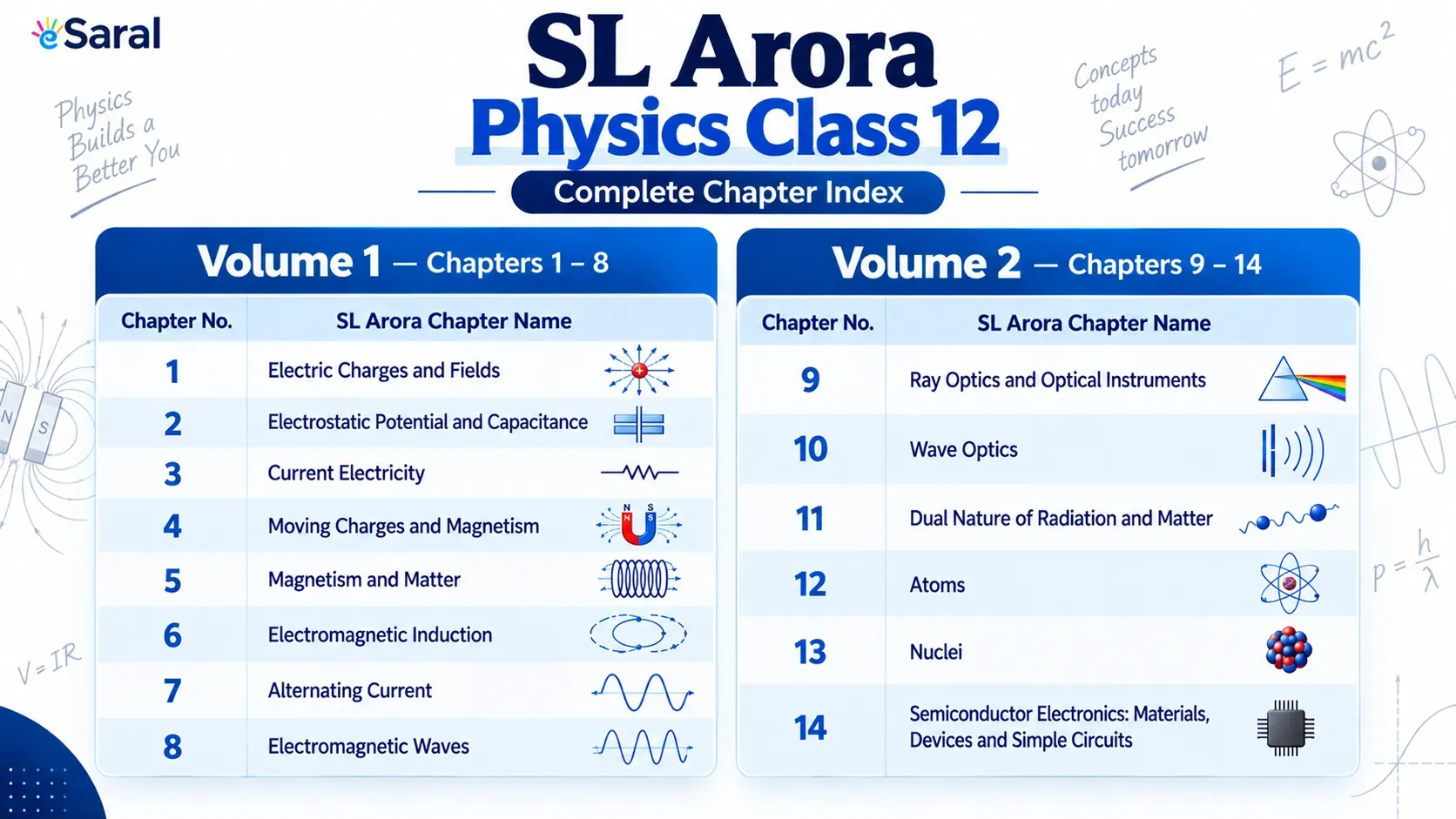
SL Arora Physics Class 12 Index – Chapter List for Volume 1 & 2
SL Arora Physics Class 12 index — complete chapter list for Volume 1 & 2, mapped to NCERT solutions for board, JEE Main, and NEET preparation.