
Mind Maps for Wave on String Revision - Class 11, JEE, NEET

eSaral Academic and Editorial Team
Summary
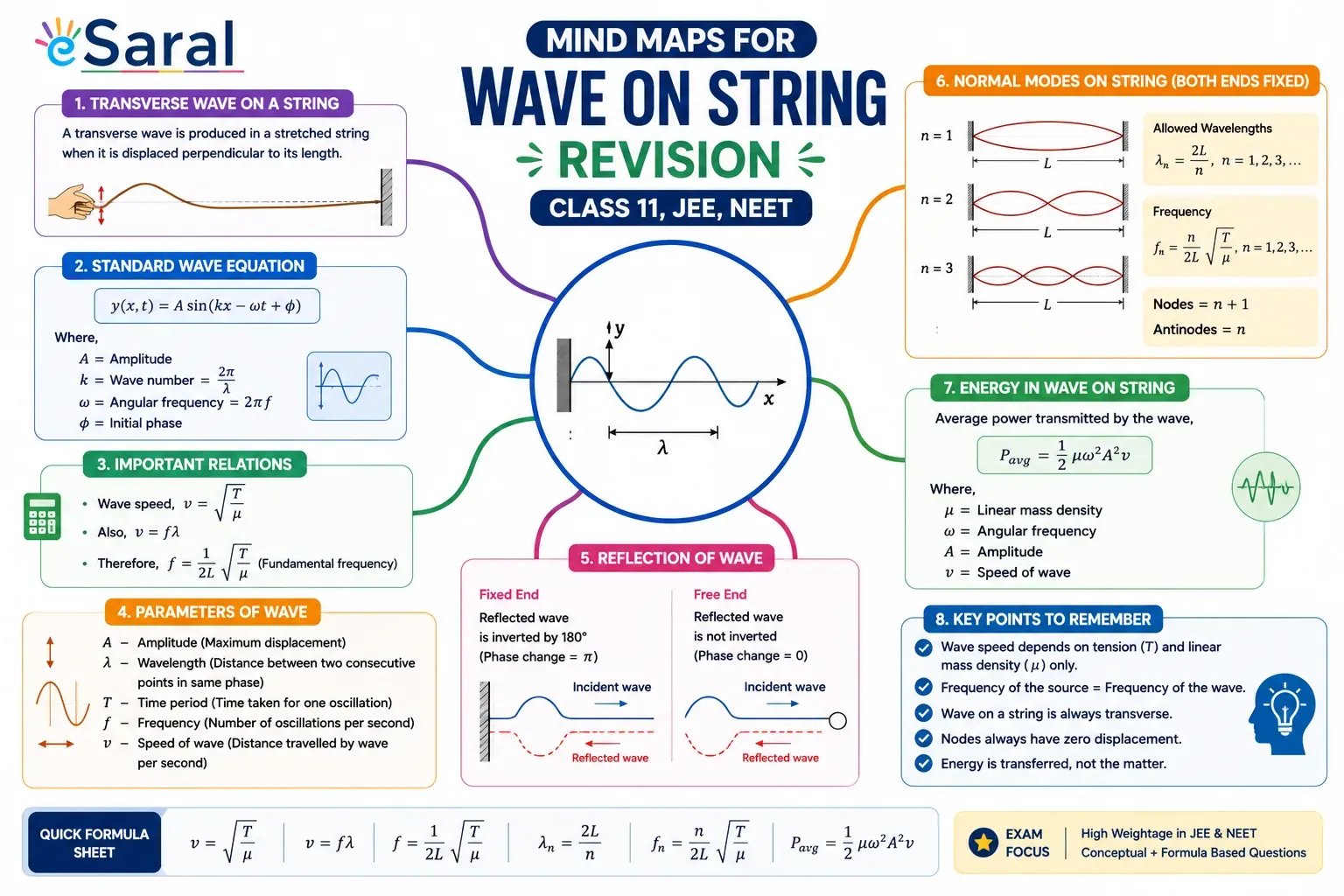
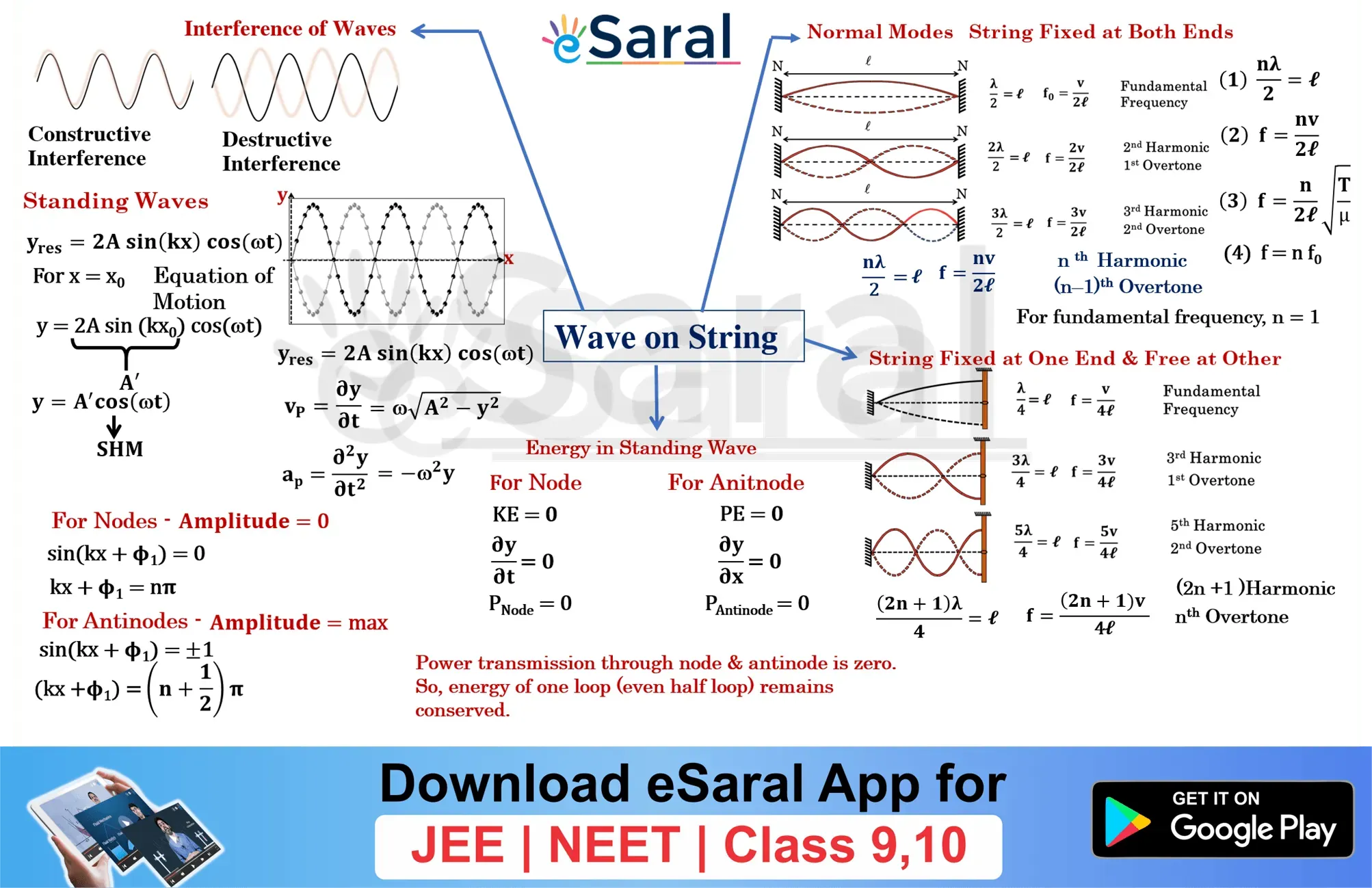
Waves on string mind maps for Class 11 summarise every key formula — wave speed (v = √T/μ), frequency of harmonics, standing wave conditions, nodes, and antinodes — on a single visual sheet. These two downloadable mind maps by eSaral cover all concepts tested in JEE Main, JEE Advanced, and NEET from the Waves chapter.
Home > Mind Maps > Waves on String Mind Map – Class 11, JEE & NEET

Waves on String in Class 11 comprises variety of cases with important formulae and key points. So here is the mind map to help you in remembering all the formulas and important key concepts on finger tips.
MIND MAP 1
India's Best Exam Preparation for Class 11th - Download Now
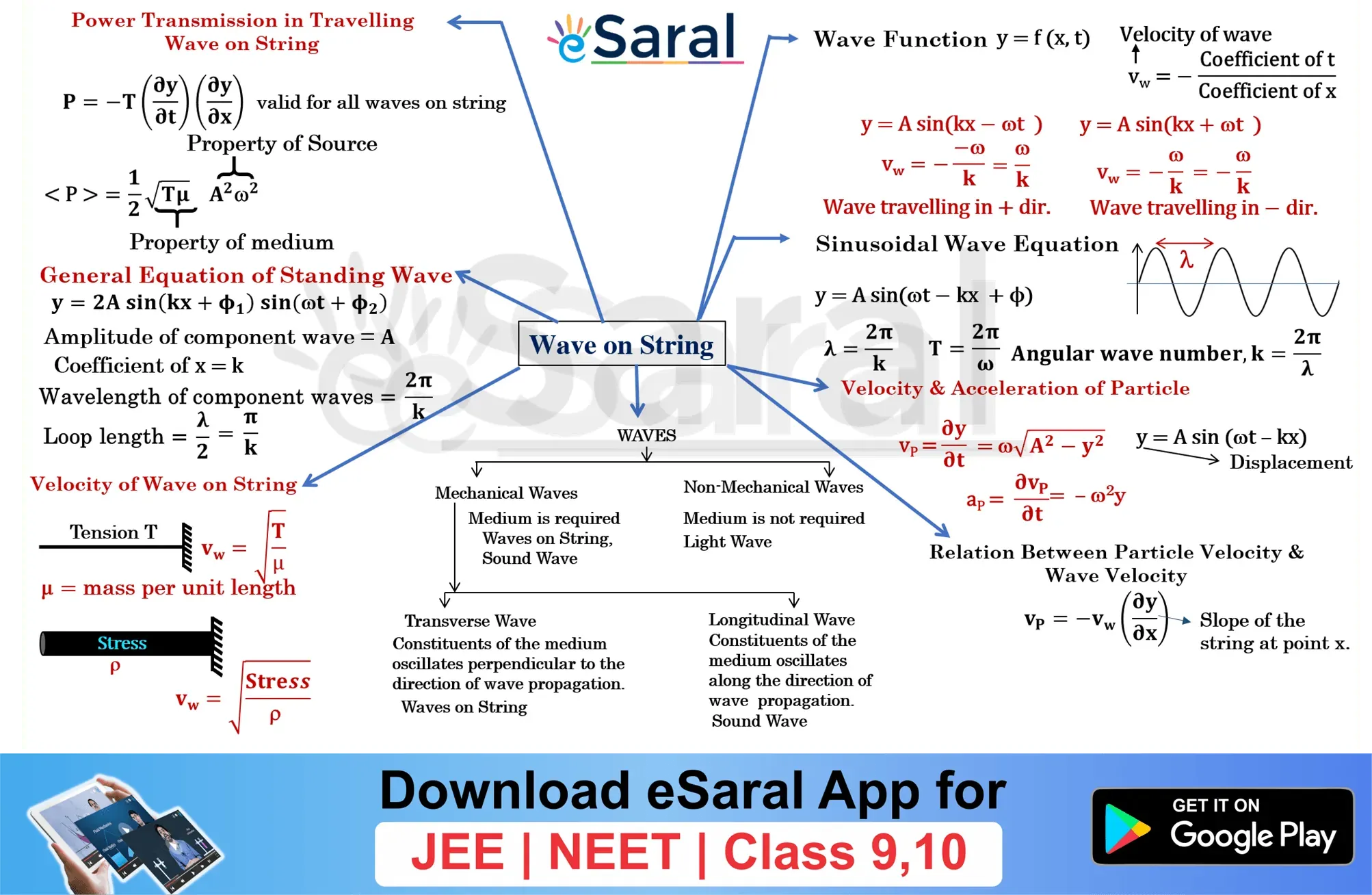
Mind Map 2
India's Best Exam Preparation for Class 11th - Download Now
Frequently Asked Questions
How many harmonics are present in a string fixed at both ends?
A string fixed at both ends supports all harmonics — 1st (fundamental), 2nd, 3rd, and so on. The nth harmonic frequency is fₙ = nv/2L. There is no restriction to odd or even harmonics, unlike a pipe closed at one end. This is a frequently tested boundary condition in both JEE Main and NEET.
What is the difference between a node and an antinode in a standing wave?
A node is a point in a standing wave where the displacement is always zero — the string does not move there. An antinode is a point of maximum displacement. Adjacent nodes are separated by λ/2, and the distance between a node and the nearest antinode is λ/4. Both JEE Main and NEET test this with diagram-based MCQs.
What is the formula for wave speed on a string?
Wave speed on a string is v = √(T/μ), where T is the tension in the string measured in Newtons and μ is the linear mass density (mass per unit length) in kg/m. This formula is the starting point for almost every numerical question on this topic in JEE Main and NEET. Memorise it with units to avoid errors.
Do I need to study waves on string for JEE Advanced as well?
Yes, and at a deeper level than JEE Main. JEE Advanced tests superposition of waves, phase analysis, energy in standing waves, and paragraph-based problems where multiple wave concepts combine. The mind maps here cover the foundational layer required for JEE Advanced; students aiming for top ranks should supplement with eSaral's video lectures by IIT Bombay faculty for the advanced applications.
Is the Waves on String chapter important for NEET 2026?
Yes. According to NTA's NEET syllabus (based on the NCERT Class 11 Physics curriculum), Waves is an examined unit every year. NEET typically asks 1–2 questions on string vibrations, standing waves, or resonance. The chapter is medium-difficulty and highly scoring once the formulas are clear, making it a priority for revision in the final weeks.
What is the difference between the 1st overtone and the 2nd harmonic?
They are the same thing. The 1st overtone is simply the second-lowest frequency at which the string resonates, which equals the 2nd harmonic (f₂ = 2f₁). The nth overtone corresponds to the (n+1)th harmonic. Confusing these two terms is one of the most common errors in JEE Main wave questions — always convert overtone number to harmonic number first
Team eSaral
eSaral Academic and Editorial Team
Team eSaral is the collective author profile for educational content created by eSaral’s teachers and academic contributors. The team draws on expertise from IIT graduates, doctors, experienced educators and subject specialists to develop resources for JEE, NEET and school students. Our articles aim to explain concepts clearly and help students study with confidence.
Related Posts
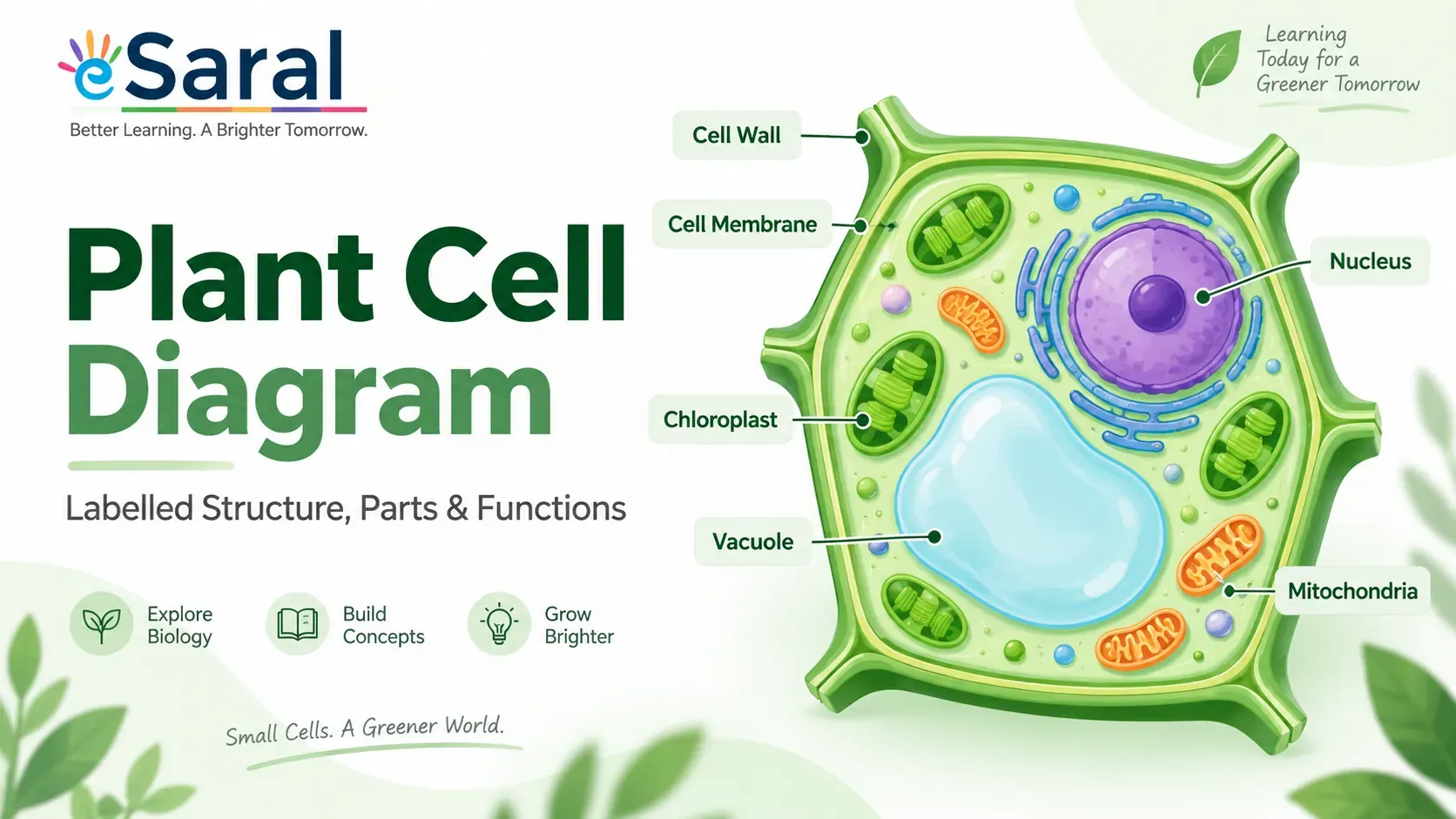
Plant Cell Diagram: Labelled Structure, Parts and Functions
Simple, labelled plant cell diagram with parts and functions. Covers plant cell structure for Class 6, 7, 8, 9, 10 and 11 students, CBSE-aligned.
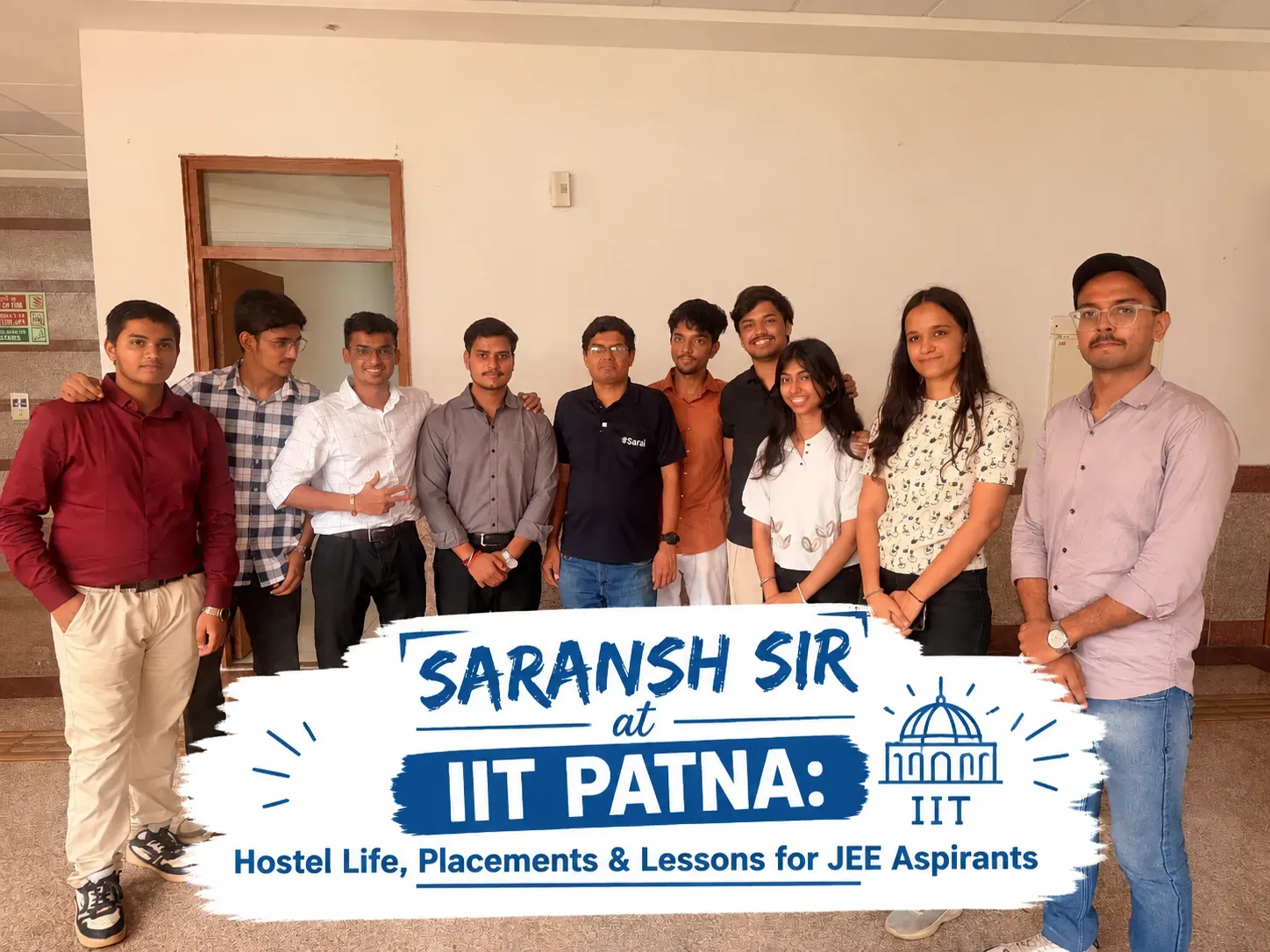
Saransh Gupta Sir's Visit to IIT Patna: Hostel Life, Placements & Lessons for JEE Aspirants
Inside Saransh Gupta Sir's IIT Patna visit — hostel life, the library, placements, internships, and real advice for JEE aspirants from students living the IIT dream.
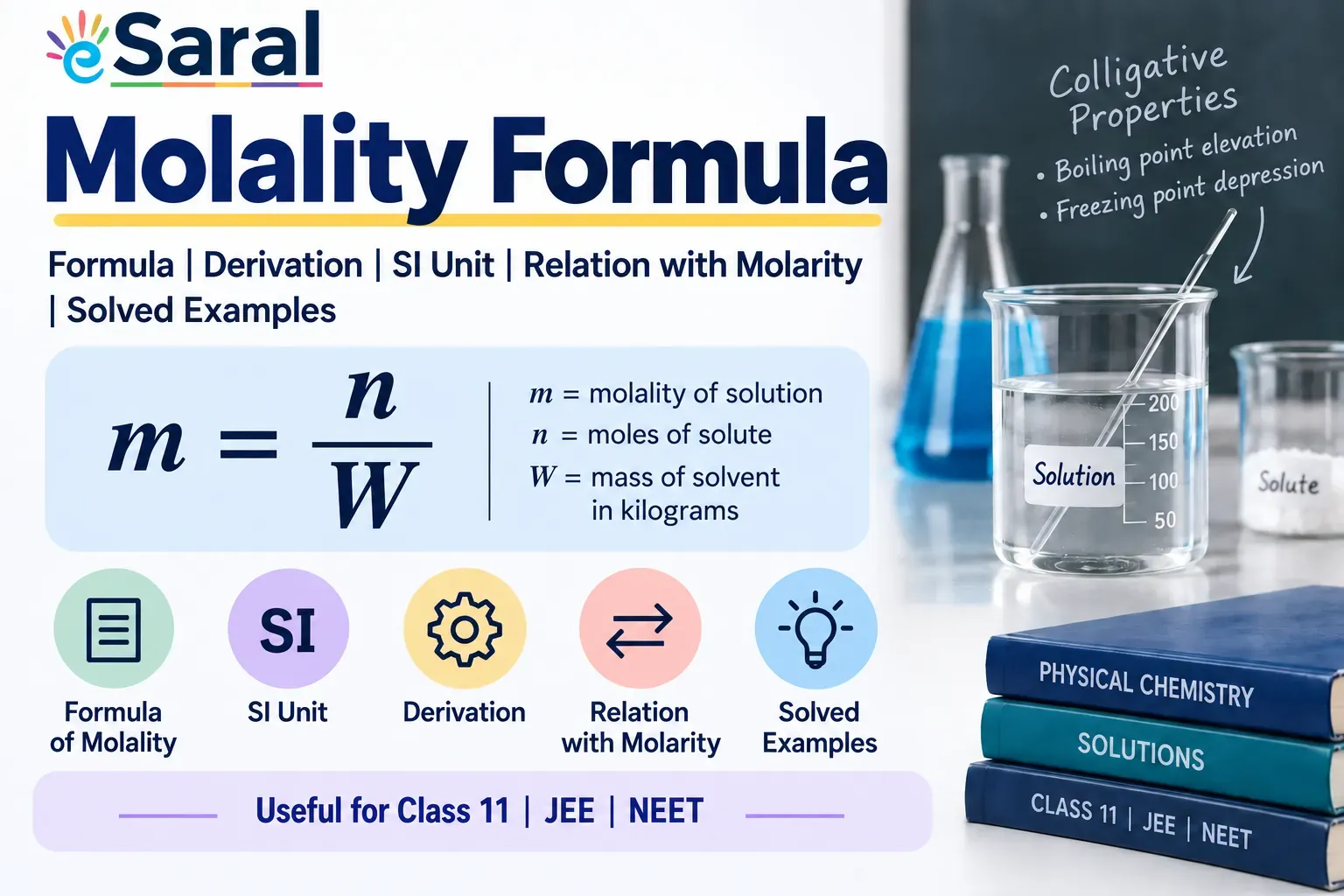
Molality Formula: Formula for Molality, Derivation & Solved Examples
Molality formula is $m = \dfrac{n}{W}$. Learn the formula of molality, its SI unit, derivation, relation with molarity, and solved examples for Class 11, JEE and NEET.
BITSAT Previous Year Question Paper PDF
Download BITSAT previous year question papers PDF. Get year-wise BITSAT PYQs, memory-based papers, exam pattern, and preparation tips to improve your BITSAT preparation.

Teachers’ Day 2026 at eSaral Gurukul: Celebrating the Bond Between Students, Teachers & Mentors
See how Teachers’ Day 2026 was celebrated at eSaral Gurukul, reflecting the bond among students, teachers, and mentors, and the role of guidance beyond academics.
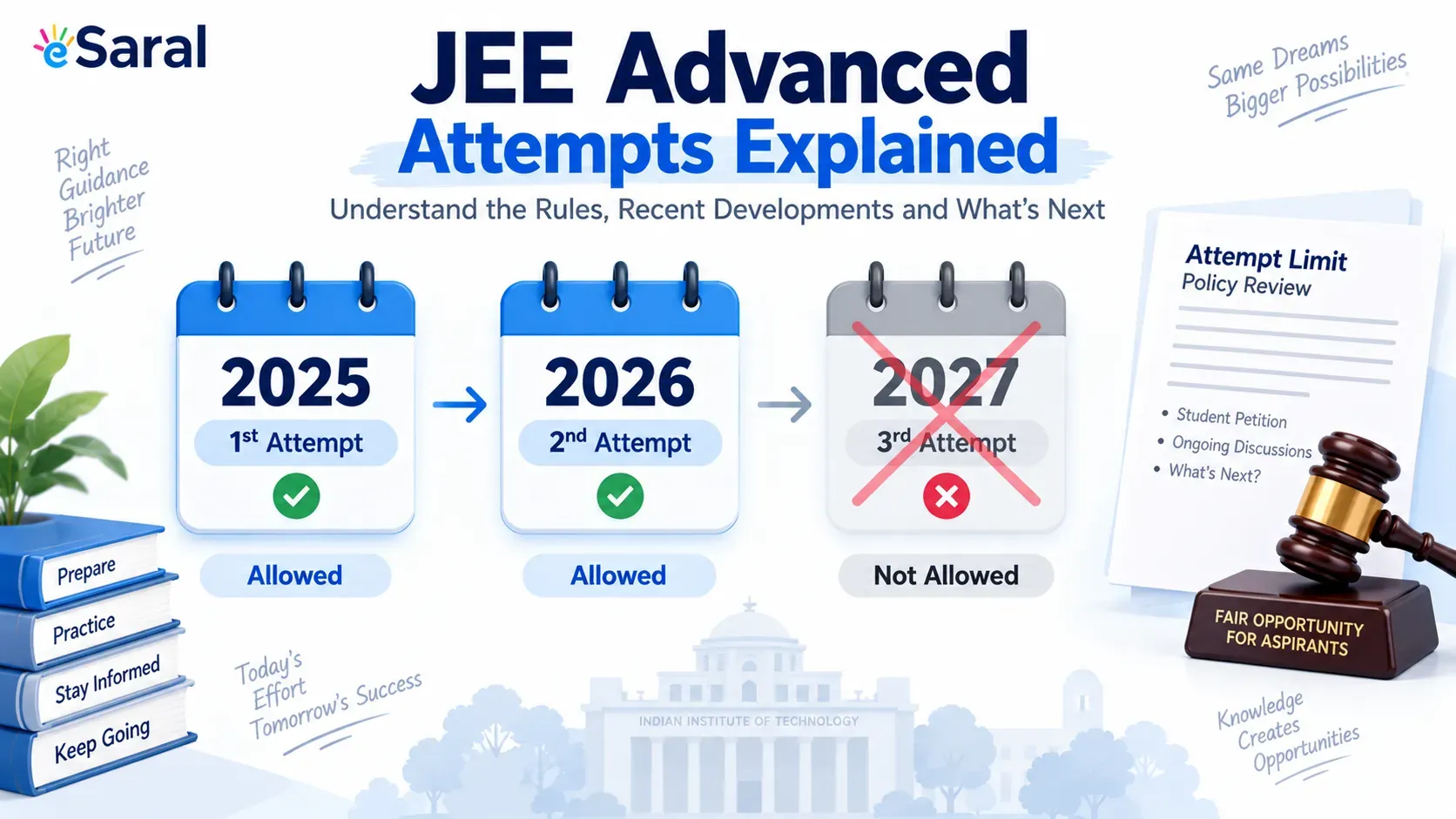
JEE Advanced Attempts: Can You Give It a Third Time? Rules Explained
JEE Advanced attempts: current rule is 2 consecutive years only: full eligibility criteria, the 2025 third-attempt controversy, and the latest 2026 petition news.

Best JEE Preparation App
Best JEE preparation app for Main & Advanced: AI mock tests, live doubt-solving, thousands of practice questions. JEE preparation app for droppers & Class 11-12.
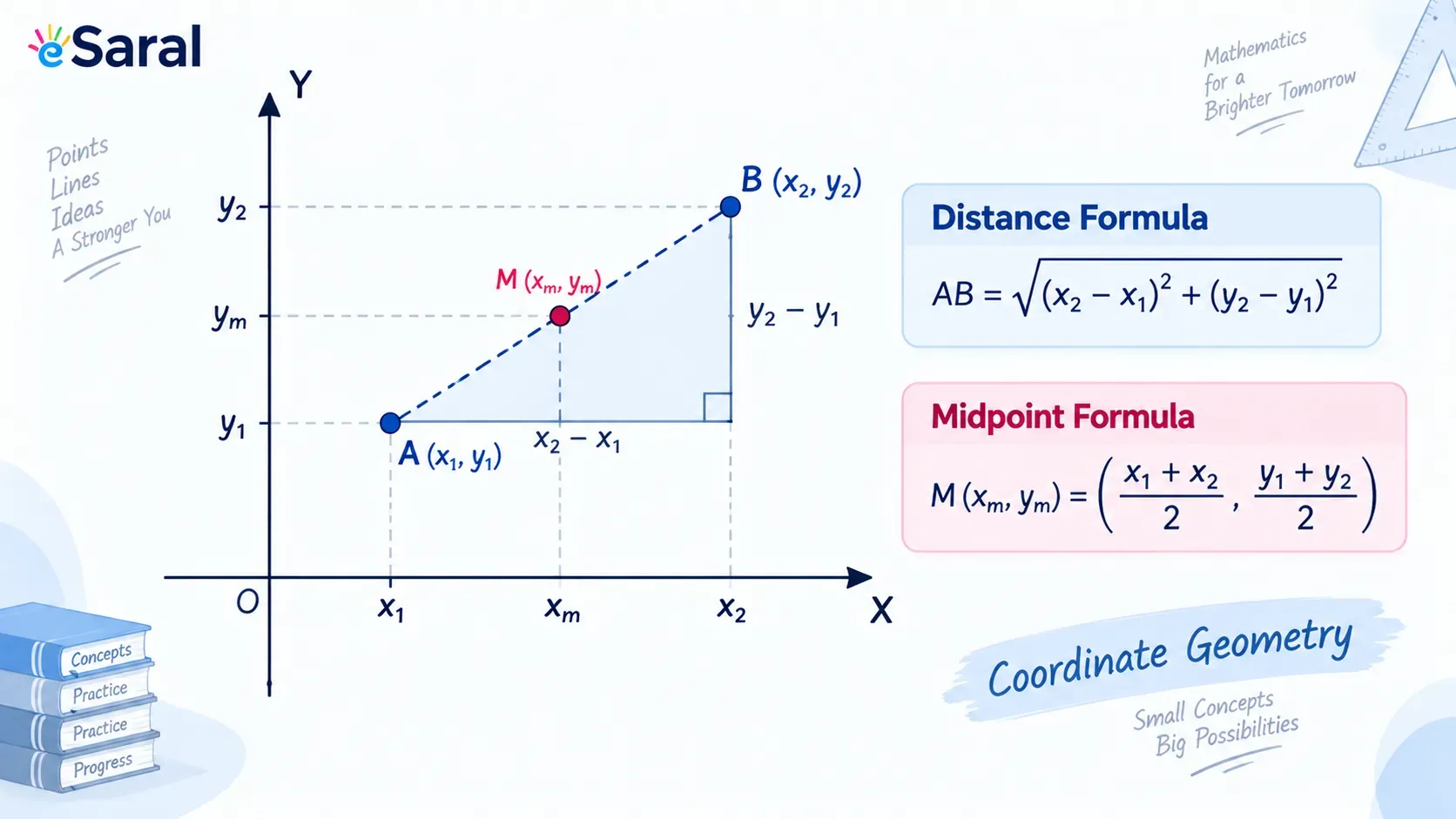
Coordinate Geometry Class 10: Formulas, Notes & Solved Examples
Coordinate geometry class 10: complete CBSE formulas — distance, section, midpoint and area of triangle — with derivation, notes and solved examples.
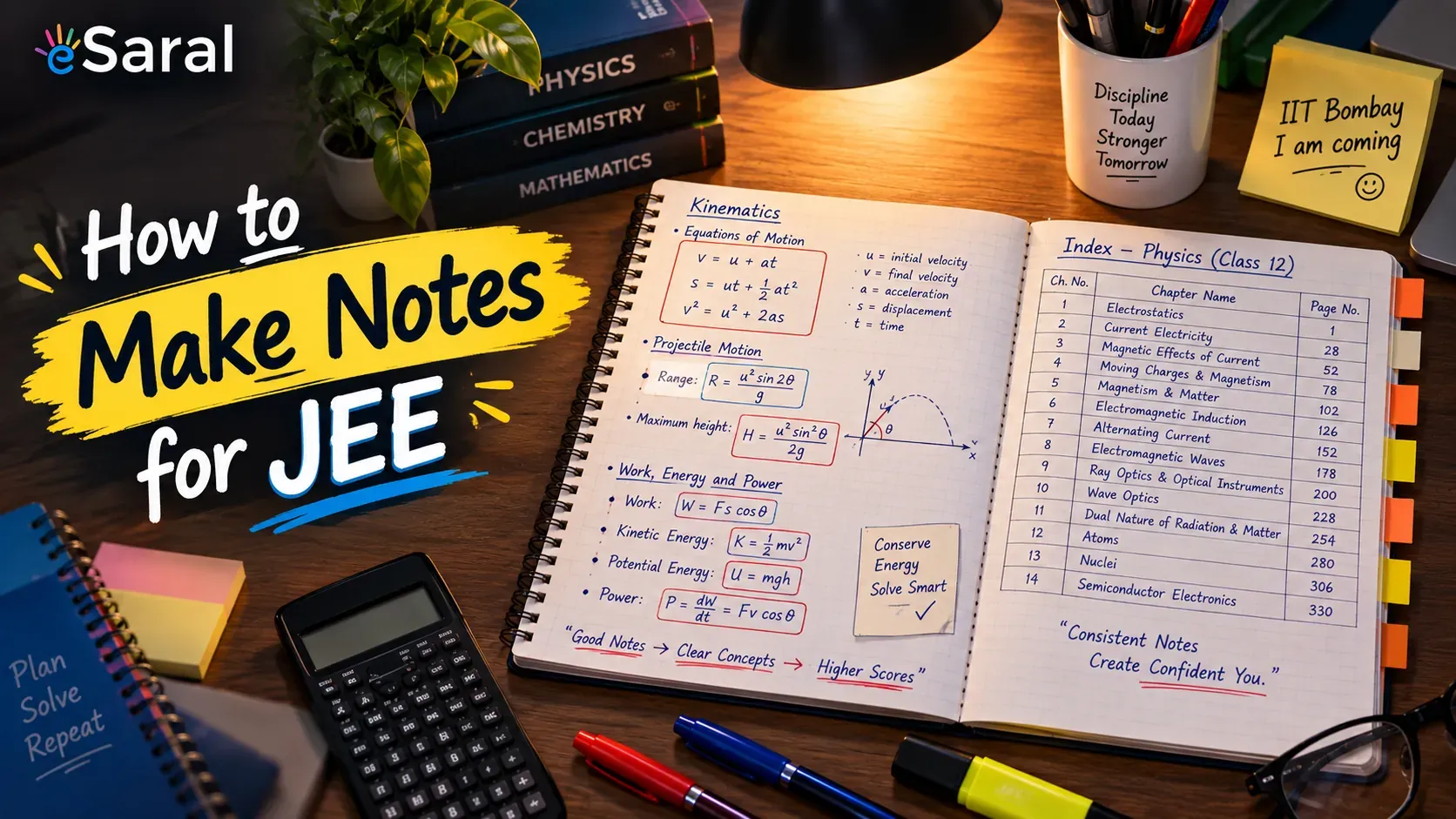
How to make Notes For JEE Smart Notes Strategy of an AIR 41
Learn how to make notes for JEE the way toppers do — indexing, shorthand, and smart short notes for JEE that cut revision time to just 5–7 days.
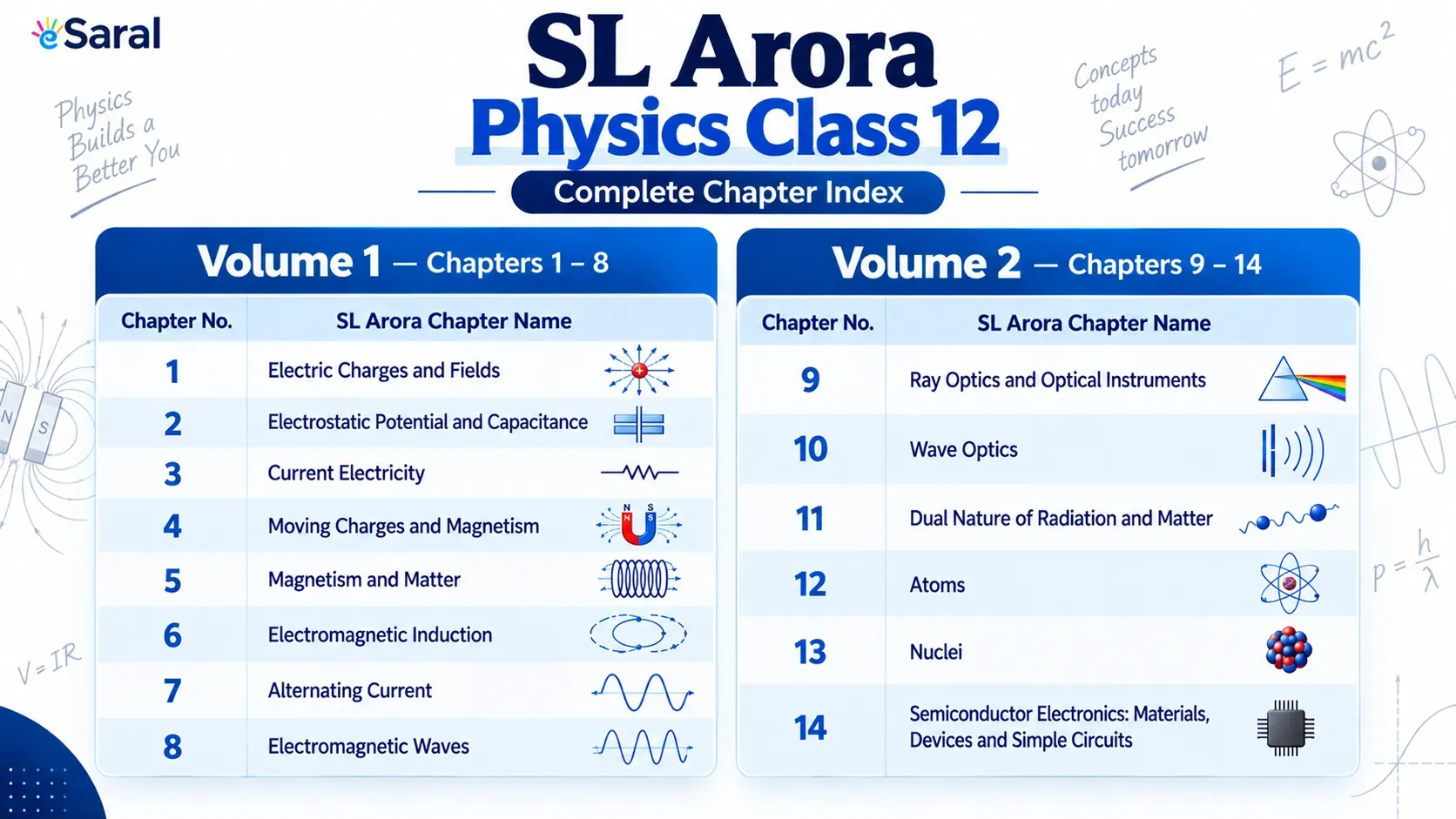
SL Arora Physics Class 12 Index – Chapter List for Volume 1 & 2
SL Arora Physics Class 12 index — complete chapter list for Volume 1 & 2, mapped to NCERT solutions for board, JEE Main, and NEET preparation.