
Mind Maps for Electrostatics Revision: Class XII, JEE, NEET

eSaral Academic and Editorial Team
Summary
Electrostatics Mind Maps: Revise electric charges, electric field, potential, and conductors quickly with concise Class 12 Electrostatics mind maps covering all key formulas and concepts for JEE, NEET, and boards.
eSaral › Class 12›Mind Maps for Electrostatics Revision

🚀 Checkout eSaral Courses
Chapter Weightage — Electrostatics in JEE & NEET
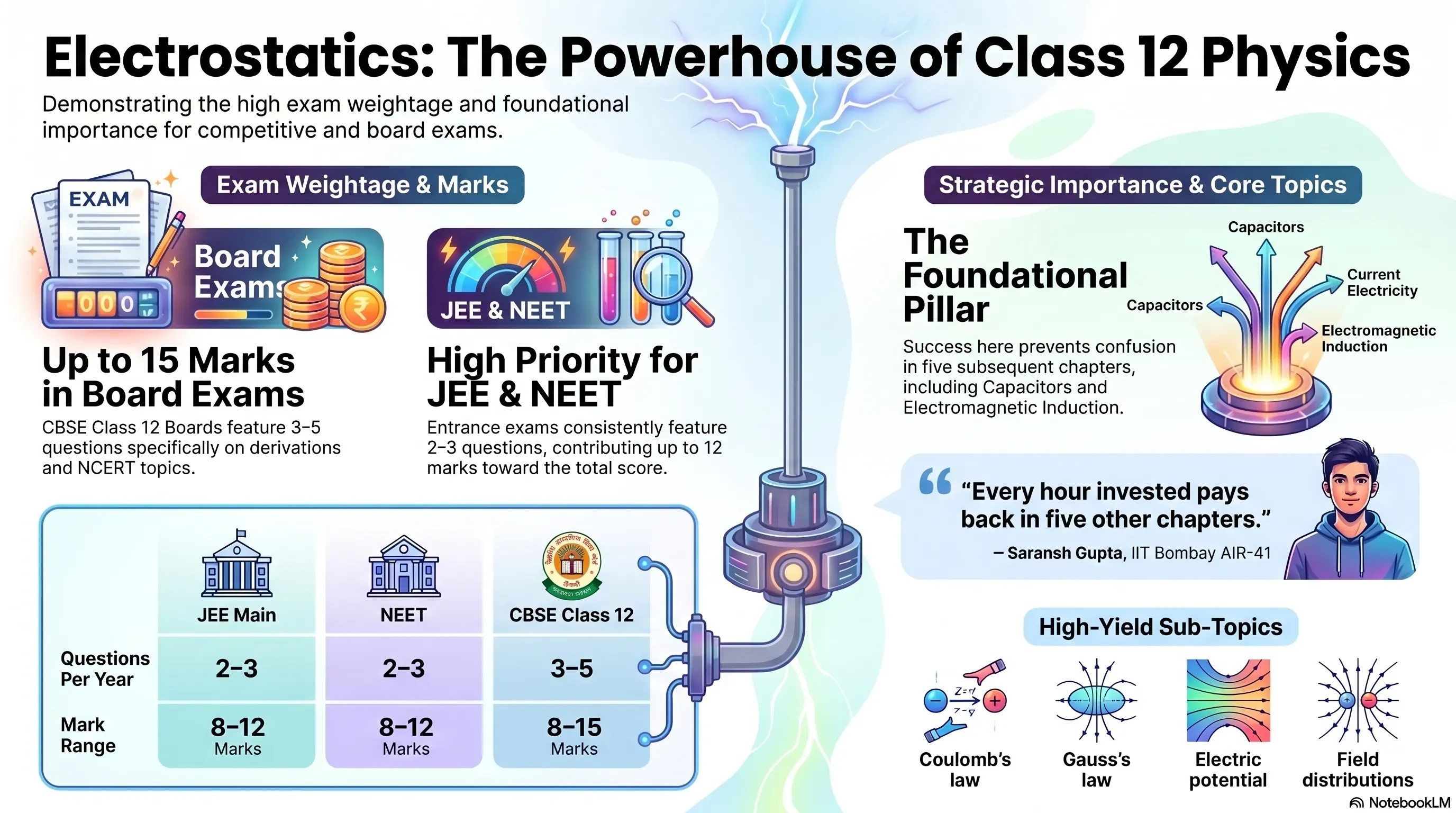
Electrostatics is Chapter 1 of NCERT Class 12 Physics and one of the foundational chapters of the entire Physics syllabus. Concepts from electrostatics recur throughout the remaining chapters — Current Electricity, Capacitors, Electromagnetic Induction, and even Modern Physics all draw on electrostatic principles.
Exam Weightage at a Glance
Exam | Questions Per Year (approx.) | Marks | Key Sub-Topics Tested |
|---|---|---|---|
JEE Main | 2–3 | 8–12 | Coulomb's law, Gauss's law, electric potential, field due to dipole |
JEE Advanced | 1–2 | 4–8 | Complex field/potential calculations, conductors, Gauss's law |
NEET | 2–3 | 8–12 | Coulomb's law, electric field due to charge distributions, potential energy |
CBSE Class 12 Board | 3–5 | 8–15 | All NCERT topics, especially derivations |
Source: NTA JEE Main and NEET official question papers, 2018–2024.
💡 Expert Tip by Saransh Gupta, IIT Bombay AIR-41: "Electrostatics is the chapter where students either build a strong conceptual foundation — or spend the rest of Class 12 confused about why current flows, why capacitors store charge, and why conductors behave the way they do. Spend extra time here. Every hour invested in electrostatics pays back in five other chapters."
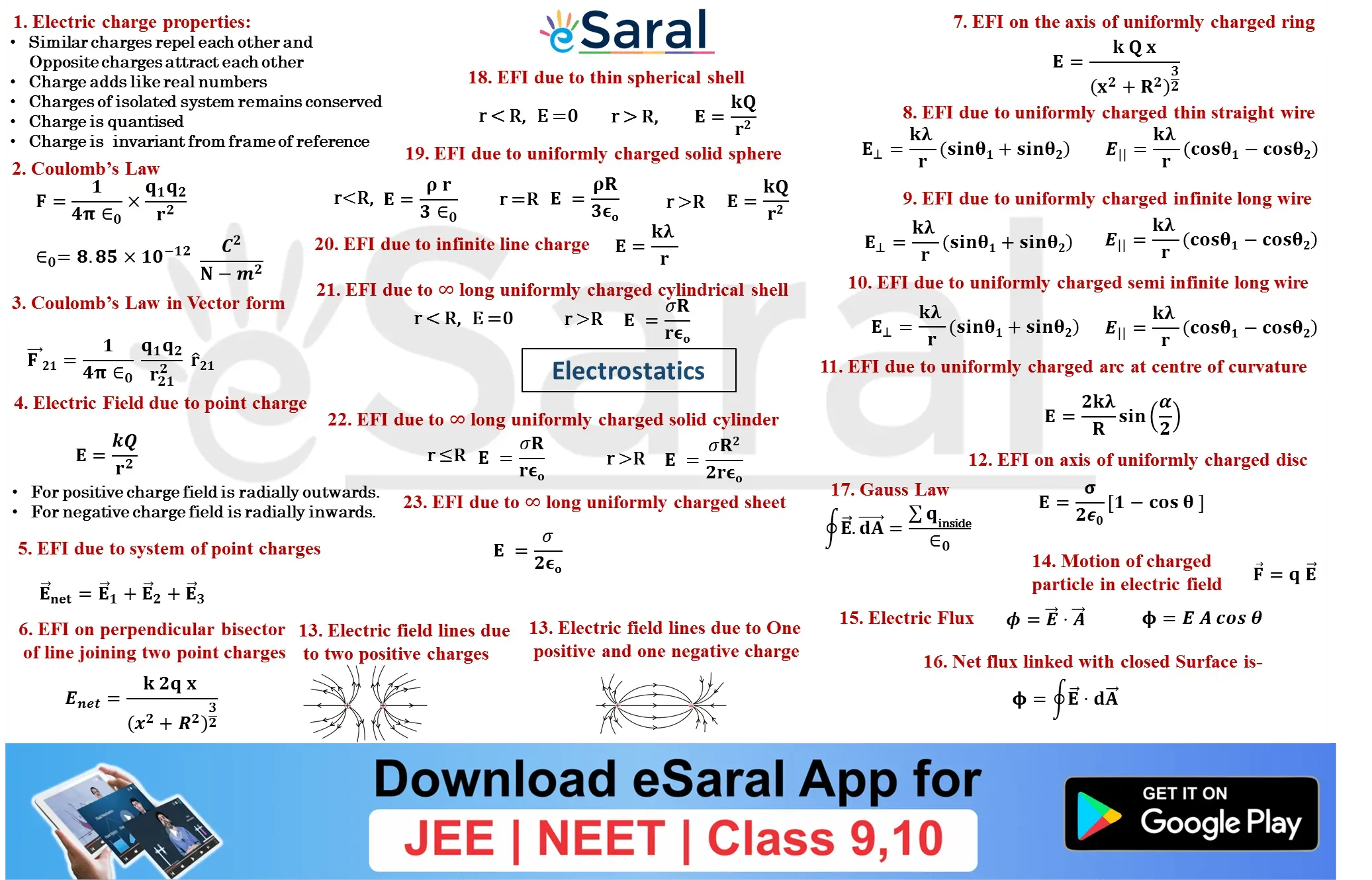
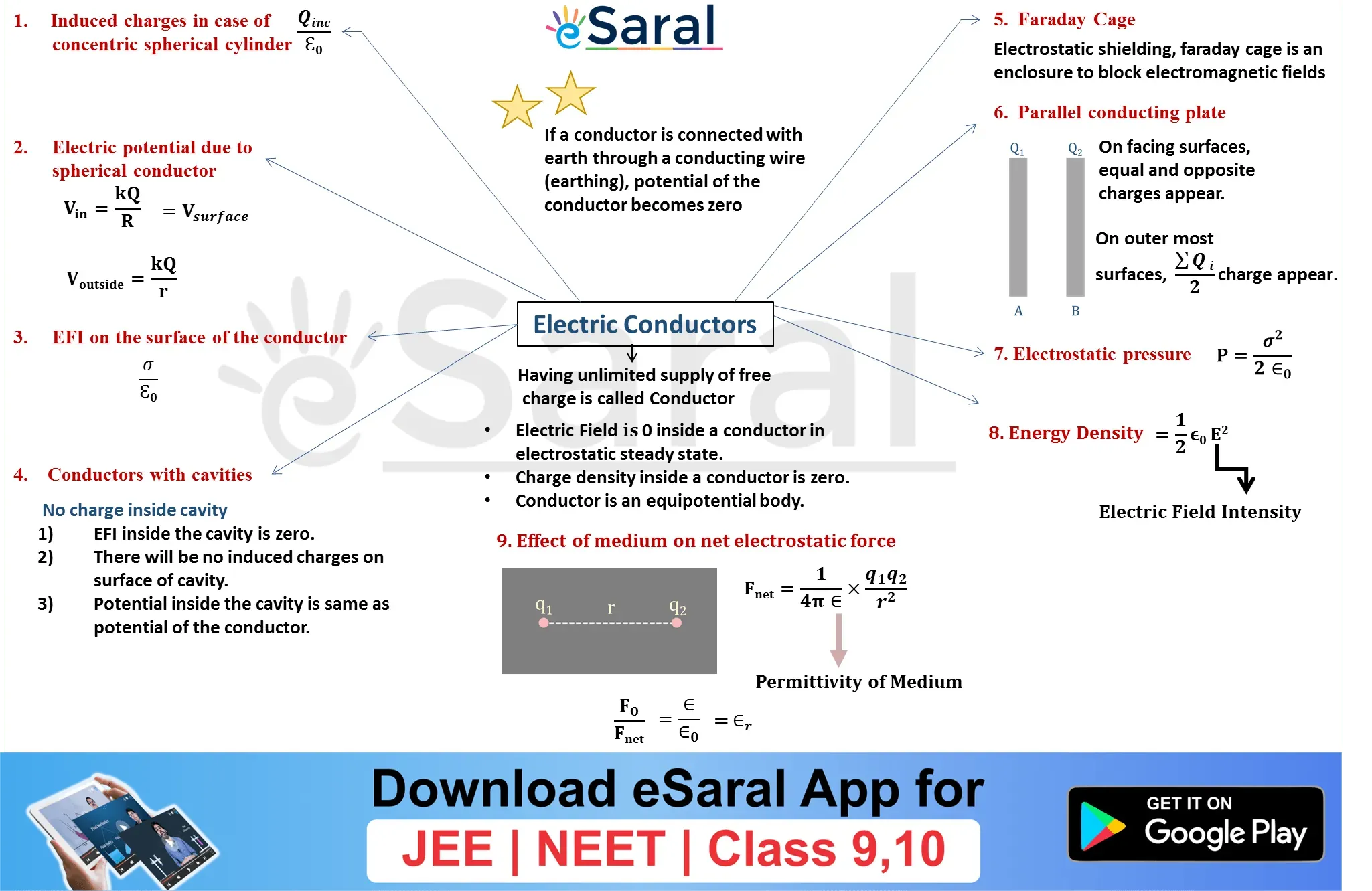
Here is the Mind Maps for Class 12Th Electrostatics Comprising all the important Formulae and Key Points. Therea re very important for quick revision during Exam.
Mind Map of Electric Field and Charges
Mind Map of Electric Potential
Mind Maps Electric Conductors

Frequently Asked Questions
What is the weightage of electrostatics in JEE Main and NEET?
Electrostatics carries approximately 4–6% weightage in both JEE Main and NEET, contributing 2–3 questions (8–12 marks) annually. Based on papers from 2018 to 2024, electric field due to charge distributions, electric potential, and Gauss's law applications are the most frequently tested topics. The chapter appears in almost every JEE Main and NEET paper, making it a high-reliability scoring area.
What are the most important formulas in electrostatics for JEE Main?
The highest-priority formulas are: Coulomb's law (F = kq₁q₂/r²), electric field due to point charge (E = kQ/r²), field due to infinite line charge (E = λ/2πε₀r), Gauss's law (Φ = Q_enclosed/ε₀), electric potential (V = kQ/r), relation between field and potential (E = –dV/dr), dipole moment formulas on axial and equatorial lines, and conductor surface field (E = σ/ε₀). These cover approximately 80% of all electrostatics questions in JEE Main.
How to revise electrostatics quickly before JEE or NEET?
The fastest revision approach is: (1) download and review all three mind maps — Electric Field, Electric Potential, and Conductors, (2) cover the maps and recall formulas from memory, (3) solve 5 previous year questions per sub-topic. This three-step process takes 3–4 hours total and is sufficient for a confident revision of the entire chapter. The mind maps on this page are designed specifically for this final-phase revision.
What is the difference between electric field and electric potential?
Electric field (E) is a vector quantity representing the force per unit positive charge at a point — it has both magnitude and direction. Electric potential (V) is a scalar quantity representing the work done per unit charge in bringing a test charge from infinity to a point — it has only magnitude (with sign). They are related by E = –dV/dr: the field points from high potential to low potential, and is the negative rate of change of potential with distance.
Why is the electric field inside a conductor zero?
In electrostatic equilibrium, free electrons in a conductor redistribute themselves until no net electric force acts on any electron. If any internal field existed, it would accelerate free electrons — they would move until they cancel that field. The final equilibrium state has all free charges on the surface, zero internal field, and the entire conductor at a single potential (equipotential body). This is a direct consequence of Gauss's law applied to a Gaussian surface inside the conductor.
Team eSaral
eSaral Academic and Editorial Team
Team eSaral is the collective author profile for educational content created by eSaral’s teachers and academic contributors. The team draws on expertise from IIT graduates, doctors, experienced educators and subject specialists to develop resources for JEE, NEET and school students. Our articles aim to explain concepts clearly and help students study with confidence.
Related Posts

Plant Cell Diagram: Labelled Structure, Parts and Functions
Simple, labelled plant cell diagram with parts and functions. Covers plant cell structure for Class 6, 7, 8, 9, 10 and 11 students, CBSE-aligned.

Saransh Gupta Sir's Visit to IIT Patna: Hostel Life, Placements & Lessons for JEE Aspirants
Inside Saransh Gupta Sir's IIT Patna visit — hostel life, the library, placements, internships, and real advice for JEE aspirants from students living the IIT dream.
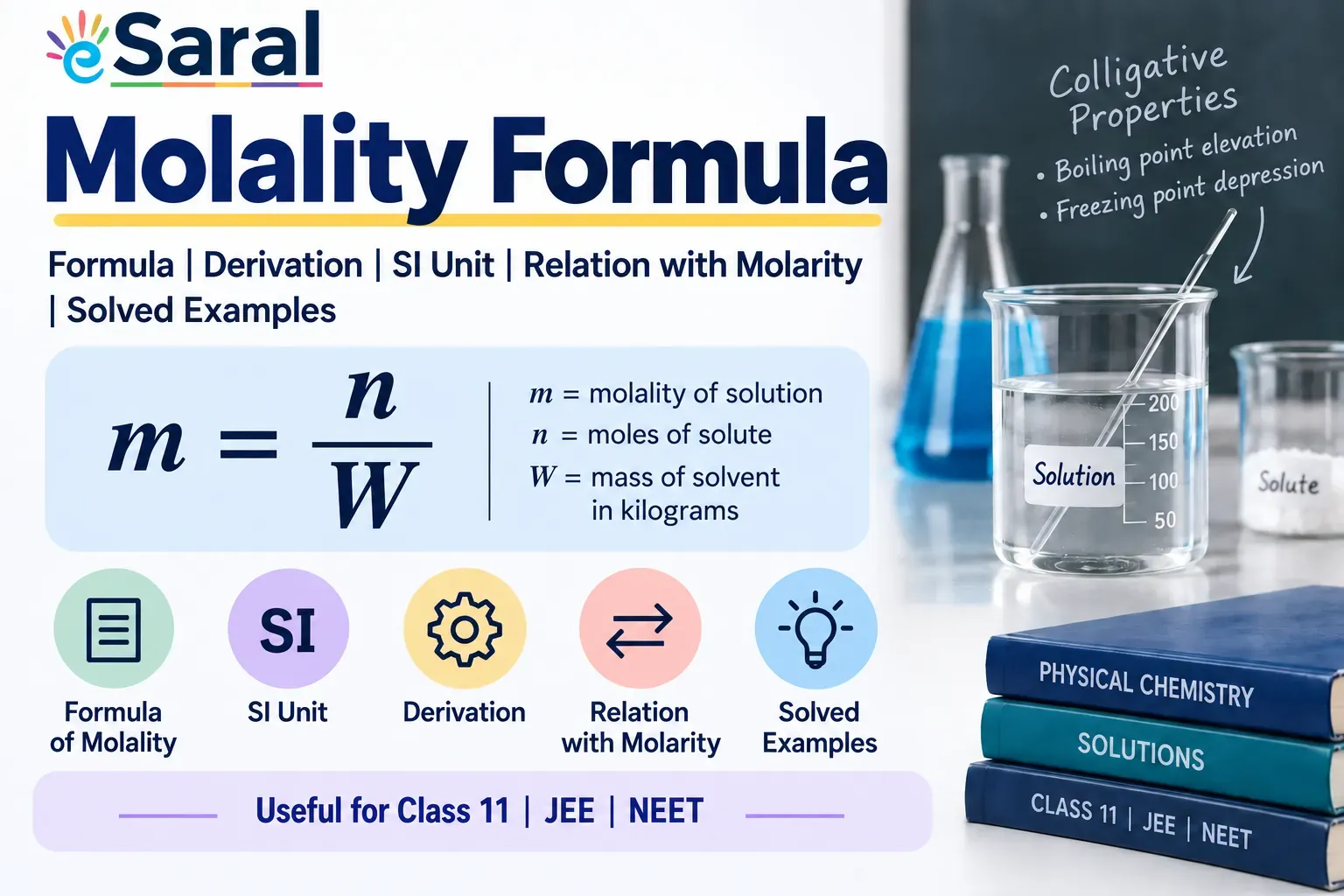
Molality Formula: Formula for Molality, Derivation & Solved Examples
Molality formula is $m = \dfrac{n}{W}$. Learn the formula of molality, its SI unit, derivation, relation with molarity, and solved examples for Class 11, JEE and NEET.

BITSAT Previous Year Question Paper PDF
Download BITSAT previous year question papers PDF. Get year-wise BITSAT PYQs, memory-based papers, exam pattern, and preparation tips to improve your BITSAT preparation.

Teachers’ Day 2026 at eSaral Gurukul: Celebrating the Bond Between Students, Teachers & Mentors
See how Teachers’ Day 2026 was celebrated at eSaral Gurukul, reflecting the bond among students, teachers, and mentors, and the role of guidance beyond academics.
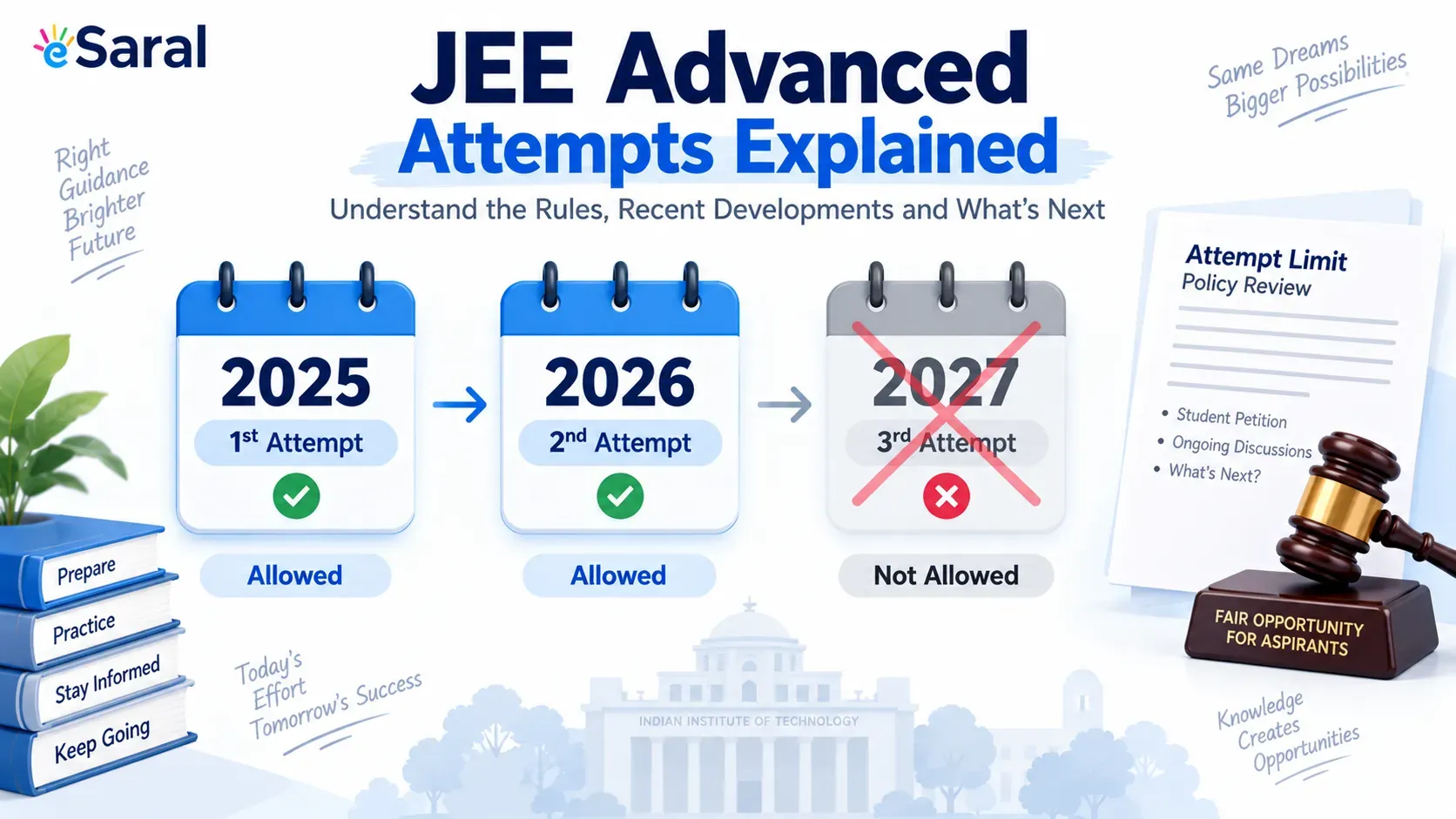
JEE Advanced Attempts: Can You Give It a Third Time? Rules Explained
JEE Advanced attempts: current rule is 2 consecutive years only: full eligibility criteria, the 2025 third-attempt controversy, and the latest 2026 petition news.

Best JEE Preparation App
Best JEE preparation app for Main & Advanced: AI mock tests, live doubt-solving, thousands of practice questions. JEE preparation app for droppers & Class 11-12.
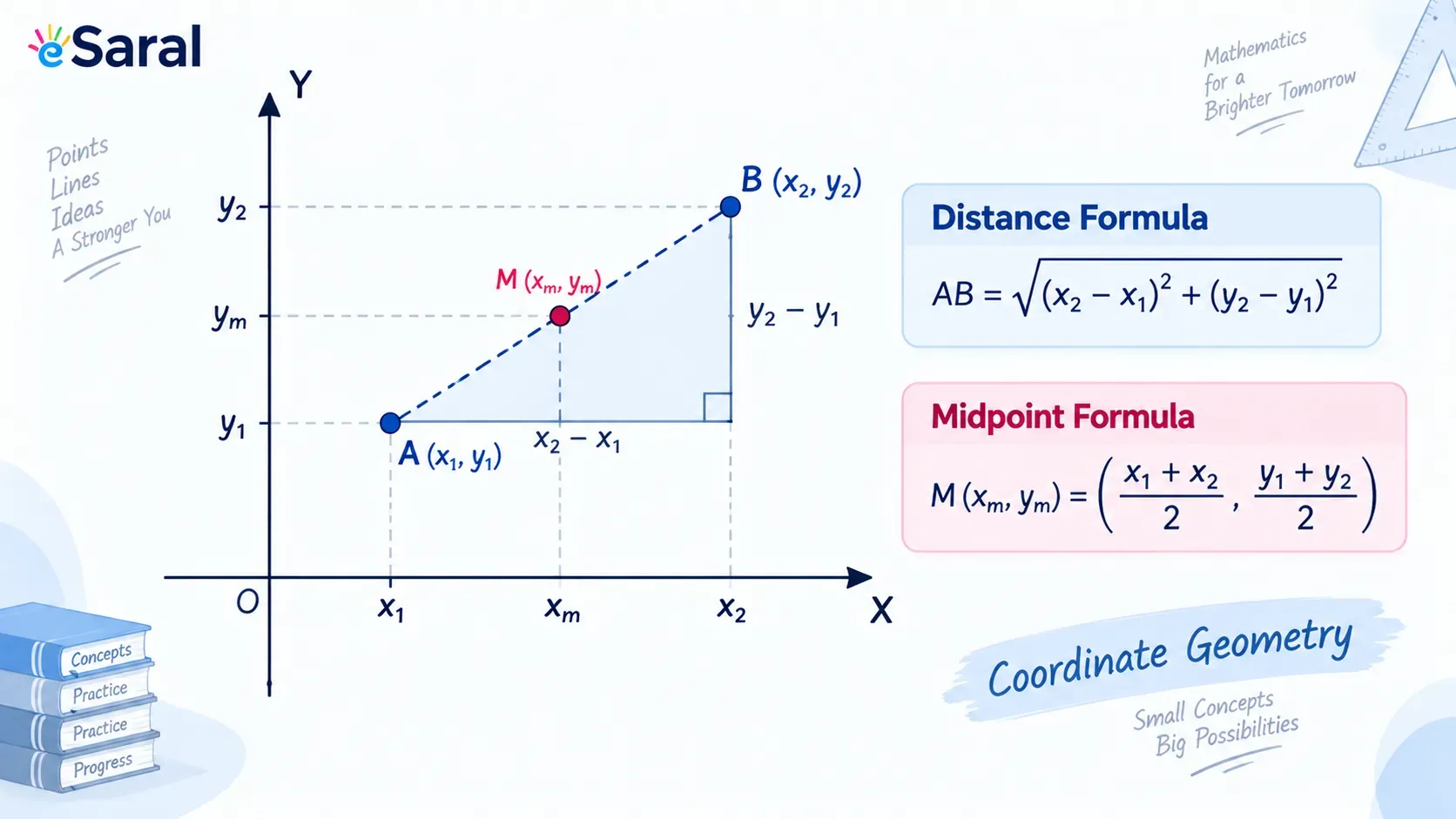
Coordinate Geometry Class 10: Formulas, Notes & Solved Examples
Coordinate geometry class 10: complete CBSE formulas — distance, section, midpoint and area of triangle — with derivation, notes and solved examples.
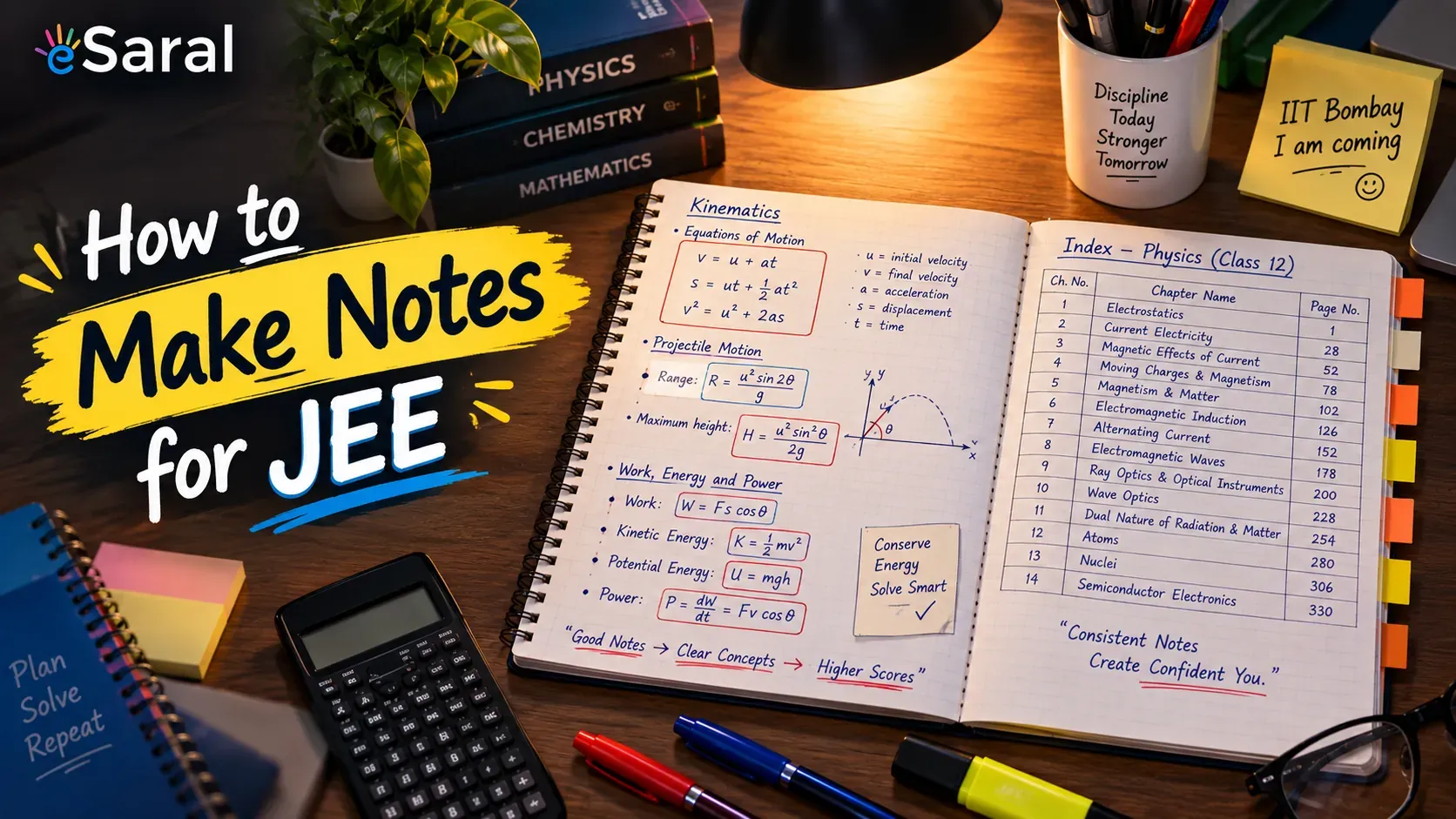
How to make Notes For JEE Smart Notes Strategy of an AIR 41
Learn how to make notes for JEE the way toppers do — indexing, shorthand, and smart short notes for JEE that cut revision time to just 5–7 days.
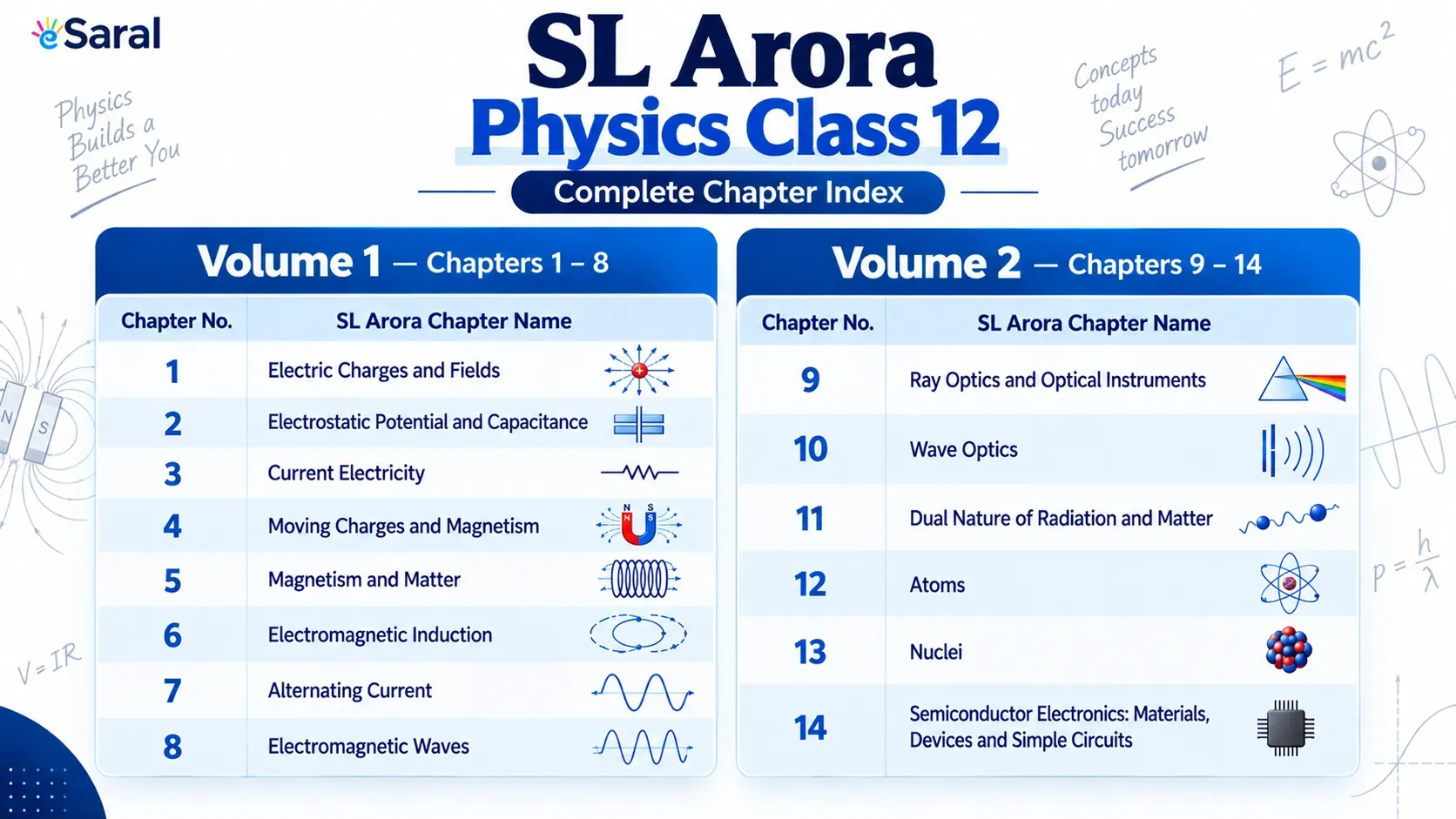
SL Arora Physics Class 12 Index – Chapter List for Volume 1 & 2
SL Arora Physics Class 12 index — complete chapter list for Volume 1 & 2, mapped to NCERT solutions for board, JEE Main, and NEET preparation.