
Mole Concept - JEE Advanced Previous Year Questions with Solutions

eSaral Academic and Editorial Team
Summary
Practice JEE Advanced Mole Concept questions covering atomic mass calculation, molarity, molality, density-based problems, mole fraction, and concentration relationships to strengthen numerical problem-solving skills in physical chemistry.
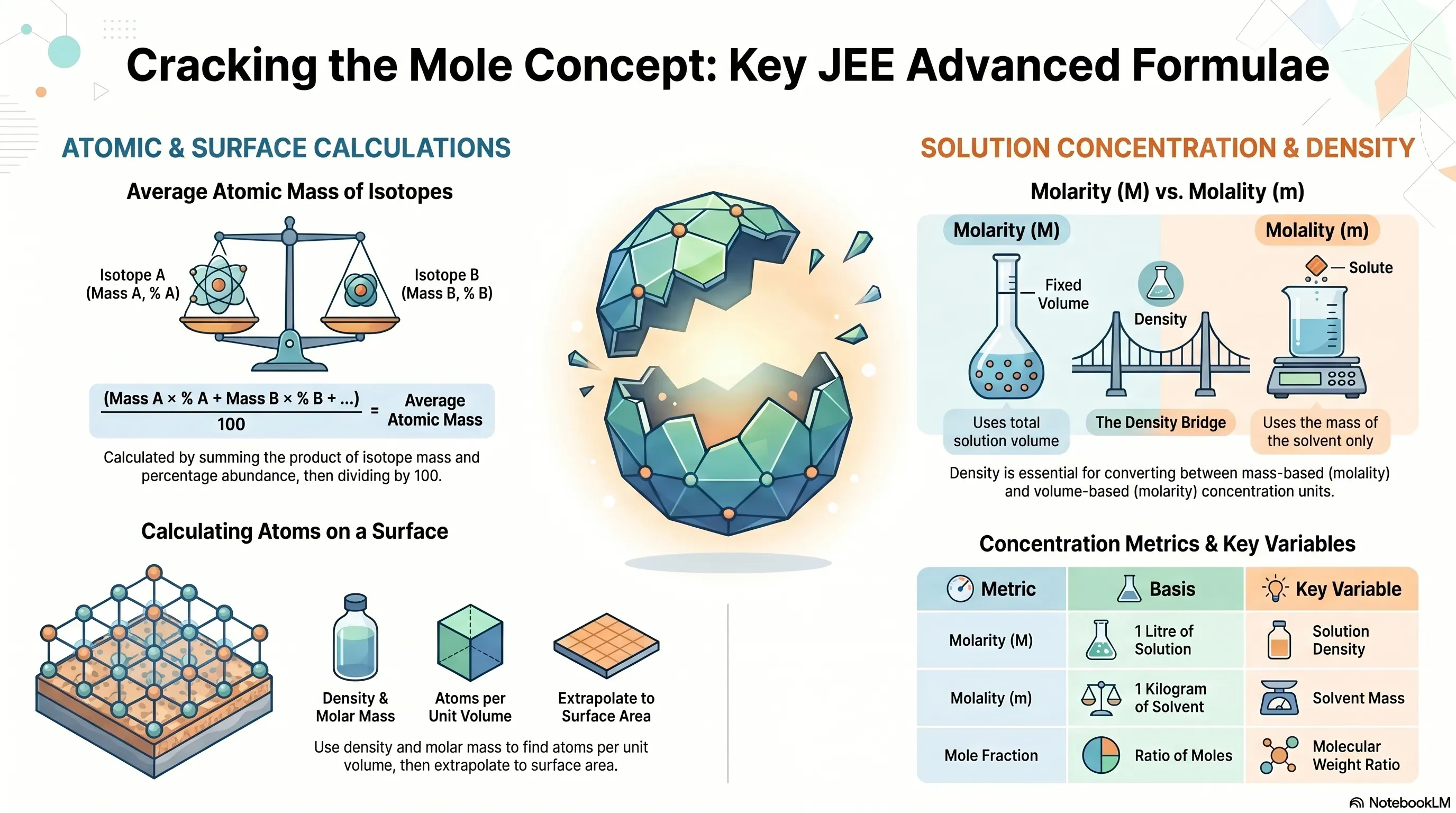
eSaral › JEE › JEE Main ›Mole Concept - JEE Advanced Previous Year Questions with Solutions

🚀 Checkout eSaral Courses
Why Mole Concept Matters in JEE Advanced
The mole concept is the foundation of physical chemistry. In JEE Advanced, it appears both as a standalone topic and as the entry point for questions on solutions, electrochemistry, and chemical equilibrium. According to the NTA's official JEE Advanced syllabi, mole concept falls under Physical Chemistry – Basic Concepts, a section that has contributed 1–3 questions in nearly every JEE Advanced paper since 2009.
What makes these questions tricky is not the formula — it is the unit conversion. Students who can mechanically apply the molarity formula still lose marks because they miss a density conversion from g/cm³ to kg/L, or confuse volume of solution with volume of solvent.
Mole Concept - JEE Advanced Previous Year Questions with Solutions
JEE Advanced Previous Year Questions of Chemistry with Solutions are available at eSaral. Practicing JEE Advanced Previous Year Papers Questions of Chemistry will help the JEE aspirants in realizing the question pattern as well as help in analyzing weak & strong areas. [esquestion] Given that the abundances of isotopes $^{54} \mathrm{Fe},^{56}$ Fe and $^{57}$ Fe are $5 \%, 90 \%$ and $5 \%$, respectively, the atomic mass of Fe is : (A) 55.85 (B) 55.95 (C) 55.75 (D) 56.05 #tag# [JEE 2009] #sol# (B) $\mathrm{M}_{\mathrm{AVg}}=\frac{\mathrm{M}_{1} \mathrm{X}_{1}+\mathrm{M}_{2} \times \mathrm{X}_{2}+\mathrm{M}_{3} \times \mathrm{X}_{3}}{\mathrm{x}_{1}+\mathrm{x}_{2}+\mathrm{x}_{3}}$ $=\frac{5 \times 54+56 \times 90+5 \times 57}{5+90+5}$ = 55.95 [/esquestion] [esquestion] Silver (atomic weight $=108 \mathrm{g} \mathrm{mol}^{-1}$ ) has a density of 10.5 g $\mathrm{cm}^{-3}$. The number of silver atoms on a surface of area $10^{-12} \mathrm{m}^{2}$ can be expressed in scientific notation as y ´ $10^{\mathrm{x}}$. The value of x is - #tag# [JEE 2010] #sol# 7 $\mathrm{d}=\frac{\text { mass }}{\mathrm{V}} \Rightarrow 10.5 \mathrm{g} / \mathrm{cm}^{3}$ means in $1 \mathrm{cm}^{3}=10.5 \mathrm{g}$ of $\mathrm{Ag}$ No of atom of $\mathrm{Ag}$ in $1 \mathrm{cm}^{3}=\frac{10.5}{108} \times \mathrm{N}_{\mathrm{A}}$ in $1 \mathrm{cm}, \mathrm{no}$ of atom of $\mathrm{Ag}=\left(\frac{10.5}{108} \times \mathrm{N}_{\mathrm{A}}\right)^{1 / 3}$ in $10^{-12} \mathrm{m}^{2}$ or $10^{-8} \mathrm{cm}^{2},$ No of atom of $\mathrm{Ag}$ $=\left(\frac{10.5 \mathrm{N}_{\mathrm{A}}}{108}\right)^{2 / 3} \times 10^{-8}=\left(\frac{1.05 \times 6.022 \times 10^{23}}{108}\right)^{2 / 3} \times 10^{-8}$ $=1.5 \times 10^{7}$ Hence $\mathrm{x}=7$ [/esquestion] [esquestion] Dissolving 120 g of urea (mol. wt. 60) in 1000 g of water gave a solution of density 1.15 g/mL. The molarity of the solution is (A) 1.78 M (B) 2.00 M (C) 2.05 M (D) 2.22 M #tag# [JEE 2011] #sol# (C) Vol of Solution $=\frac{\text { mass }}{\text { density }}$ $=\frac{1000+120}{1.15} \mathrm{mL}$ $=\frac{1120}{1.15} \mathrm{ml}$ Molarity $=\frac{120 / 60}{\frac{1120}{1.15}} \times 1000=2.05 \mathrm{M}$ [/esquestion] [esquestion] A compound $\mathrm{H}_{2} \mathrm{X}$ with molar weight of 80 g is dissolved in a solvent having density of 0.4 g /ml, Assuming no change in volume upon dissolution, the molality of a 3.2 molar solution is. #tag# [JEE 2014] #sol# 8 $\mathrm{V}_{\text {solvent }}=\mathrm{V}_{\text {solution }}$ 3.2 mol present in 1L solution (solvent) 3.2 mol / solvent $1000 \times 0.4=400 \mathrm{gm}$ $=.4 \mathrm{Kg}$ Molality $=\frac{3.2}{0.4}=8 \mathrm{m}$ [/esquestion] [esquestion] The mole fraction of a solute in a solution is 0.1. At 298 K, molarity of this solution is the same as its molality. Density of this solution at 298 K is 2.0 g $\mathrm{cm}^{-3}$. The ratio of the molecular weights of the solute and solvent, $\left(\frac{\mathrm{MW}_{\text {solute }}}{\mathrm{MW}_{\text {solikent }}}\right)$, is #tag# [JEE - ADV. 2016] #sol# 9 1 mole solution has 0.1 mole solute and 0.9 mole solvent Let $\mathrm{M}_{1}=$ Molar mass solute $\mathrm{M}_{2}=$ Molar mass solvent [/esquestion]
After practising Mole Concept - JEE Advanced PYQs (Chemistry), explore complete papers through the JEE Advanced PYQ collection.
Frequently Asked Questions
How many questions come from the mole concept in JEE Advanced?
Typically 1–2 questions appear from mole concept in JEE Advanced each year, usually in Paper 1. They are often integer-type or single-correct MCQs. While the weightage is not the highest, these questions are considered scoring because the formulas are fixed and errors are avoidable with careful unit management.
Is mole concept important for JEE Advanced or only JEE Main?
Mole concept is tested in both JEE Main and JEE Advanced. In JEE Advanced, the questions are more application-based — for example, combining density, Avogadro's number, and surface area in a single problem (as seen in the 2010 silver atoms question). It also acts as a prerequisite for electrochemistry and solution chemistry at the JEE Advanced level.
What is the fastest way to calculate average atomic mass in JEE?
Use the weighted average formula directly: M_avg = Σ(mass of isotope × abundance%) ÷ 100. Do not divide by the number of isotopes. For the 2009 Fe question, this gives (54×5 + 56×90 + 57×5) ÷ 100 = 55.95. This formula works for any number of isotopes and takes under 30 seconds with practice.
What is the difference between molarity and molality in JEE problems?
Molarity (M) = moles of solute per litre of solution — it changes with temperature because volume changes. Molality (m) = moles of solute per kilogram of solvent — it is temperature-independent. In JEE Advanced 2016, the question exploited the condition where M = m at a specific density and mole fraction to find a molecular weight ratio.
Are there mole concept questions in JEE Advanced after 2016?
Yes. While this page currently covers 2009–2016, mole concept continues to appear post-2016, often embedded within thermochemistry, solutions, or electrochemistry questions rather than as a standalone topic. Checking the full JEE Advanced question papers year-wise on eSaral will give you the most current coverage.
Team eSaral
eSaral Academic and Editorial Team
Team eSaral is the collective author profile for educational content created by eSaral’s teachers and academic contributors. The team draws on expertise from IIT graduates, doctors, experienced educators and subject specialists to develop resources for JEE, NEET and school students. Our articles aim to explain concepts clearly and help students study with confidence.
Related Posts

Plant Cell Diagram: Labelled Structure, Parts and Functions
Simple, labelled plant cell diagram with parts and functions. Covers plant cell structure for Class 6, 7, 8, 9, 10 and 11 students, CBSE-aligned.

Saransh Gupta Sir's Visit to IIT Patna: Hostel Life, Placements & Lessons for JEE Aspirants
Inside Saransh Gupta Sir's IIT Patna visit — hostel life, the library, placements, internships, and real advice for JEE aspirants from students living the IIT dream.
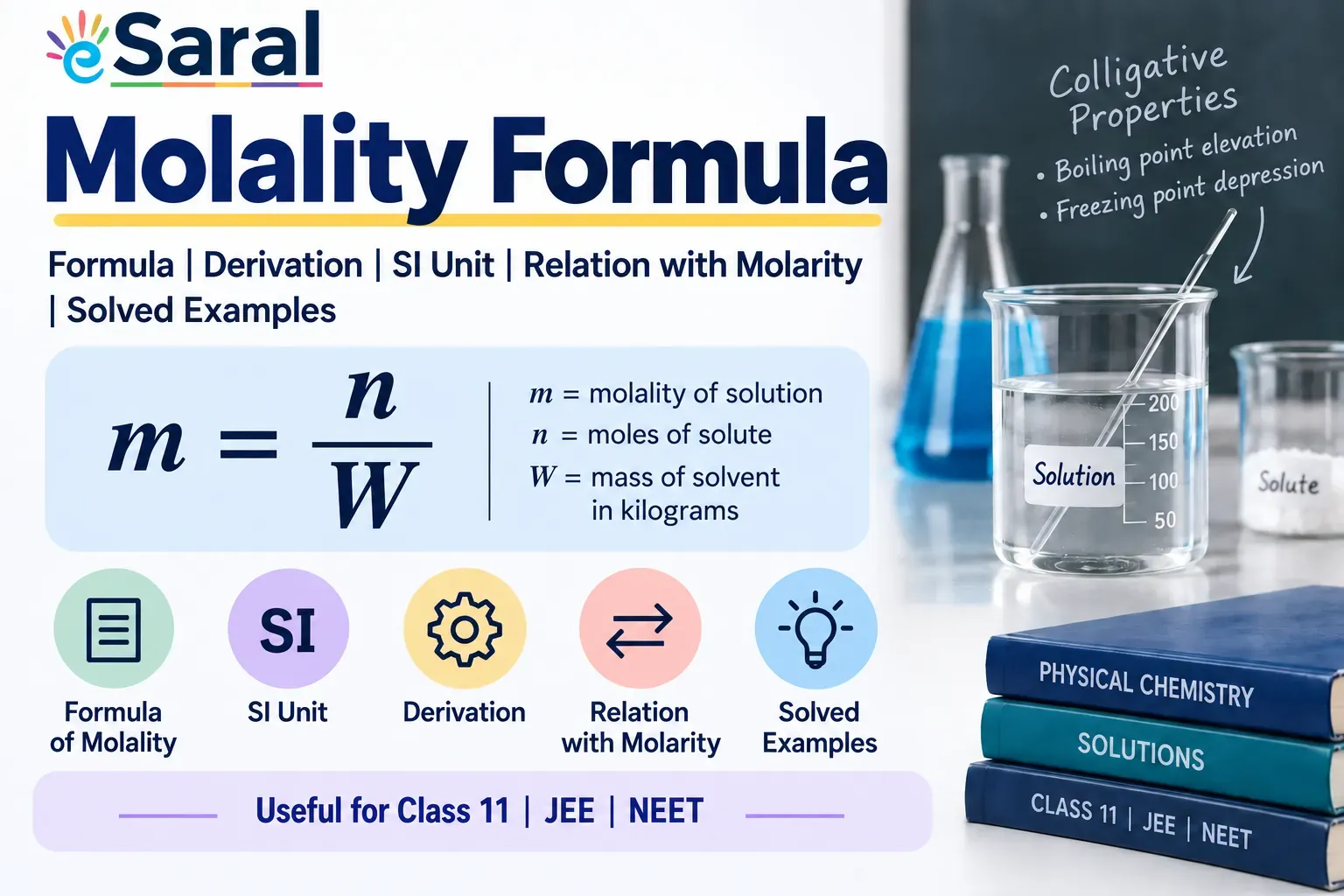
Molality Formula: Formula for Molality, Derivation & Solved Examples
Molality formula is $m = \dfrac{n}{W}$. Learn the formula of molality, its SI unit, derivation, relation with molarity, and solved examples for Class 11, JEE and NEET.
BITSAT Previous Year Question Paper PDF
Download BITSAT previous year question papers PDF. Get year-wise BITSAT PYQs, memory-based papers, exam pattern, and preparation tips to improve your BITSAT preparation.

Teachers’ Day 2026 at eSaral Gurukul: Celebrating the Bond Between Students, Teachers & Mentors
See how Teachers’ Day 2026 was celebrated at eSaral Gurukul, reflecting the bond among students, teachers, and mentors, and the role of guidance beyond academics.

JEE Advanced Attempts: Can You Give It a Third Time? Rules Explained
JEE Advanced attempts: current rule is 2 consecutive years only: full eligibility criteria, the 2025 third-attempt controversy, and the latest 2026 petition news.

Best JEE Preparation App
Best JEE preparation app for Main & Advanced: AI mock tests, live doubt-solving, thousands of practice questions. JEE preparation app for droppers & Class 11-12.
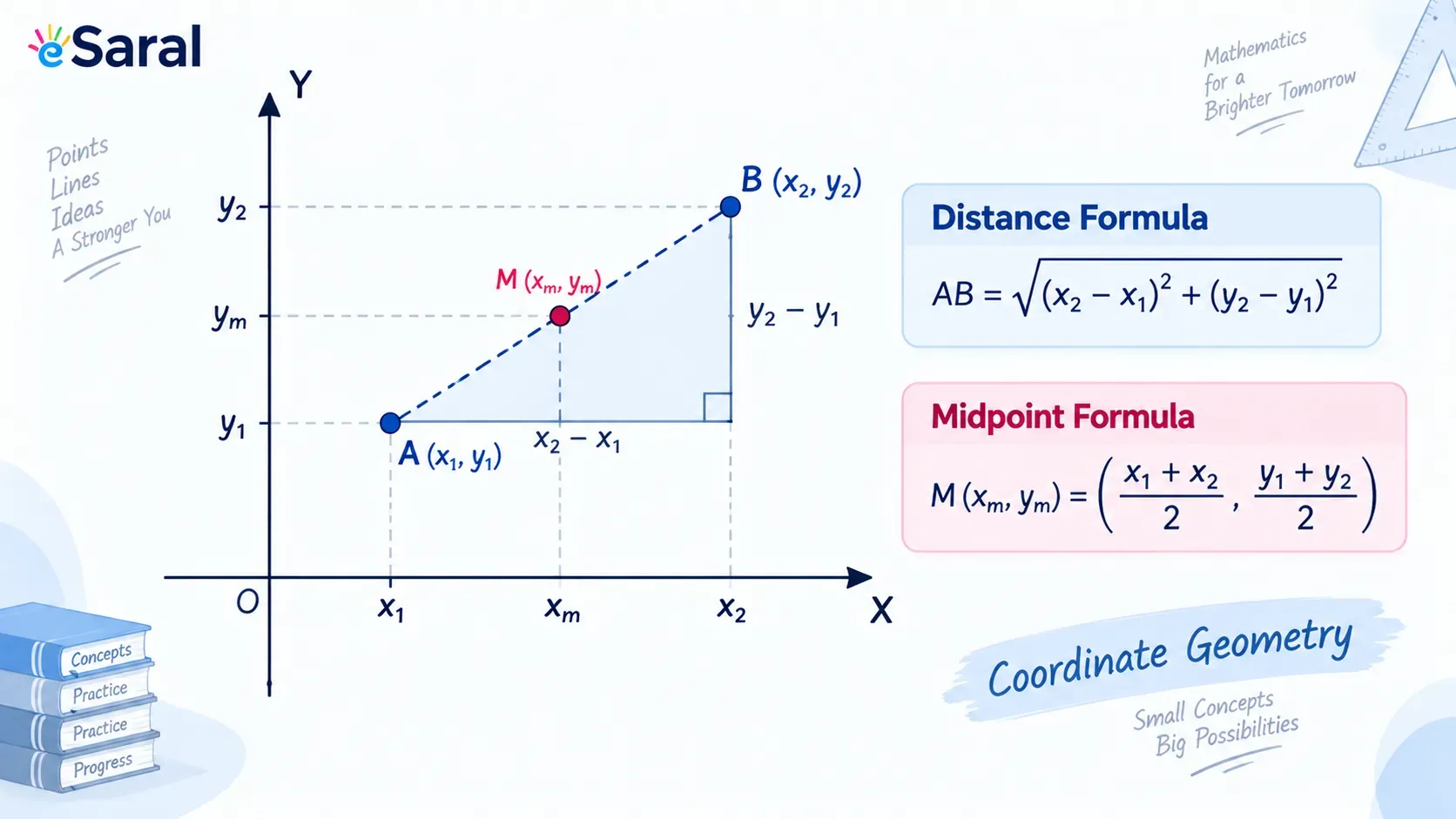
Coordinate Geometry Class 10: Formulas, Notes & Solved Examples
Coordinate geometry class 10: complete CBSE formulas — distance, section, midpoint and area of triangle — with derivation, notes and solved examples.
How to make Notes For JEE Smart Notes Strategy of an AIR 41
Learn how to make notes for JEE the way toppers do — indexing, shorthand, and smart short notes for JEE that cut revision time to just 5–7 days.
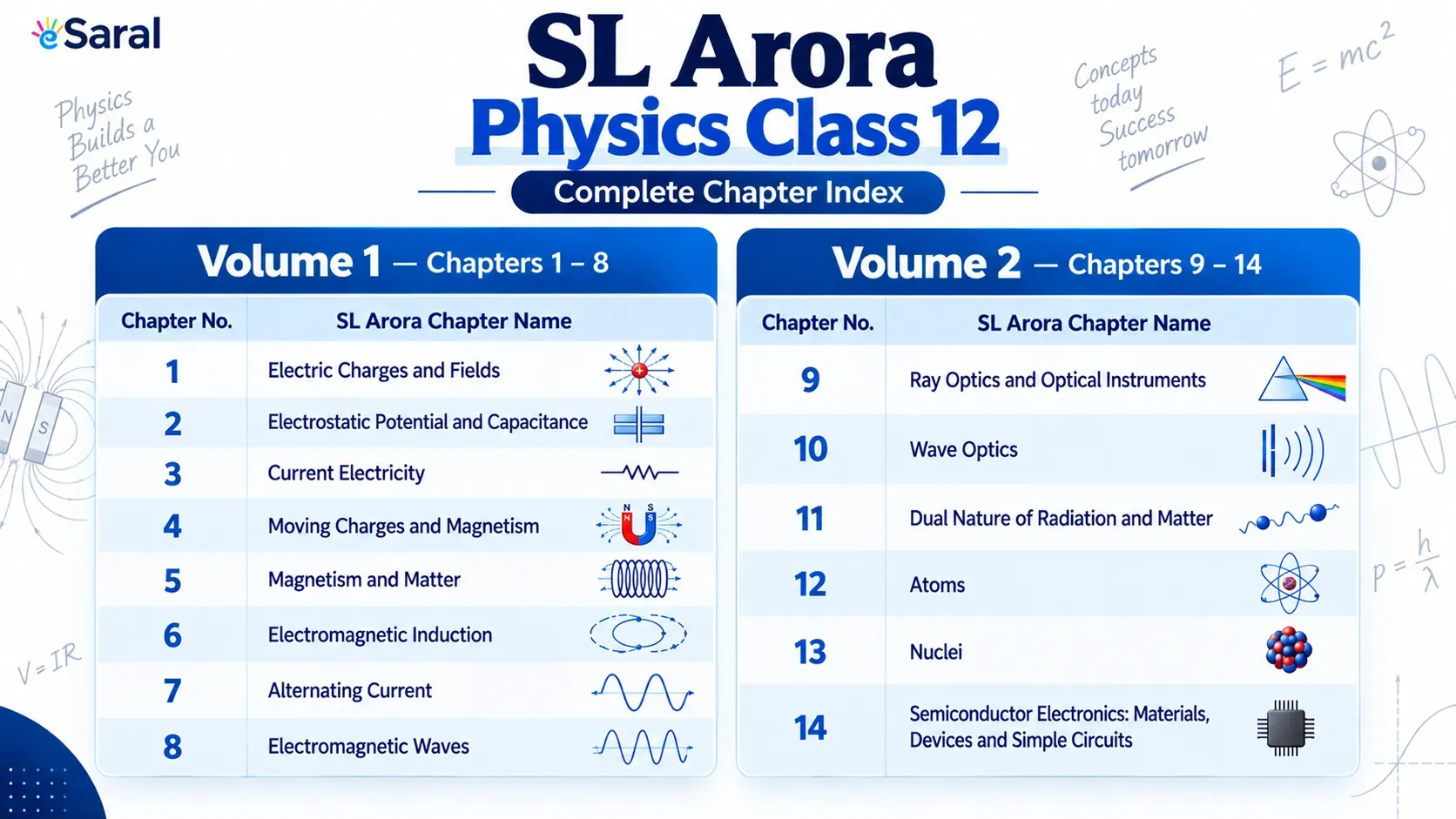
SL Arora Physics Class 12 Index – Chapter List for Volume 1 & 2
SL Arora Physics Class 12 index — complete chapter list for Volume 1 & 2, mapped to NCERT solutions for board, JEE Main, and NEET preparation.