
NCERT Class 9 Physics book PDF- Free PDF Download - eSaral

eSaral Academic and Editorial Team
Summary
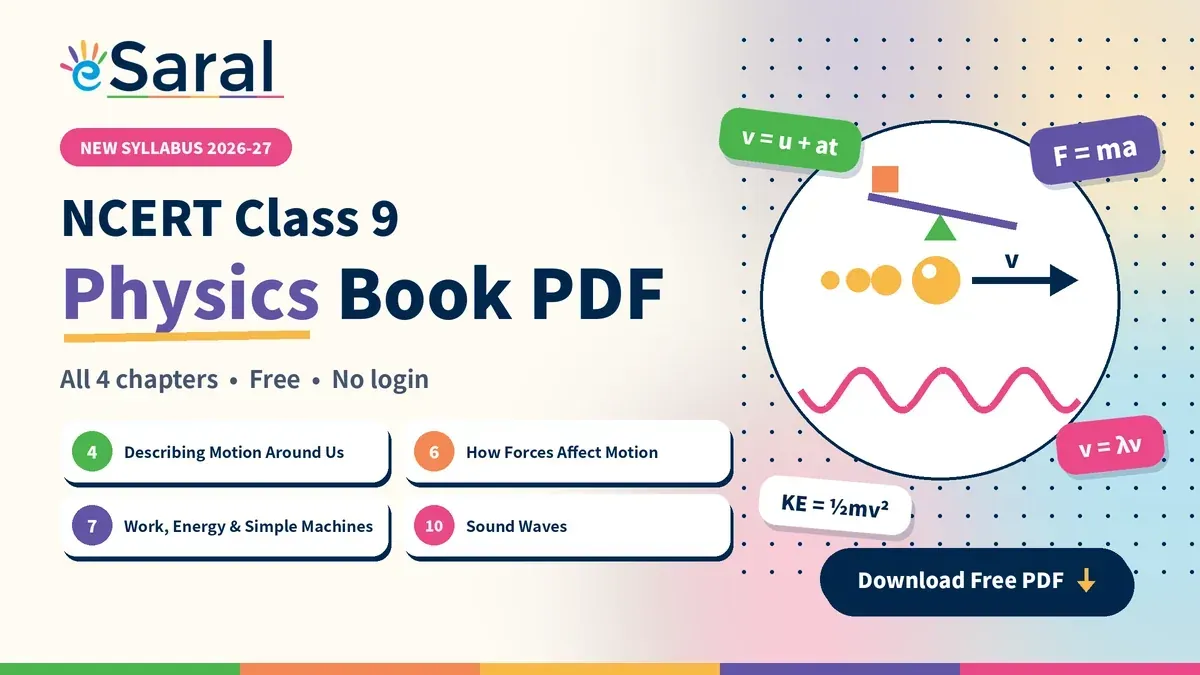
The NCERT Class 9 Physics book PDF is not a separate book. The Physics chapters are part of the new NCERT Class 9 Science textbook Exploration (2026-27), which has 4 Physics chapters: Describing Motion Around Us (Ch 4), How Forces Affect Motion (Ch 6), Work, Energy, and Simple Machines (Ch 7) and Sound Waves: Characteristics and Applications (Ch 10). Download each chapter of the NCERT Class 9 Physics book PDF free below.
What Is the NCERT Class 9 Physics Book?
NCERT does not publish a standalone Class 9 Physics book. Physics, Chemistry and Biology are combined in one Science textbook, Exploration, which has 13 chapters in the 2026-27 edition. The NCERT Class 9 Physics book PDF is the set of four Physics chapters from that book.
These chapters cover motion, forces and Newton's laws, work and energy, and sound. To download the full textbook, see the NCERT Class 9 Science book PDF. The other subject portions are on the Class 9 Chemistry NCERT book and Class 9 Biology NCERT book pages.
NCERT Class 9 Physics Book PDF – Chapter-wise Download (2026-27)
The NCERT Class 9 Physics book PDF has 4 chapters. Click Download PDF to open any chapter. No login is needed.
Chapter No. | Physics Chapter (New Syllabus) | Download |
|---|---|---|
Chapter 4 | Describing Motion Around Us | |
Chapter 6 | How Forces Affect Motion | |
Chapter 7 | Work, Energy, and Simple Machines | |
Chapter 10 | Sound Waves: Characteristics and Applications |
Why are the chapters numbered 4, 6, 7 and 10? Chapter numbers in the NCERT Class 9 Physics book PDF follow the full Exploration textbook, where Physics chapters sit between Chemistry and Biology chapters.
Class 9 Physics Syllabus: Old vs New Chapters
The 2026-27 NCERT Class 9 Physics book PDF has 4 chapters instead of the earlier 5.
Old Chapter (up to 2025-26) | New Chapter (2026-27) |
|---|---|
Motion | Ch 4 – Describing Motion Around Us |
Force and Laws of Motion | Ch 6 – How Forces Affect Motion |
Work and Energy | Ch 7 – Work, Energy, and Simple Machines (now adds power and simple machines) |
Sound | Ch 10 – Sound Waves: Characteristics and Applications |
Gravitation | No longer a separate chapter; weight (W = mg) is covered in Ch 6 |
If your guidebook still lists the old Class 9 Physics chapters, such as Gravitation, it follows the old syllabus. Check the latest CBSE Class 9 syllabus for marks distribution.
What Each Chapter of the NCERT Class 9 Physics Book PDF Covers
Chapter 4 — Describing Motion Around Us
This chapter explains how to describe motion using position, distance and displacement, speed and velocity, and acceleration. Students learn to read position-time and velocity-time graphs, derive the three equations of motion for constant acceleration, and understand why uniform circular motion is accelerated even at constant speed.
Key concepts and formulae: Distance vs displacement, speed vs velocity, acceleration, position-time and velocity-time graphs, v = u + at, s = ut + ½at², v² = u² + 2as, uniform circular motion.
Motion returns in Class 11 as kinematics — continue later with eSaral's motion in a straight line notes.
Chapter 6 — How Forces Affect Motion
This chapter explains what a force is, how balanced and unbalanced forces affect motion, and the role of friction. It covers Newton's three laws of motion, momentum, the relation between force and rate of change of momentum, and weight (W = mg).
Key concepts and formulae: Balanced and unbalanced forces, friction, inertia, Newton's first, second and third laws, F = ma, momentum p = mv, weight W = mg.
This is the base for Laws of Motion in Class 11.
Chapter 7 — Work, Energy, and Simple Machines
This chapter defines work in science, links it to energy through the work-energy theorem, and covers kinetic and potential energy. Students learn the conservation of mechanical energy, power, and how simple machines such as levers, pulleys and inclined planes reduce effort without reducing total work.
Key concepts and formulae: W = F × s, kinetic energy ½mv², potential energy mgh, conservation of mechanical energy, power P = W/t, mechanical advantage = load ÷ effort.
Take it further with Work, Energy and Power Class 11 notes.
Chapter 10 — Sound Waves: Characteristics and Applications
This chapter explains sound as a longitudinal wave that needs a medium, travelling as compressions and rarefactions. It covers wavelength, frequency, time period and amplitude, the relation v = λν, how pitch and loudness depend on frequency and amplitude, the speed of sound in different media, echo and reverberation, and uses of ultrasound such as SONAR and medical imaging.
Key concepts and formulae: Longitudinal waves, compression and rarefaction, wavelength, frequency, T = 1/ν, v = λν, pitch, loudness, audible range (20 Hz–20 kHz), echo, reverberation, ultrasound, SONAR.
Waves are studied in depth in Class 11 — see Waves Class 11 notes.
How to Download the NCERT Class 9 Physics Book PDF
- Go to the chapter-wise table above.
- Click Download PDF next to the chapter you need. It opens in your browser.
- Use the browser's download button to save it for offline study.
You can also get the NCERT Class 9 Physics book PDF from the official NCERT textbooks portal by choosing Class IX, then Science. Hindi-medium students can use the NCERT Class 9 Physics book in Hindi.
How to Study Class 9 Physics from the NCERT Book
- Read each chapter of the NCERT Class 9 Physics book PDF once without stopping, then go back to the worked examples.
- Keep a one-page formula sheet for the four chapters, with SI units.
- Solve every in-text example yourself before looking at the solution.
- Practise graphs and diagrams. Velocity-time graphs (Ch 4), force diagrams (Ch 6) and wave diagrams (Ch 10) are common exam questions.
- Check your answers with NCERT Solutions for Class 9 Science, then test yourself with the eSaral Class 9 and 10 test series.
💡 Expert Tip by eSaral Physics Faculty Reading alone will not earn marks in Physics; numerical practice will. After each chapter of the NCERT Class 9 Physics book PDF, solve the exercise numericals without help and always write the formula, substitution and unit. Most lost marks come from missing units or skipped steps.
Why Use the NCERT Book for Class 9 Physics?
- It is the CBSE-prescribed textbook, so school exams are set from it.
- Concepts are built from everyday examples before formulae are introduced.
- Worked examples and exercises train step-by-step numerical solving.
- It builds the base for Class 11 Physics, especially kinematics, laws of motion, work-energy and waves, which matter for JEE and NEET later.
How Does Class 9 Physics Connect to JEE Main Preparation?
Every single chapter in Class 9 Physics feeds directly into the JEE Main and JEE Advanced syllabus. This is not a coincidence — the NCERT progression is deliberately designed this way.
Class 9 Chapter | Connects to JEE Topic (Class 11) | JEE Weightage |
|---|---|---|
Ch 4 — Describing Motion Around Us | Kinematics — Motion in a Straight Line, Projectile Motion | Very High |
Ch 6 — How Forces Affect Motion | Laws of Motion — Newton’s Laws, Friction, Circular Motion | Very High |
Ch 7 — Work, Energy and Simple Machines | Work, Energy, and Power — Conservative Forces, Collisions | High |
Ch 10 — Sound Waves: Characteristics and Applications | Waves — Wave Motion, Superposition, Doppler Effect | Medium–High |
Students who master these 5 chapters in Class 9 enter Class 11 with a significant advantage. The equations of motion, Newton's laws, and energy conservation laws introduced in Class 9 NCERT are the same ones used to solve JEE Advanced problems — just at a higher level of complexity.
To watch free learning videos on Class 9 Physics topics by Kota's top IITian Faculties, install the eSaral App.
How to Study NCERT Class 9 Physics Effectively?
Physics requires a different approach than Biology or Chemistry. Concepts must be understood, not memorised. Here is a chapter-by-chapter study strategy:
Step | What to Do | Why It Works |
|---|---|---|
1 | Read the chapter once without stopping | Builds an overall picture before focusing on details |
2 | Write down all formulae on one page | Creates a quick-reference sheet for revision |
3 | Solve all in-text examples without looking at solutions | Tests real understanding, not just reading comprehension |
4 | Attempt all exercise numericals independently | CBSE marks heavily for the correct numerical method and units |
5 | Check answers using Class 9 Science NCERT Solutions | Identifies errors in method before they become habits |
6 | Revise formulae and definitions 2 days before any test | Spaced repetition improves retention significantly |
So, that's all from this article. I hope you found this helpful. If you did, please share it with other students. Also Read:
- Class 9 Science NCERT Solutions
- NCERT Class 9 Solutions for Math
- NCERT Math Class 9 Exemplar
- NCERT Science Class 9 Exemplar
- Download NCERT Book for Class 9
If you have any confusion related to the NCERT Class 9 Physics book PDF, feel free to ask in the comments section below. To watch Free Learning Videos on Physics by Kota's top IITian Faculties, install the eSaral App.
Frequently Asked Questions
How many physics chapters are there in NCERT Class 9 Science 2026-27?
There are 4 Physics chapters: Chapter 4 (Describing Motion Around Us), Chapter 6 (How Forces Affect Motion), Chapter 7 (Work, Energy, and Simple Machines) and Chapter 10 (Sound Waves: Characteristics and Applications).
Can I download the NCERT Class 9 Physics book PDF for free?
Yes. eSaral links all four chapters in the download table on this page, with no login or payment needed. The same PDFs are on the official NCERT website, ncert.nic.in.
Is there a separate NCERT Physics book for Class 9?
No. Physics is part of the integrated Class 9 Science textbook Exploration. A separate Physics textbook starts from Class 11.
Is Gravitation in the new Class 9 Physics syllabus?
No, Gravitation is no longer a separate chapter. Weight (W = mg) is covered in Chapter 6, and universal gravitation is studied in detail in Class 11, where eSaral's Gravitation notes cover it.
Which is the most important chapter in Class 9 Physics?
Chapter 4 (Describing Motion Around Us) and Chapter 6 (How Forces Affect Motion). They have the most numericals and form the base of Class 11 kinematics and laws of motion, which eSaral teachers recommend mastering early.
Is the NCERT Class 9 Physics book enough for school exams?
Yes. School exam questions are based on the NCERT Class 9 Physics book PDF chapters, so reading every chapter, solving all examples and exercises, and practising graphs is enough to score well.
Team eSaral
eSaral Academic and Editorial Team
Team eSaral is the collective author profile for educational content created by eSaral’s teachers and academic contributors. The team draws on expertise from IIT graduates, doctors, experienced educators and subject specialists to develop resources for JEE, NEET and school students. Our articles aim to explain concepts clearly and help students study with confidence.
Related Posts

BITSAT 2027: Registration Date, Exam Date, Syllabus, Eligibility, Pattern & Fees
BITSAT 2027 exam dates, registration timeline, eligibility criteria, exam pattern, marking scheme, syllabus and fees in one page.

BITSAT Previous Year Question Paper PDF (2017-2026)
Download BITSAT previous year question papers PDF from 2017 to 2026,session-wise. Memory-based papers,exam pattern, paper analysis and how to practise

CBSE Class 10 Date Sheet 2027: Expected Exam Dates, Release Date, Admit Card & Result Timeline
CBSE Class 10 date sheet 2027 is awaited. See the expected exam dates, release window, how to download the PDF, admit card and result timelines.

NCERT Physics Class 10 Book PDF in Hindi 2026-27 – भौतिक विज्ञान के 4 अध्याय (Free Download)
NCERT Physics Class 10 book PDF in Hindi 2026-27: download all 4 chapters (अध्याय 9–12) free, with topics and important formulas.

NCERT Biology Class 9 Book Anveshan PDF in Hindi - जीव विज्ञान कक्षा 9 पुस्तक अन्वेषण PDF
Download NCERT Biology Class 9 book PDF in Hindi chapterwise for 2026-27: Cell, Tissues, Reproduction and Diversity. Free PDFs.

Essay On Artificial Intelligence in English (100,150, 200, 250, 300, 500 Words)
This is in contrast to the natural intelligence of humans. With Artificial Intelligence, machines can perform

Essay on 78th India Independence Day in English for Student (100, 150, 200, 250, 300, 500 Words)
Read the best essays on India's Independence Day in English. Short & long essays (100, 150, 200, 250, 300, 500 words) perfect for school exams
NCERT Class 11 English Snapshots book - Free PDF download- Esaral
Download NCERT Class 11 English Snapshots book PDF for free. Get all 8 chapters, chapter-wise. Start your prep today!
NCERT Class 10 biology book pdf - Free PDF Download - eSaral
NCERT Class 10 Biology book PDF 2026-27: all 5 chapters (Life Processes to Our Environment) in English & Hindi, with CBSE syllabus, marks & practical

Essay on Global Warming in English (100,150, 200, 250, 300, 500 Words)
Global warming means the Earth is getting hotter. This happens because of things like pollution from cars and factories.