
Parabola Class 11 Notes & Numericals for IIT JEE

eSaral Academic and Editorial Team
Summary
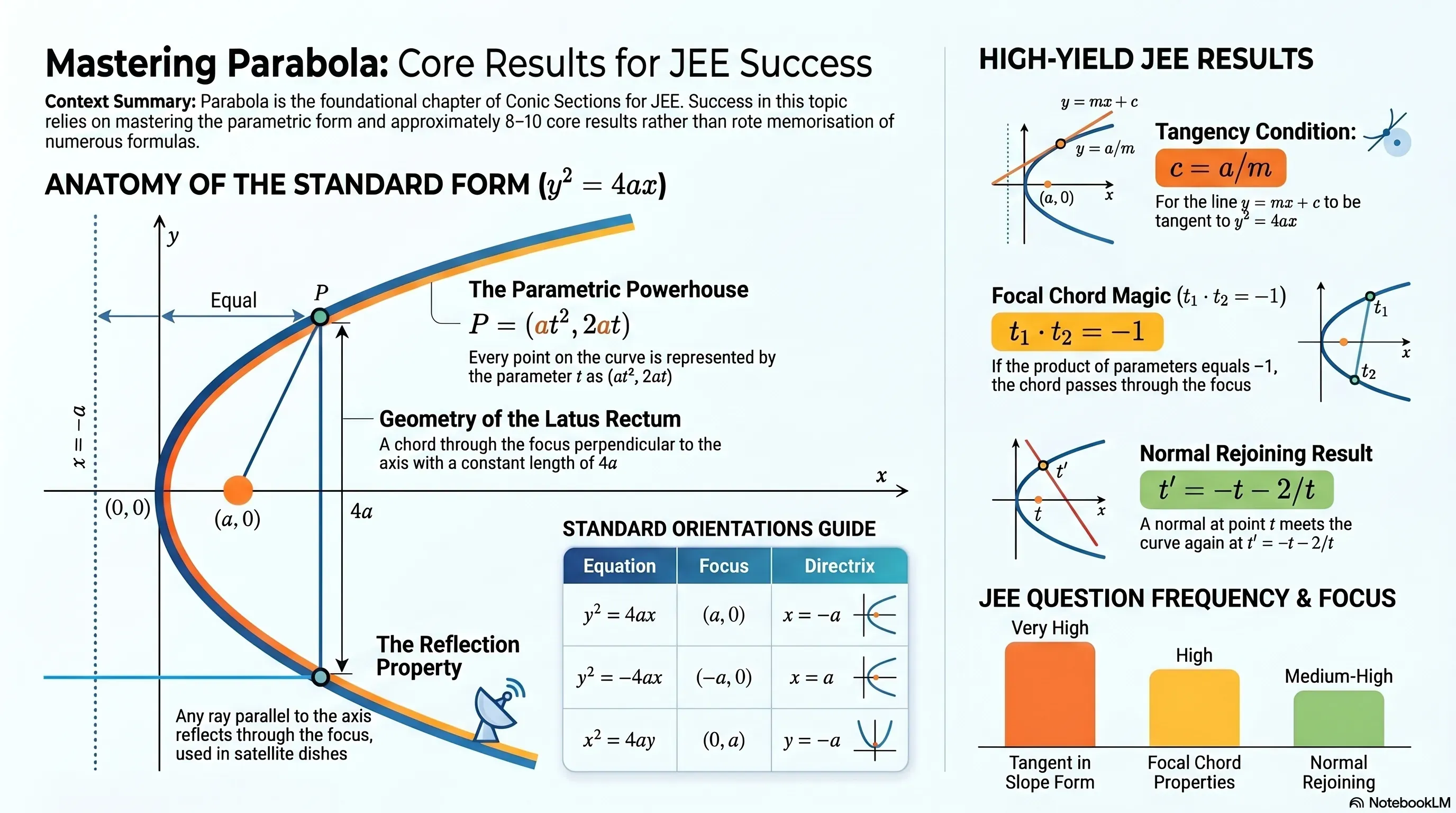
<p><strong>Parabola</strong> is a high-weightage Conic Sections chapter for JEE covering standard equations, tangents, normals, focal chords, and parametric forms, with 1–2 questions appearing regularly in JEE Main and Advanced.</p>
eSaral › JEE › JEE Main ›Parabola Class 11 Notes & Numericals for IIT JEE

🚀 Checkout eSaral Courses
Why Parabola Is a High-Priority Chapter for IIT JEE
Parabola is part of Conic Sections (Class 11, Chapter 11) — one of the most consistently tested chapters in both JEE Main and JEE Advanced. Together with Ellipse and Hyperbola, Conics contributes 2–4 questions every year in JEE Main and at least 1–2 high-difficulty questions in JEE Advanced.
Among the three non-circular conics, the Parabola is the foundation chapter — mastered first because its equation is the simplest and its properties (tangent, normal, focal chord) carry over structurally to Ellipse and Hyperbola. A student who deeply understands Parabola completes Ellipse and Hyperbola in significantly less time.
For JEE Main, Parabola questions typically test: standard equation identification, tangent and normal equations (all three forms), and properties of focal chords. For JEE Advanced, questions test deeper results — combined locus problems, tangent-normal intersections, and multi-concept problems where Parabola interacts with other chapters.
💡 Expert Tip by eSaral Mathematics Faculty, IIT Kota: "Parabola in JEE is not about memorising 50 results — it is about deeply knowing 8–10 core results and being able to derive everything else from them. The students who score full marks from Conics in JEE are not the ones who memorised the most formulas; they are the ones who understood the parametric form (at², 2at) so deeply that they could derive tangent, normal, and chord equations in the exam hall without looking at a formula sheet."
Parabola Class 11 Notes & Numericals
India's Best Exam Preparation for Class 11th - Download Now
India's Best Exam Preparation for Class 11th - Download Now
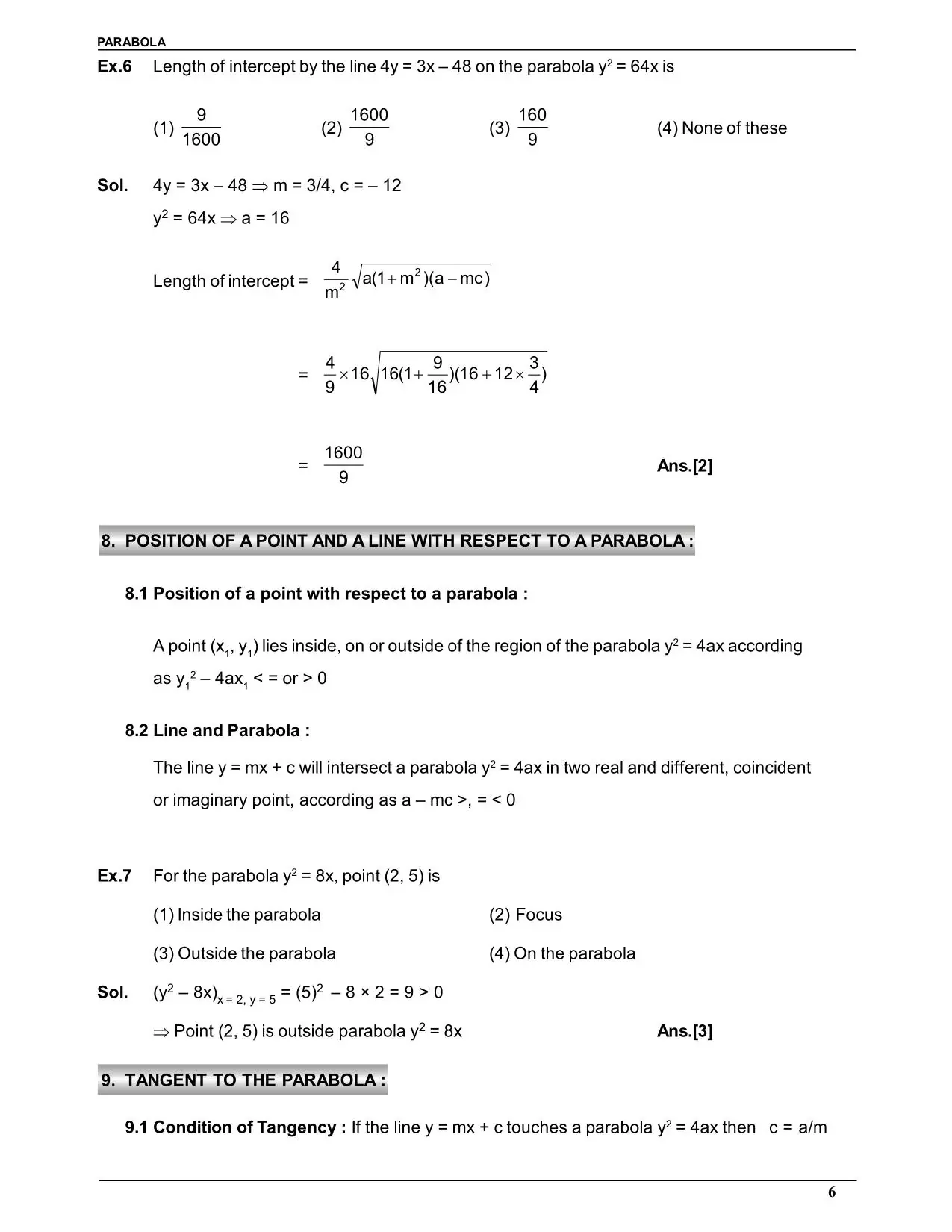
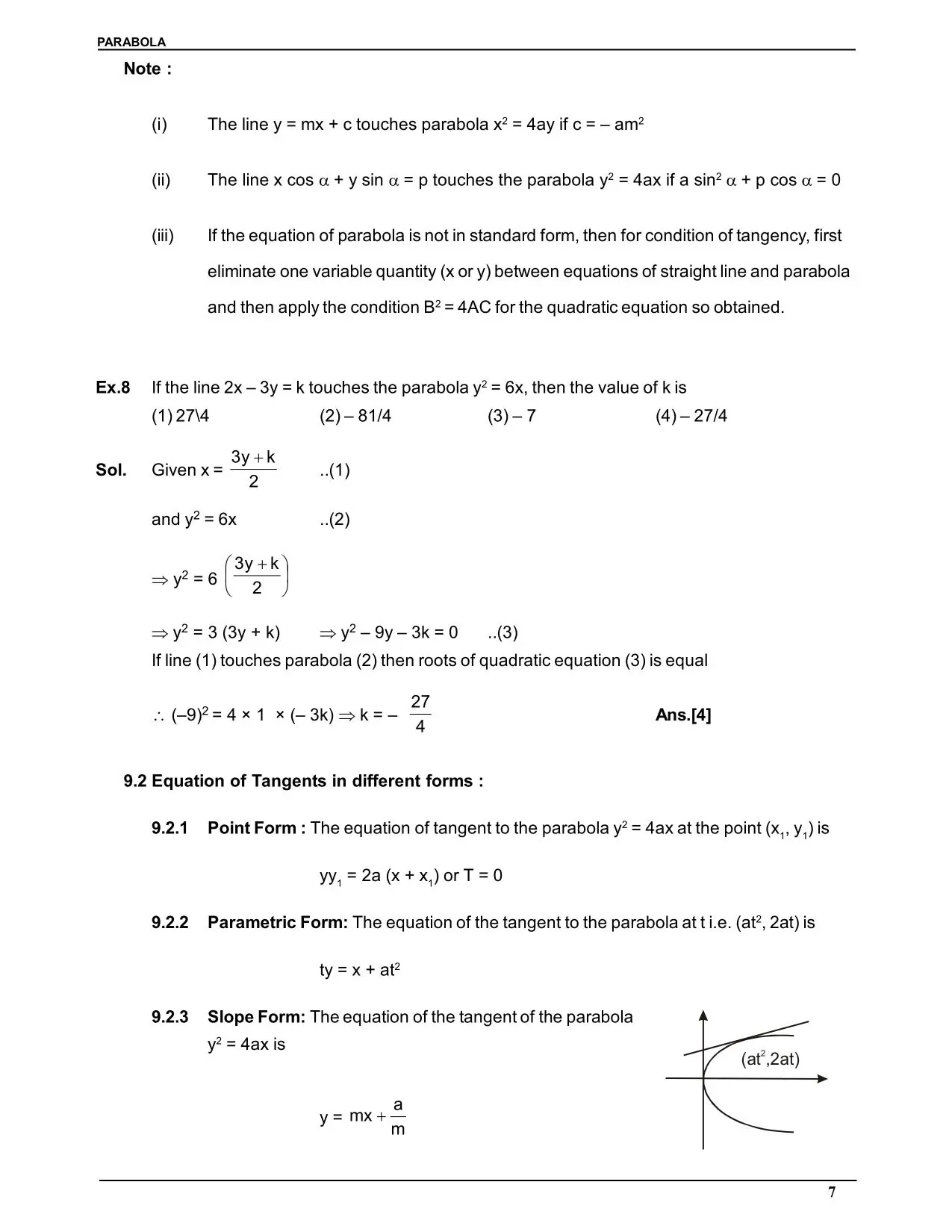
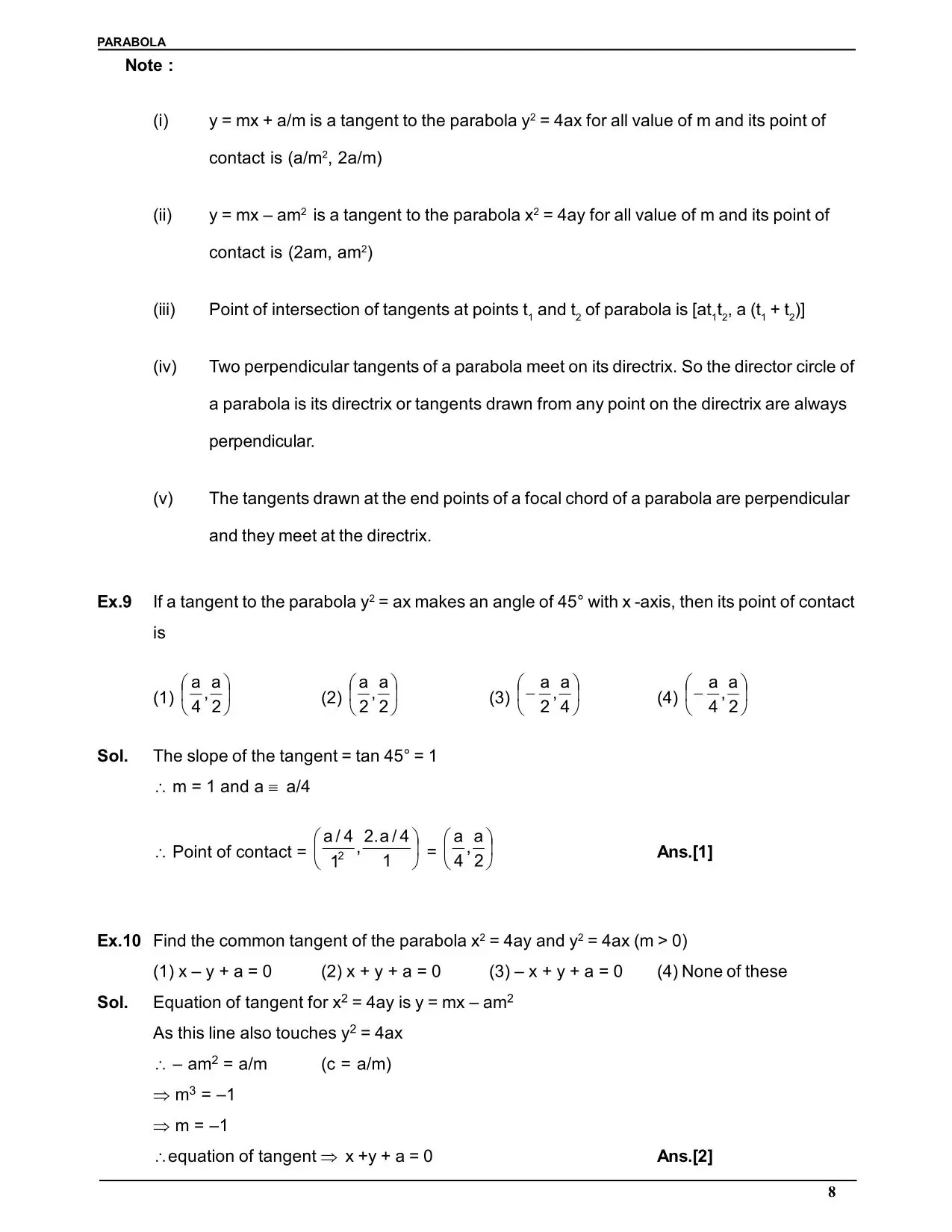
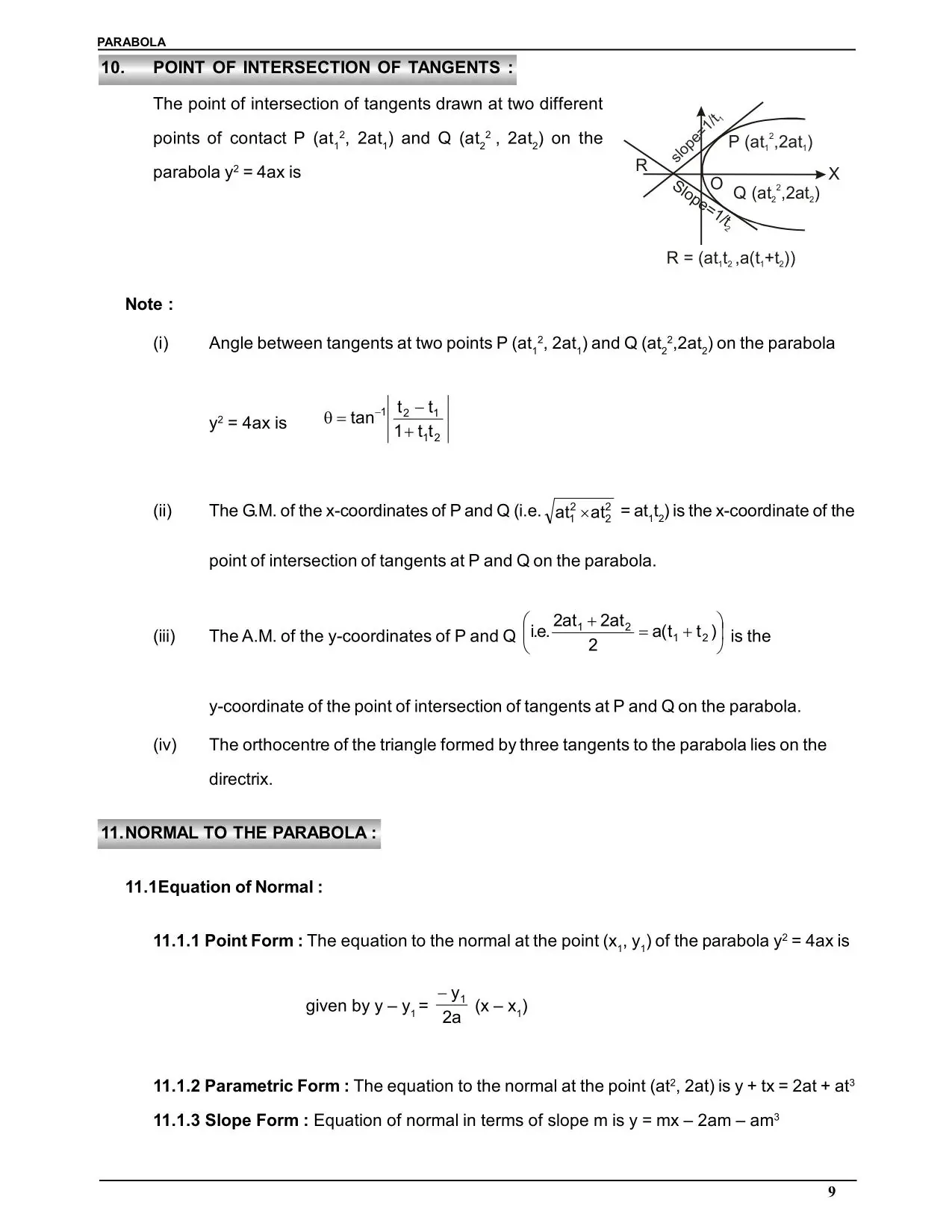
India's Best Exam Preparation for Class 11th - Download Now
India's Best Exam Preparation for Class 11th - Download Now
India's Best Exam Preparation for Class 11th - Download Now
Basic Definitions and Key Terminology
Core Definitions
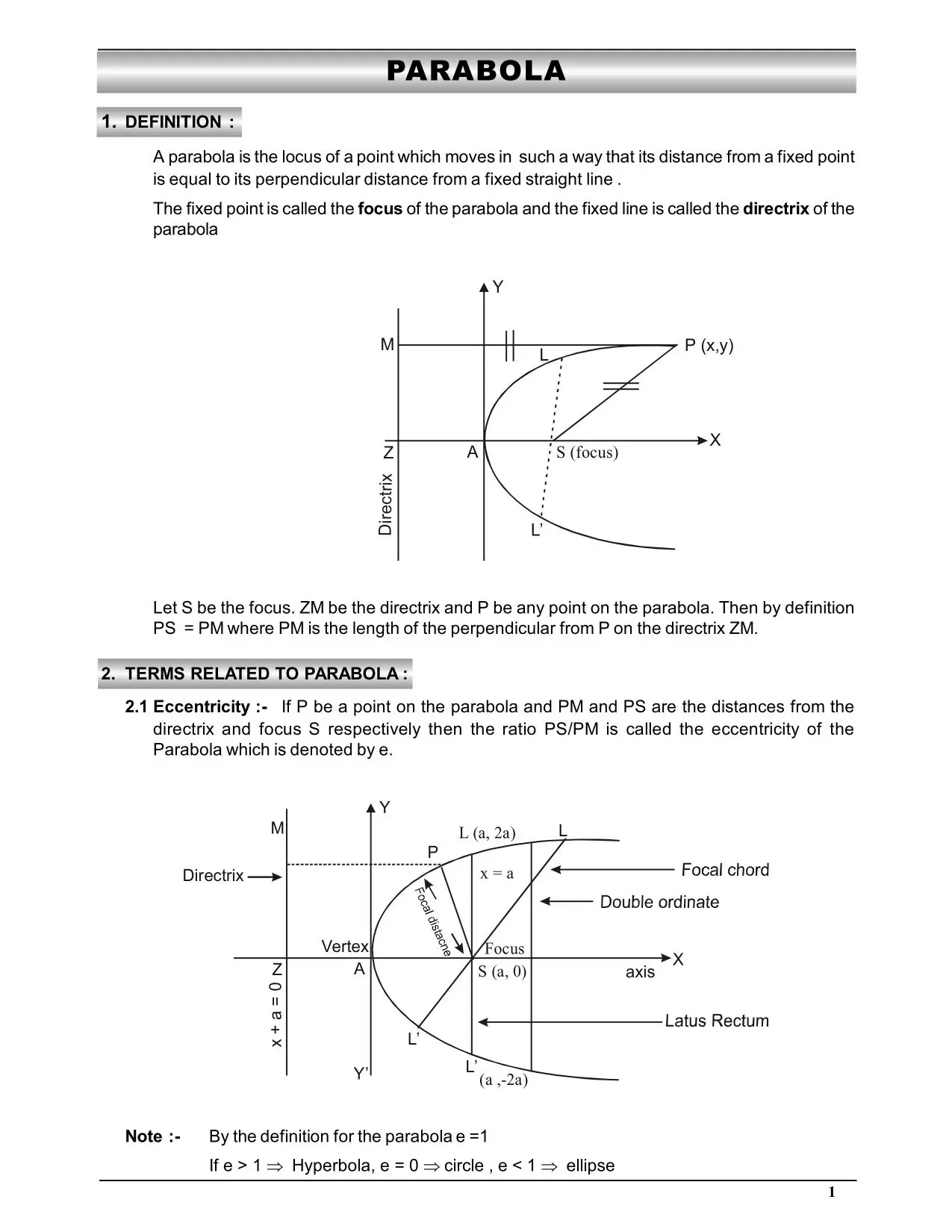
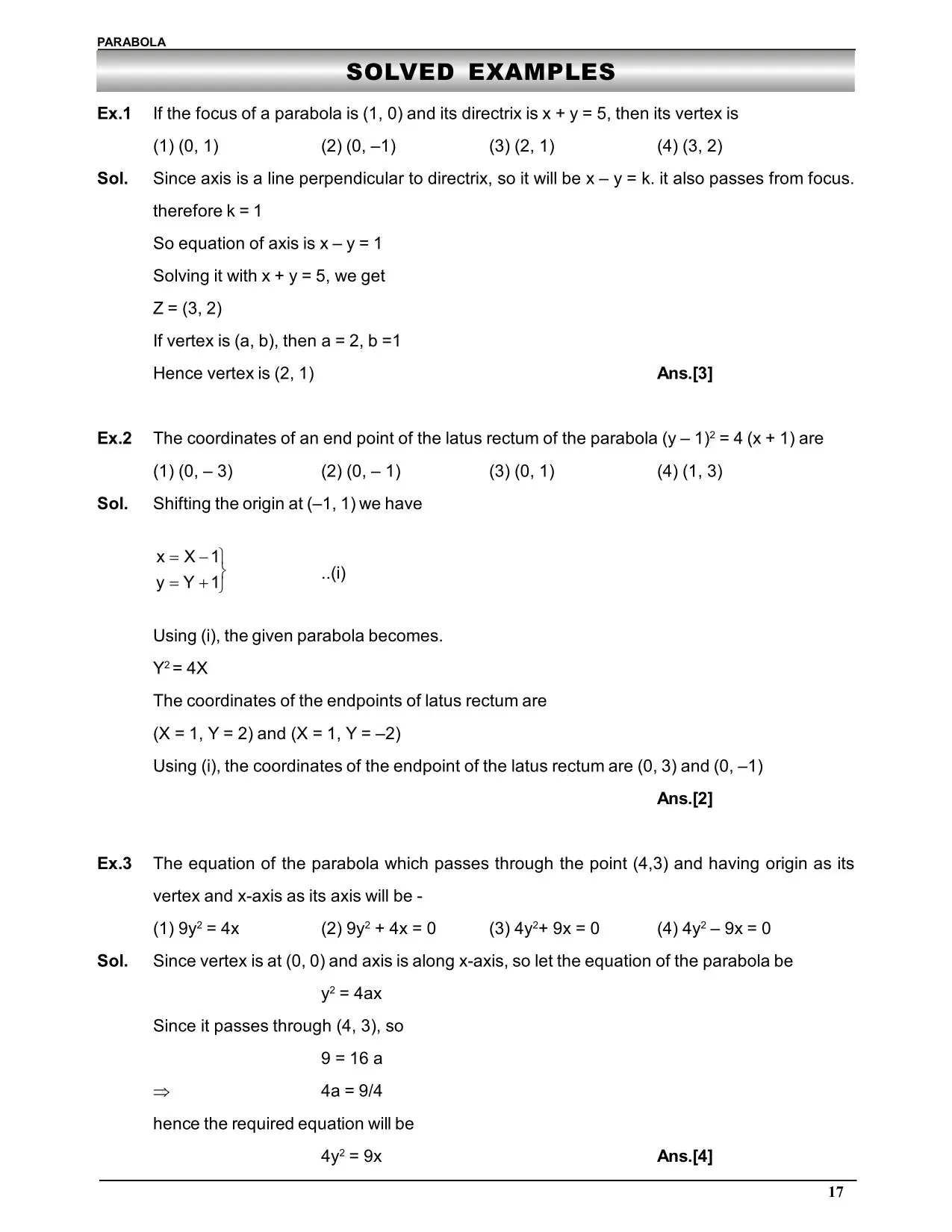
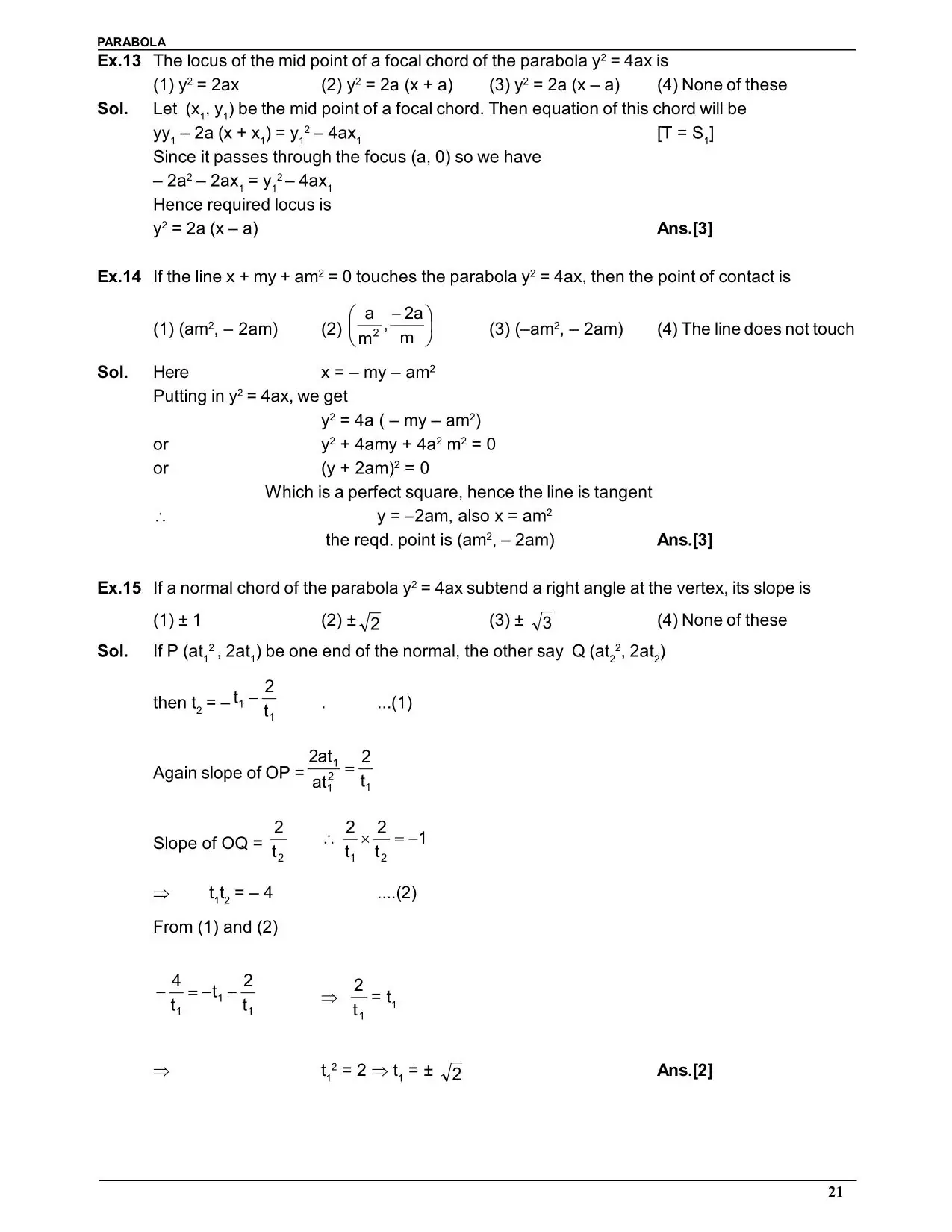
Parabola: The locus of a point P that moves such that its distance from a fixed point (the focus) is always equal to its distance from a fixed line (the directrix).
PS=PM\text{PS} = \text{PM}PS=PM
where S = focus and M = foot of perpendicular from P to the directrix.
Eccentricity: For a parabola, eccentricity e = 1 always. This is the defining property that distinguishes a parabola from an ellipse (e < 1) and a hyperbola (e > 1).
Key Elements of a Parabola
Term | Definition |
|---|---|
Focus (S) | The fixed point; parabola curves around the focus |
Directrix | The fixed line from which distances are measured |
Vertex | The midpoint of the perpendicular from focus to directrix; the "tip" of the parabola |
Axis | The line of symmetry passing through focus and vertex; perpendicular to directrix |
Latus Rectum | The chord through the focus perpendicular to the axis; length = 4a |
Focal Distance | Distance from any point P(x, y) on the parabola to the focus; = x + a (for y² = 4ax) |
Focal Chord | Any chord of the parabola that passes through the focus |
Standard Forms of Parabola — All Four Orientations
Complete Reference Table
Equation | Opens | Focus | Directrix | Vertex | Axis | Latus Rectum |
|---|---|---|---|---|---|---|
y² = 4ax (a > 0) | Right | (a, 0) | x = −a | (0, 0) | x-axis (y = 0) | 4a |
y² = −4ax (a > 0) | Left | (−a, 0) | x = a | (0, 0) | x-axis | 4a |
x² = 4ay (a > 0) | Upward | (0, a) | y = −a | (0, 0) | y-axis (x = 0) | 4a |
x² = −4ay (a > 0) | Downward | (0, −a) | y = a | (0, 0) | y-axis | 4a |
The Most Important Form — y² = 4ax
For the standard parabola y² = 4ax:
- Any point on the parabola can be written as (at², 2at) — the parametric form
- Focal distance of point (x₁, y₁): PS = x₁ + a
- Equation of latus rectum: x = a
- Endpoints of latus rectum: (a, 2a) and (a, −2a)
- Length of latus rectum: 4a
General Second-Degree Conic and Parabola Condition
A second-degree equation ax² + bxy + cy² + dx + ey + f = 0 represents a parabola when:
b2−4ac=0 (discriminant condition)b^2 - 4ac = 0 \text{ (discriminant condition)}b2−4ac=0 (discriminant condition)
Parametric Equations of a Parabola {#parametric}
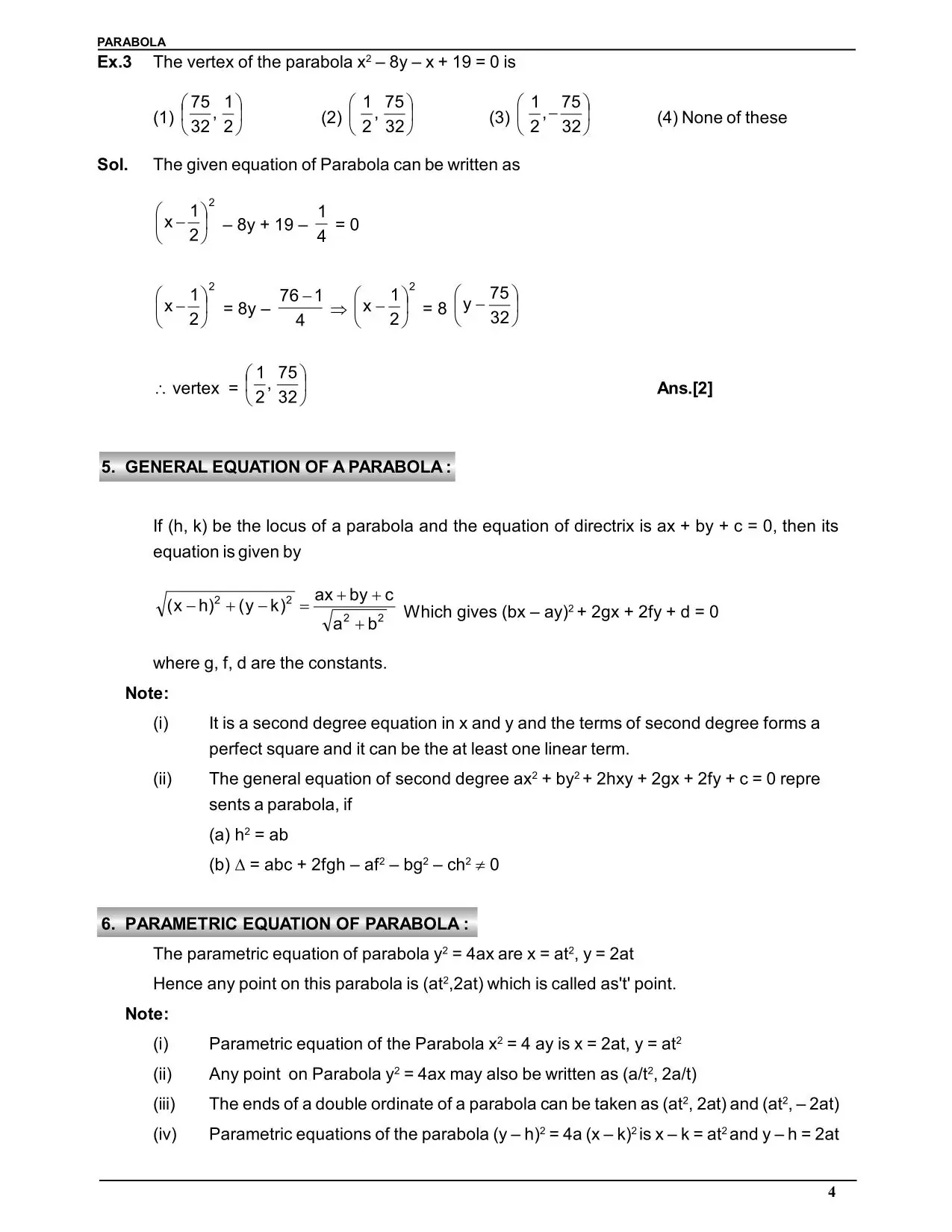
For y² = 4ax, the parametric form is:
x=at2,y=2atx = at^2, \quad y = 2atx=at2,y=2at
where t is the parameter. Any point on the parabola is written as P(t) = (at², 2at).
Why the Parametric Form Is Essential for JEE
The parametric form simplifies every derivation in this chapter:
- Instead of working with (x, y) coordinates separately, one parameter t describes any point
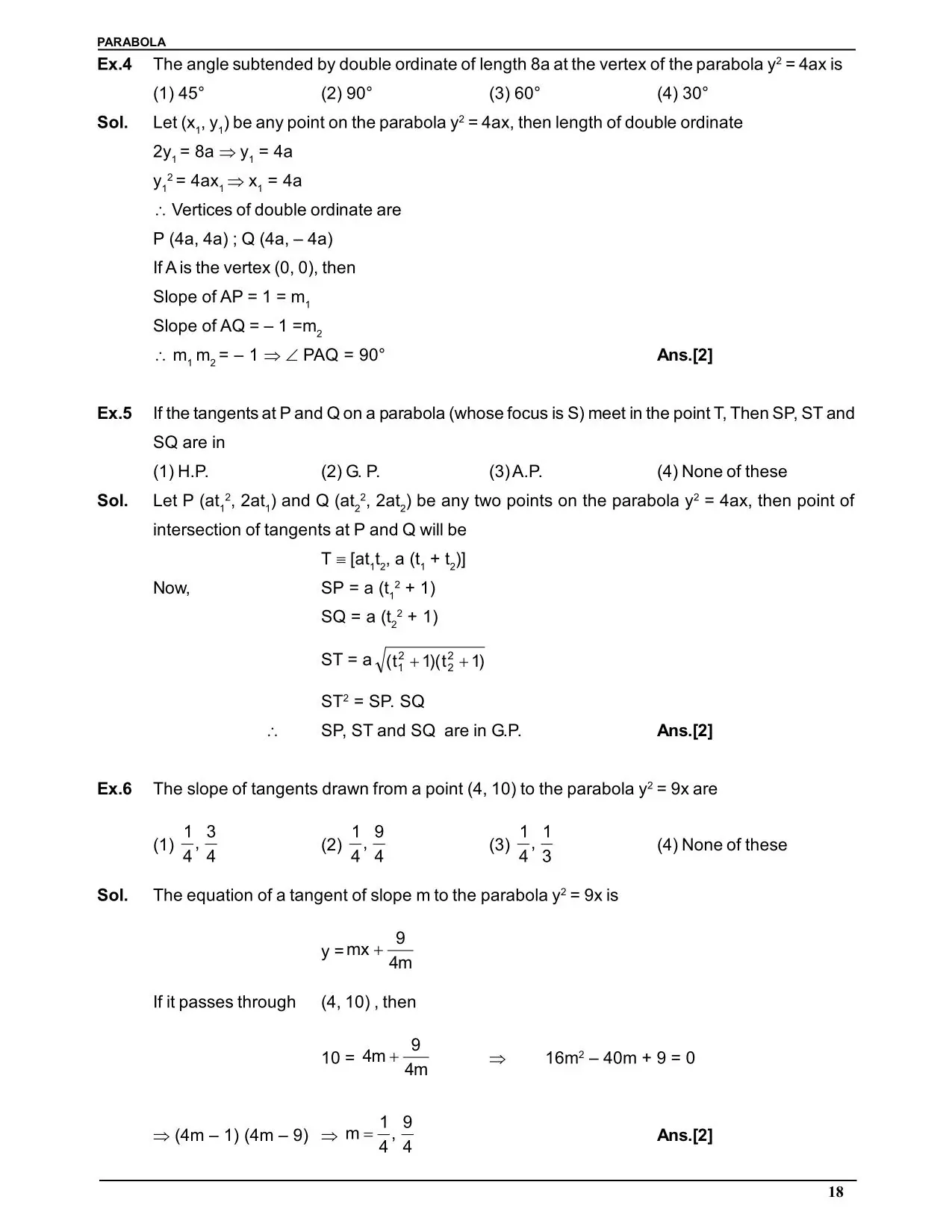
- Tangent at P(t): ty = x + at²
- Normal at P(t): y + tx = 2at + at³
- Chord joining P(t₁) and P(t₂): (t₁ + t₂)y = 2x + 2at₁t₂
Key Parametric Results
Result | Formula |
|---|---|
Point on parabola | (at², 2at) |
Tangent at parameter t | ty = x + at² |
Normal at parameter t | y + tx = 2at + at³ |
Slope of tangent at t | 1/t |
Slope of normal at t | −t |
Foot of normal from external point | Solve: at³ + t(2a − h) − k = 0 |
Position of a Point Relative to a Parabola
For the parabola y² = 4ax, a point P(h, k) lies:
Condition | Position |
|---|---|
k² − 4ah < 0 | Inside the parabola |
k² − 4ah = 0 | On the parabola |
k² − 4ah > 0 | Outside the parabola |
Physical interpretation: Inside the parabola means closer to the axis than the parabola curve; outside means farther from the axis.
Tangent to a Parabola — All Three Forms
For the parabola y² = 4ax:
Form 1 — Point Form (Tangent at a given point on the parabola)
Tangent at point (x₁, y₁) on y² = 4ax:
yy1=2a(x+x1)yy_1 = 2a(x + x_1)yy1=2a(x+x1)
Form 2 — Slope Form (Tangent with a given slope m)
y=mx+amy = mx + \frac{a}{m}y=mx+ma
This line is tangent to y² = 4ax for any value of m ≠ 0.
Point of tangency: (am2,2am)\left(\frac{a}{m^2}, \frac{2a}{m}\right) (m2a,m2a)
Condition of tangency: For line y = mx + c to be tangent to y² = 4ax:
c=amc = \frac{a}{m}c=ma
Form 3 — Parametric Form (Tangent at parameter t)
ty=x+at2ty = x + at^2ty=x+at2
Key Tangent Properties
- Two tangents drawn from an external point to y² = 4ax meet the axis at angles supplementary to the angle between the chord of contact and the axis
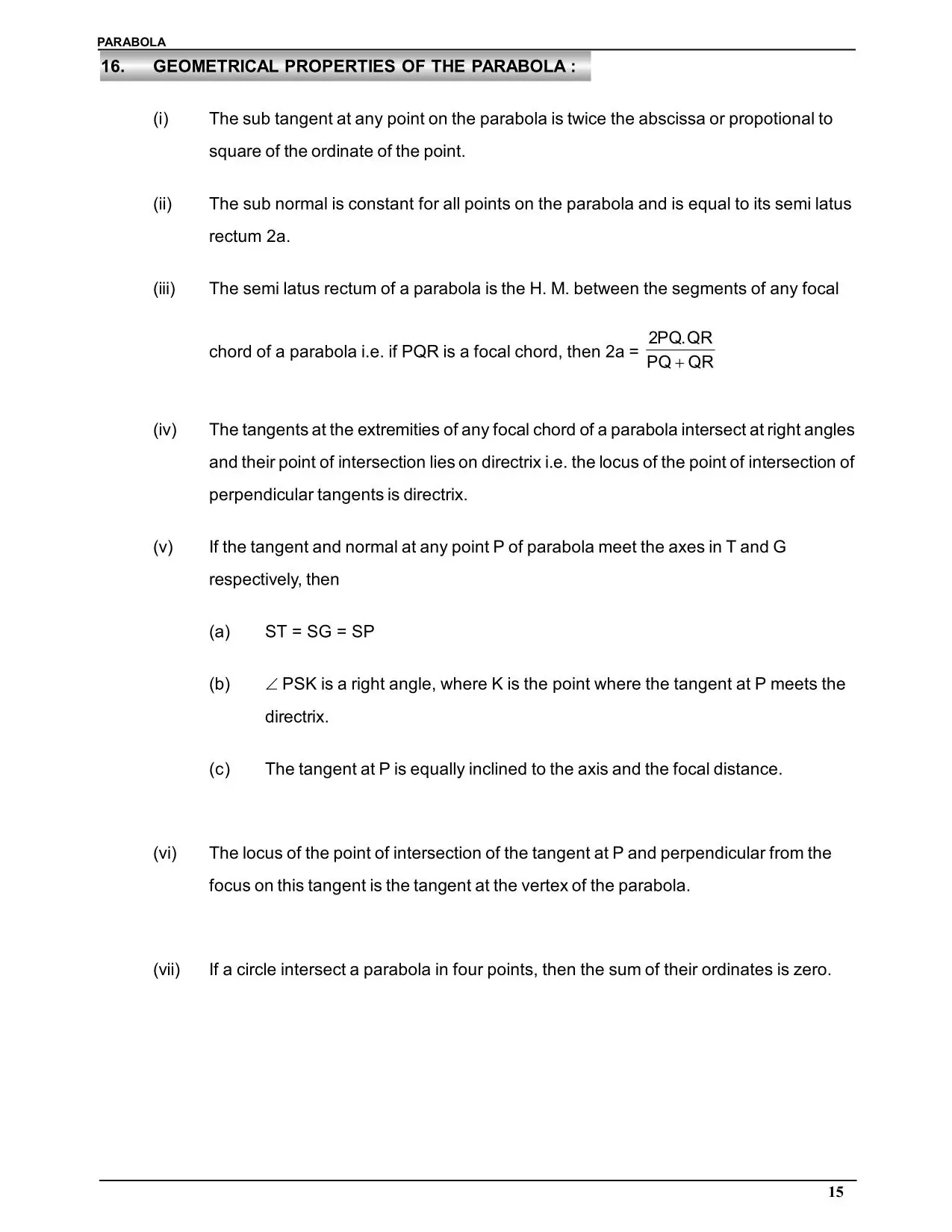
- Tangents at the ends of a focal chord of y² = 4ax are perpendicular to each other and meet on the directrix
- Tangent at the vertex (origin) is the y-axis (x = 0)
Normal to a Parabola {#normal}
Equation of Normal — Three Forms
For y² = 4ax:
At point (x₁, y₁):
y−y1=−y12a(x−x1)y - y_1 = -\frac{y_1}{2a}(x - x_1)y−y1=−2ay1(x−x1)
In slope form (slope = m):
y=mx−2am−am3y = mx - 2am - am^3y=mx−2am−am3
The foot of this normal has coordinates (am², −2am).
In parametric form (at parameter t):
y+tx=2at+at3y + tx = 2at + at^3y+tx=2at+at3
Important Normal Properties
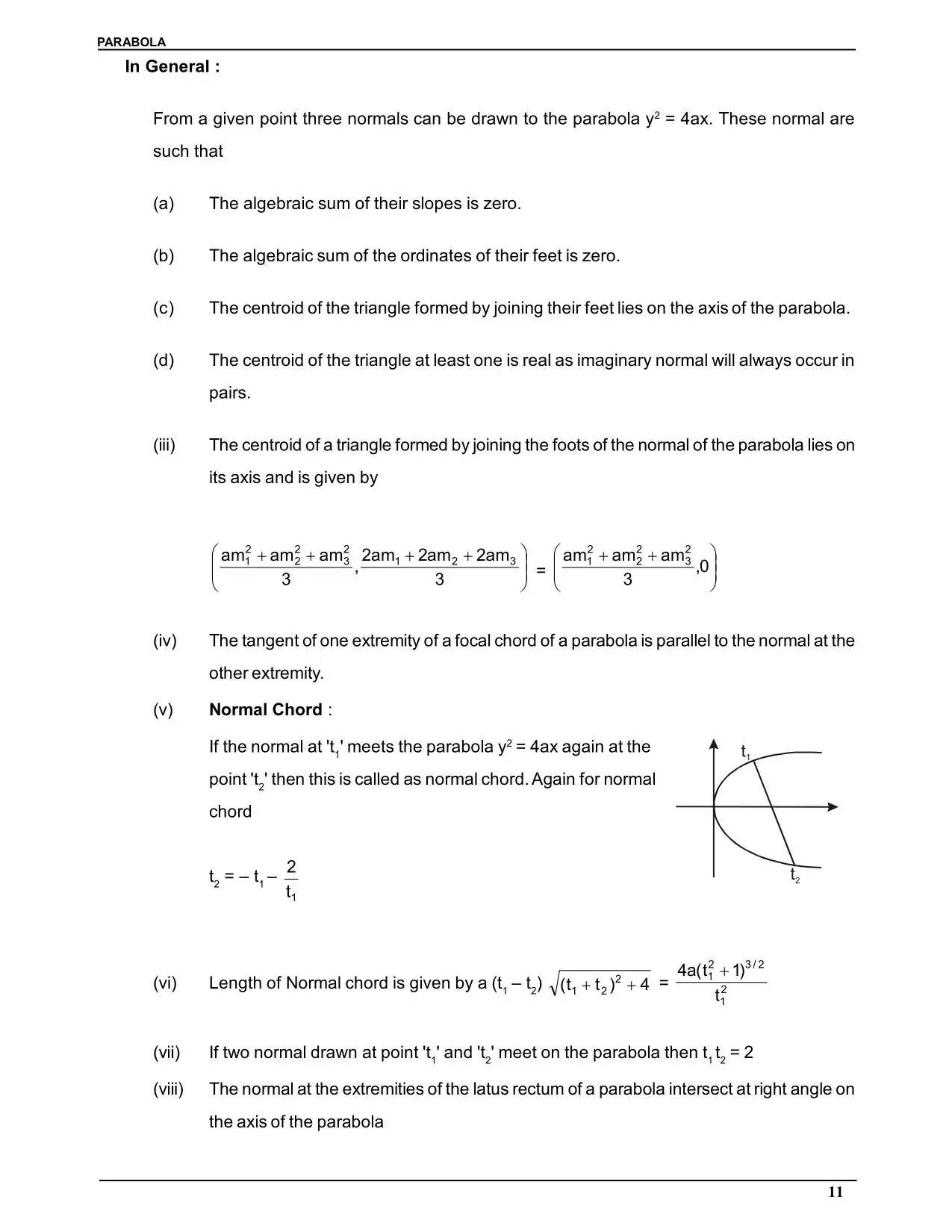
- The normal at point P(t) meets the parabola again at point Q(t') where:
t′=−t−2tt' = -t - \frac{2}{t}t′=−t−t2
- Three normals can be drawn from an external point to y² = 4ax in general
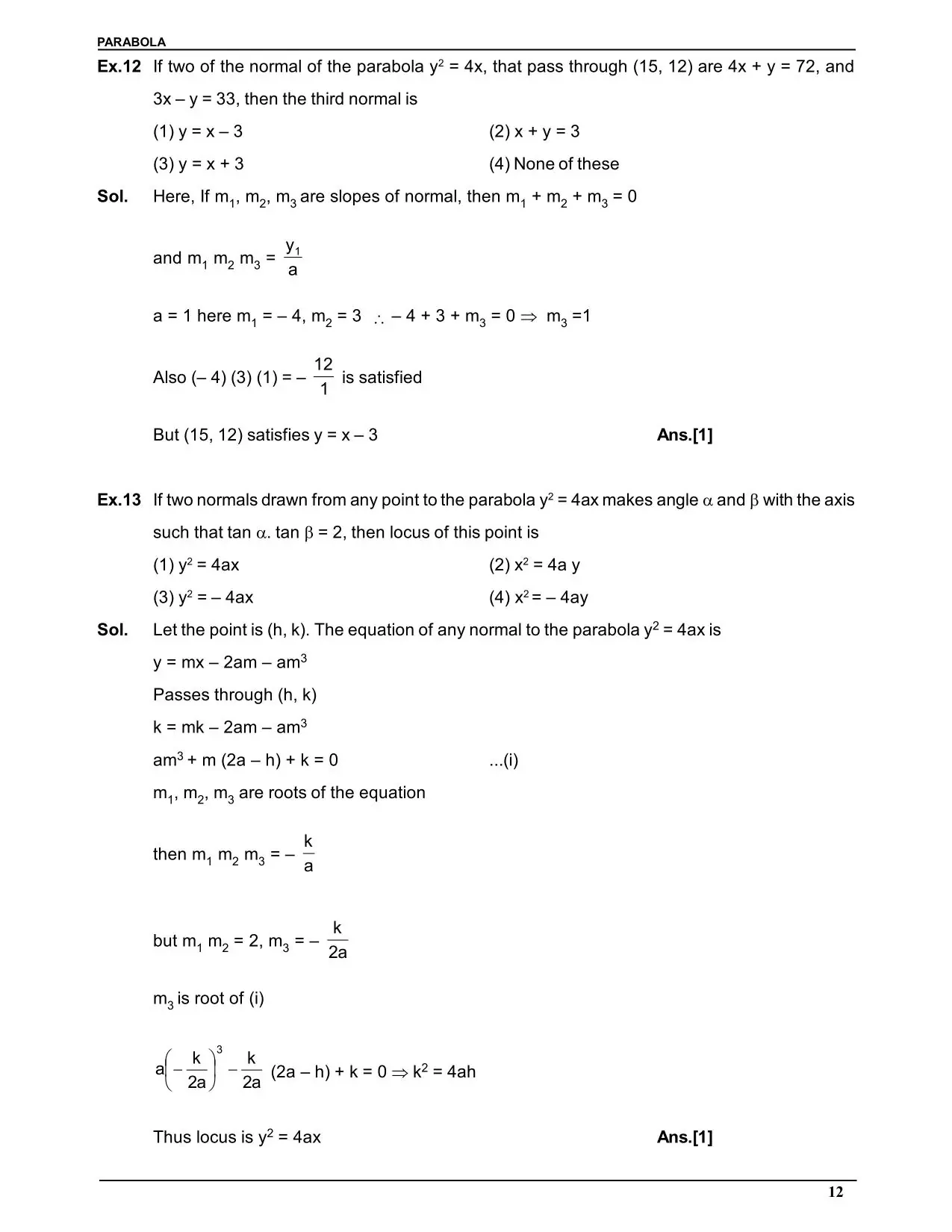
- If three normals from point (h, k) have slopes m₁, m₂, m₃, then:
- m₁ + m₂ + m₃ = 0
- m₁m₂ + m₂m₃ + m₁m₃ = (2a − h)/a
- m₁m₂m₃ = k/a
Chord of Contact and Chord with Given Midpoint
Chord of Contact
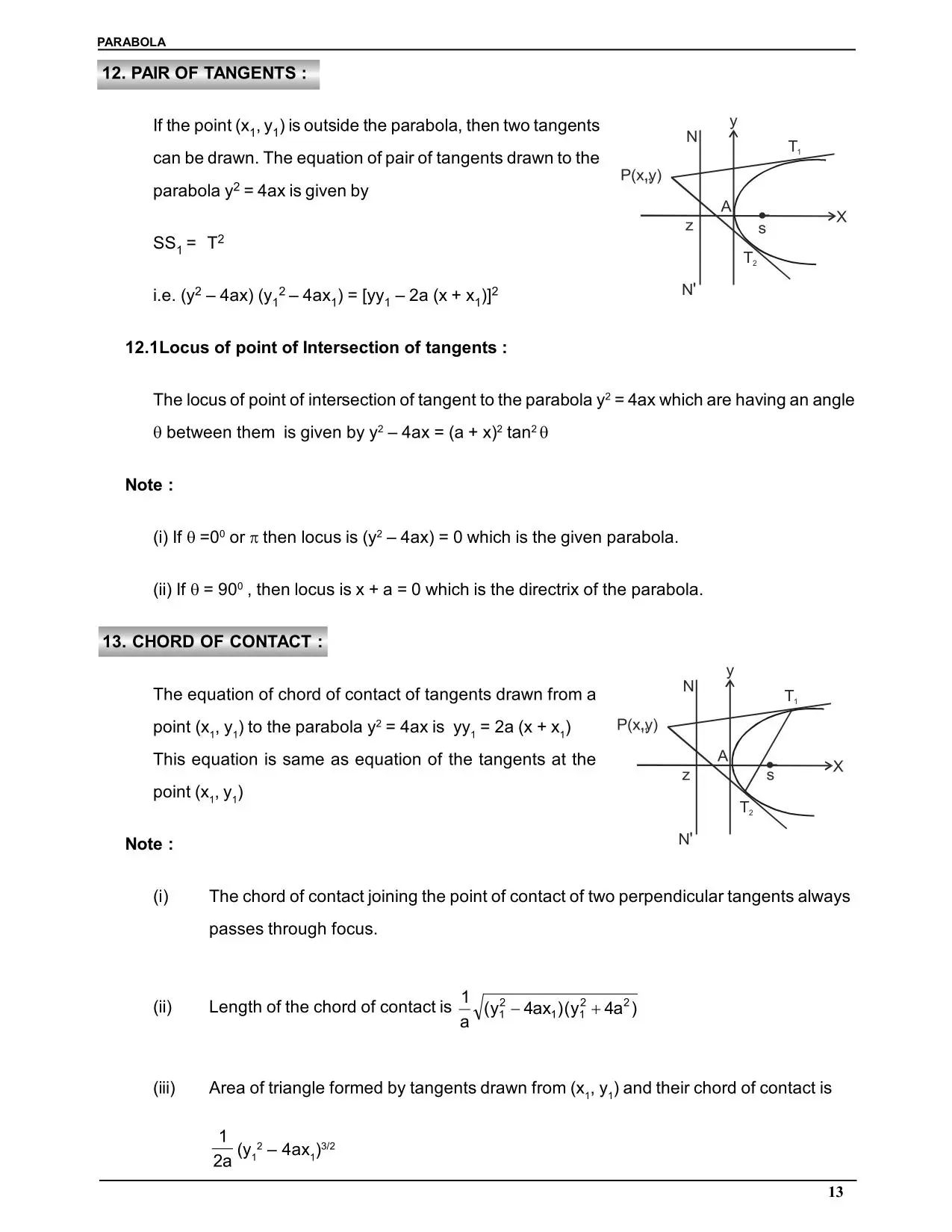
If tangents are drawn from an external point P(h, k) to y² = 4ax, the chord of contact (line joining the two points of tangency) has equation:
ky=2a(x+h)ky = 2a(x + h)ky=2a(x+h)
This can be written as T = 0 where T = yy₁ − 2a(x + x₁) evaluated at (h, k).
Chord with Given Midpoint
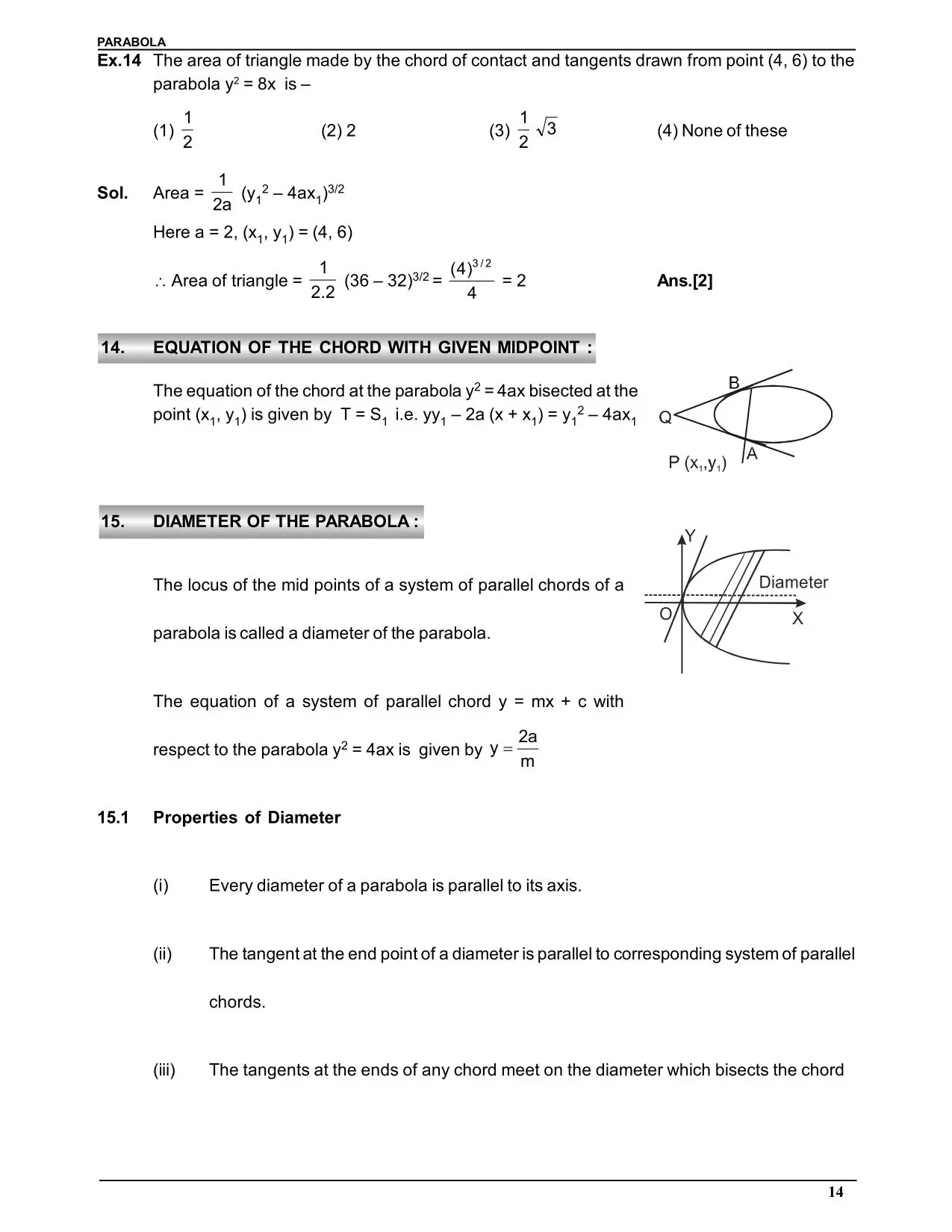
If the midpoint of a chord of y² = 4ax is M(h, k), the equation of that chord is:
k(y−k)=2a(x−h)k(y - k) = 2a(x - h)k(y−k)=2a(x−h)
Or equivalently: T = S₁
where T = yy₁ − 2a(x + x₁) and S₁ = y₁² − 4ax₁ evaluated at (h, k).
Focal Chord Properties
For a focal chord joining points P(t₁) and Q(t₂) on y² = 4ax:
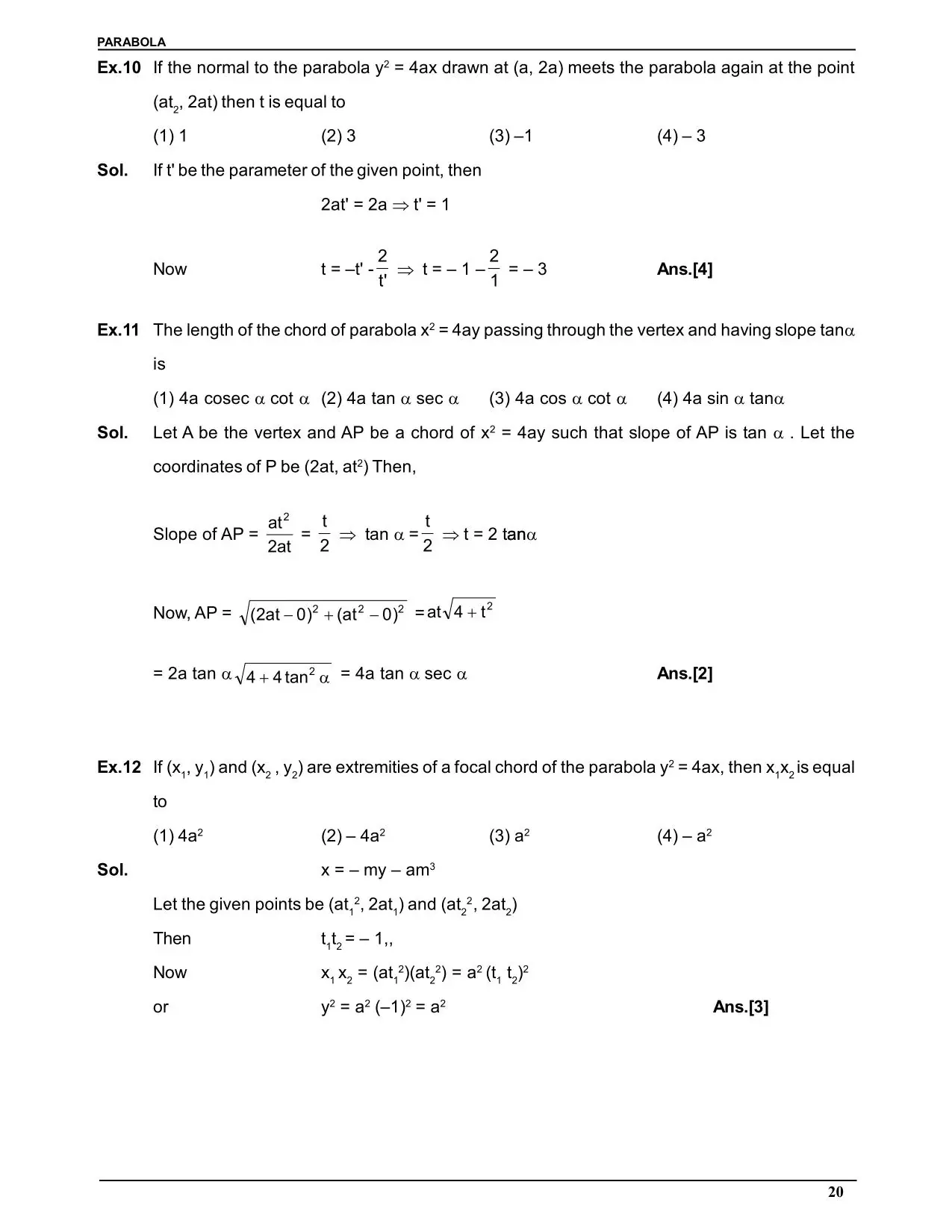
t1⋅t2=−1t_1 \cdot t_2 = -1t1⋅t2=−1
This is one of the most important results for JEE — if t₁t₂ = −1, the chord is focal (passes through the focus).
Length of focal chord through parameter t:
ℓ=a(t+1t)2\ell = a\left(t + \frac{1}{t}\right)^2ℓ=a(t+t1)2
Harmonic mean of focal distances: If SP and SQ are the focal distances of endpoints of a focal chord, then:
1SP+1SQ=1a\frac{1}{SP} + \frac{1}{SQ} = \frac{1}{a}SP1+SQ1=a1
Key Properties and Important Results
Must-Know Results for JEE — Quick Reference
Result | Statement |
|---|---|
Eccentricity | e = 1 for all parabolas |
Latus rectum length | 4a for all standard parabolas |
Focal distance of (x₁, y₁) on y² = 4ax | x₁ + a |
Tangent condition (y = mx + c) | c = a/m |
Tangents at focal chord ends | Perpendicular; meet on directrix |
Normal rejoining parabola | t' = −t − 2/t |
Focal chord parameter relation | t₁t₂ = −1 |
Three normals: sum of slopes | m₁ + m₂ + m₃ = 0 |
Chord of contact from (h,k) | ky = 2a(x + h) |
Tangent at vertex | x = 0 (y-axis) |
Reflection property | Any ray parallel to axis reflects through focus |
The Reflection Property — JEE Conceptual Question
The most physically significant property of a parabola: any ray parallel to the axis of a parabola, on reflection from the parabolic surface, passes through the focus. This is why parabolic reflectors are used in satellite dishes, car headlights (reversed: light from focus → parallel rays), and telescopes.
JEE Main and JEE Advanced Weightage
Exam | Questions from Conics | Parabola Contribution | Marks |
|---|---|---|---|
JEE Main | 2–3 questions from all conics | 1–2 questions most years | 4–8 marks |
JEE Advanced | 1–3 questions from all conics | Often part of multi-concept problem | 4–12 marks |
CBSE Board | 6–8 marks (entire conics unit) | Parabola definition + standard form | 3–5 marks |
Most Repeated JEE Main Question Types from Parabola
Question Type | Frequency |
|---|---|
Equation of tangent in slope form / condition of tangency | Very High |
Length of latus rectum given equation | High |
Equation of parabola from given focus/directrix | High |
Focal chord properties (t₁t₂ = −1) | High |
Normal that is also a chord / rejoins parabola | Medium–High |
Locus of intersection of two tangents/normals | Medium |
How to Study Parabola for Maximum JEE Marks
Step-by-Step Study Plan
Step 1 — Master the standard form y² = 4ax completely (Day 1) Before touching any other form, make y² = 4ax your reference form. Write from memory: focus, directrix, vertex, axis, latus rectum endpoints, focal distance formula, and the parametric point (at², 2at). Everything in this chapter flows from this one form.
Step 2 — Learn all four orientations with one diagram each (Day 1) Draw the four standard parabolas (y² = 4ax, y² = −4ax, x² = 4ay, x² = −4ay) with their focus and directrix labelled. The table in this article covers all four — reproduce it from memory after reading it once.
Step 3 — Derive tangent and normal in all three forms (Day 2) Do not just memorise the tangent formulas — derive them for y² = 4ax:
- Point form by implicit differentiation
- Parametric form by substituting (at², 2at)
- Slope form by using the condition c = a/m
Deriving these yourself locks them in more firmly than any amount of memorisation.
Step 4 — Practise the five most important JEE result types (Day 3) Work through these five result types with 2–3 examples each:
- Tangent in slope form and condition of tangency
- Normal rejoining the parabola (t' = −t − 2/t)
- Focal chord (t₁t₂ = −1)
- Chord of contact from external point
- Locus problems (intersection of two tangents/normals)
Step 5 — Solve JEE Main PYQs on Parabola year-wise (Day 4–5) Access all JEE Main previous year question papers on eSaral and filter for Parabola. Solve year by year from the most recent. After 4–5 years of PYQs, every important question template will feel familiar.
Cross-link to the trigonometric formulas class 11 page here too, as part of a broader set of class 11 maths formula references.
🚀 Checkout eSaral Courses
Frequently Asked Questions
What are the important formulas of Parabola for JEE?
The ten most critical formulas are: standard equation y² = 4ax; parametric point (at², 2at); tangent at parameter t: ty = x + at²; slope form tangent: y = mx + a/m; condition c = a/m; normal at t: y + tx = 2at + at³; normal rejoining at t': t' = −t − 2/t; focal chord relation: t₁t₂ = −1; focal distance = x + a; chord of contact from (h,k): ky = 2a(x + h).
How to study Parabola Class 11 for IIT JEE?
Master y² = 4ax as the reference form first. Learn all four orientations. Derive (not just memorise) tangent and normal in all three forms. Practise five result types: tangent condition, normal rejoining, focal chord, chord of contact, and locus problems. Then solve JEE Main PYQs year-wise to identify recurring question templates.
What are the standard equations of parabola for JEE?
The four standard equations are: y² = 4ax (opens right, focus at (a,0)), y² = −4ax (opens left, focus at (−a,0)), x² = 4ay (opens upward, focus at (0,a)), and x² = −4ay (opens downward, focus at (0,−a)). All have vertex at the origin and latus rectum length 4a.
What is the condition for a line to be tangent to y² = 4ax?
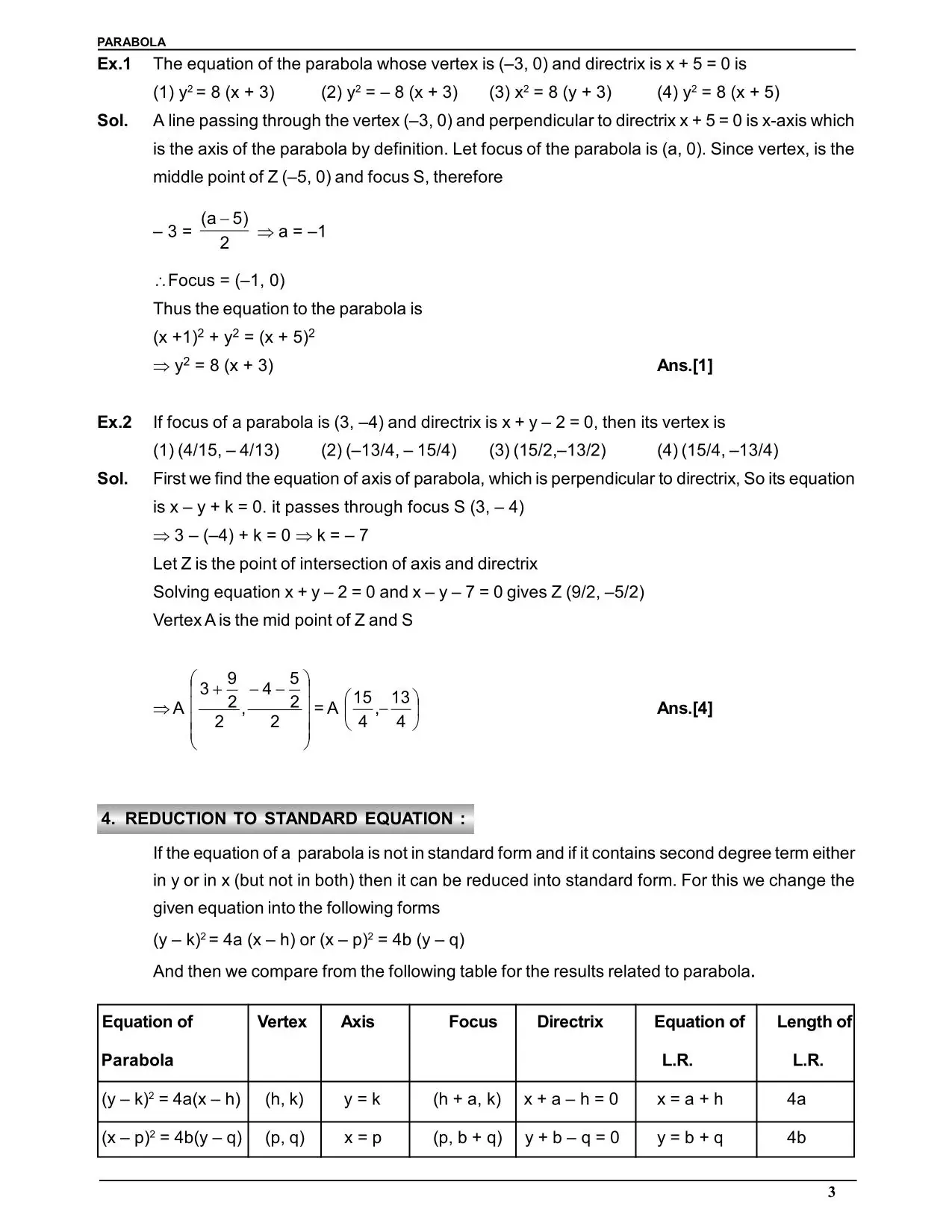
For the line y = mx + c to be tangent to the parabola y² = 4ax, the condition is c = a/m. This comes from substituting y = mx + c into y² = 4ax and setting the discriminant equal to zero (for a single point of intersection). The point of tangency is (a/m², 2a/m).
What is the significance of t₁t₂ = −1 for a focal chord?
If P(t₁) and Q(t₂) are the endpoints of a chord of y² = 4ax, then that chord passes through the focus (is a focal chord) if and only if t₁t₂ = −1. This result simplifies all focal chord problems in JEE — whenever you see a chord through the focus, immediately write t₁t₂ = −1 and use it as a constraint. It is one of the most frequently applied results in JEE Parabola questions.
Team eSaral
eSaral Academic and Editorial Team
Team eSaral is the collective author profile for educational content created by eSaral’s teachers and academic contributors. The team draws on expertise from IIT graduates, doctors, experienced educators and subject specialists to develop resources for JEE, NEET and school students. Our articles aim to explain concepts clearly and help students study with confidence.
Related Posts
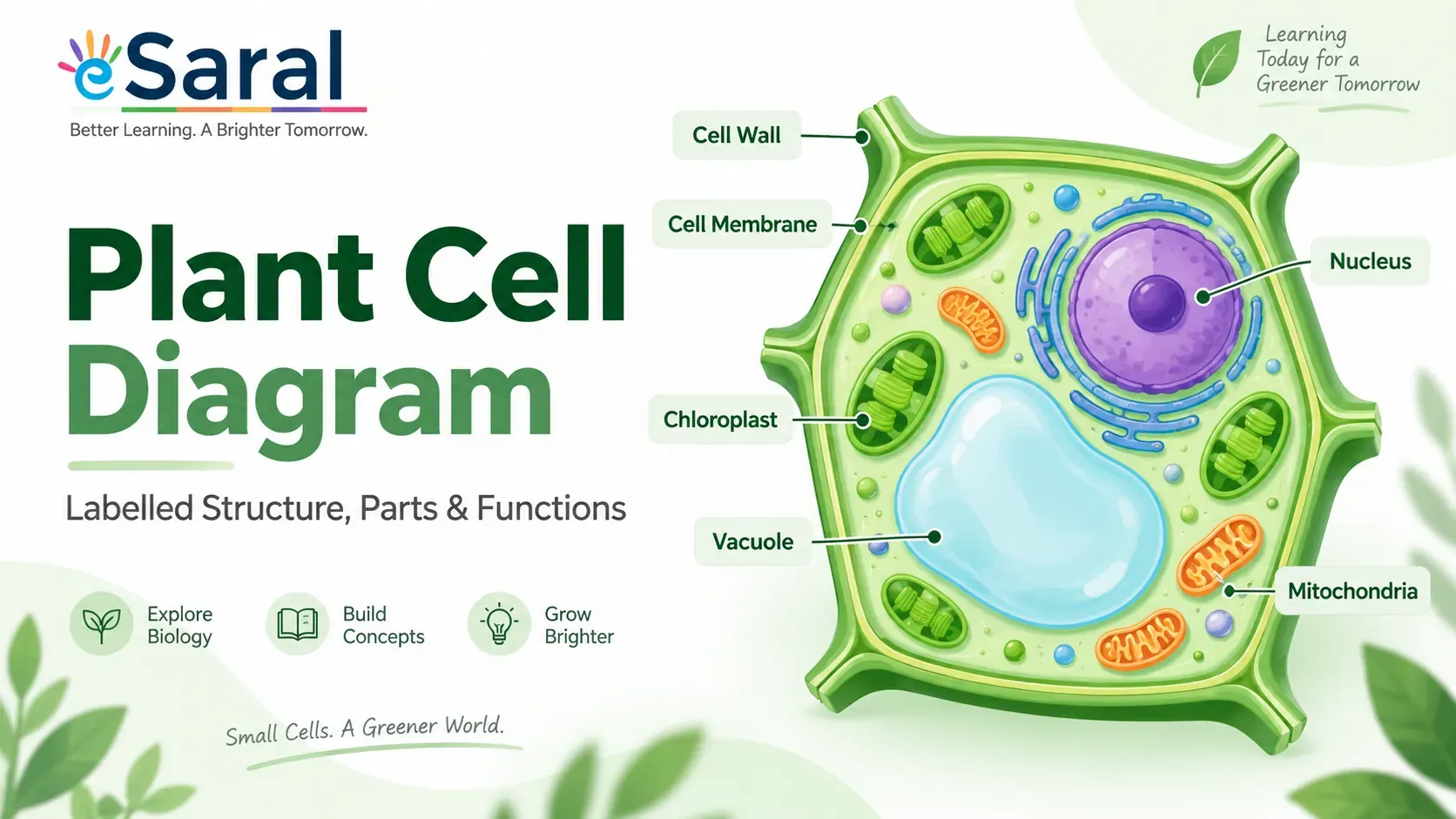
Plant Cell Diagram: Labelled Structure, Parts and Functions
Simple, labelled plant cell diagram with parts and functions. Covers plant cell structure for Class 6, 7, 8, 9, 10 and 11 students, CBSE-aligned.

Saransh Gupta Sir's Visit to IIT Patna: Hostel Life, Placements & Lessons for JEE Aspirants
Inside Saransh Gupta Sir's IIT Patna visit — hostel life, the library, placements, internships, and real advice for JEE aspirants from students living the IIT dream.
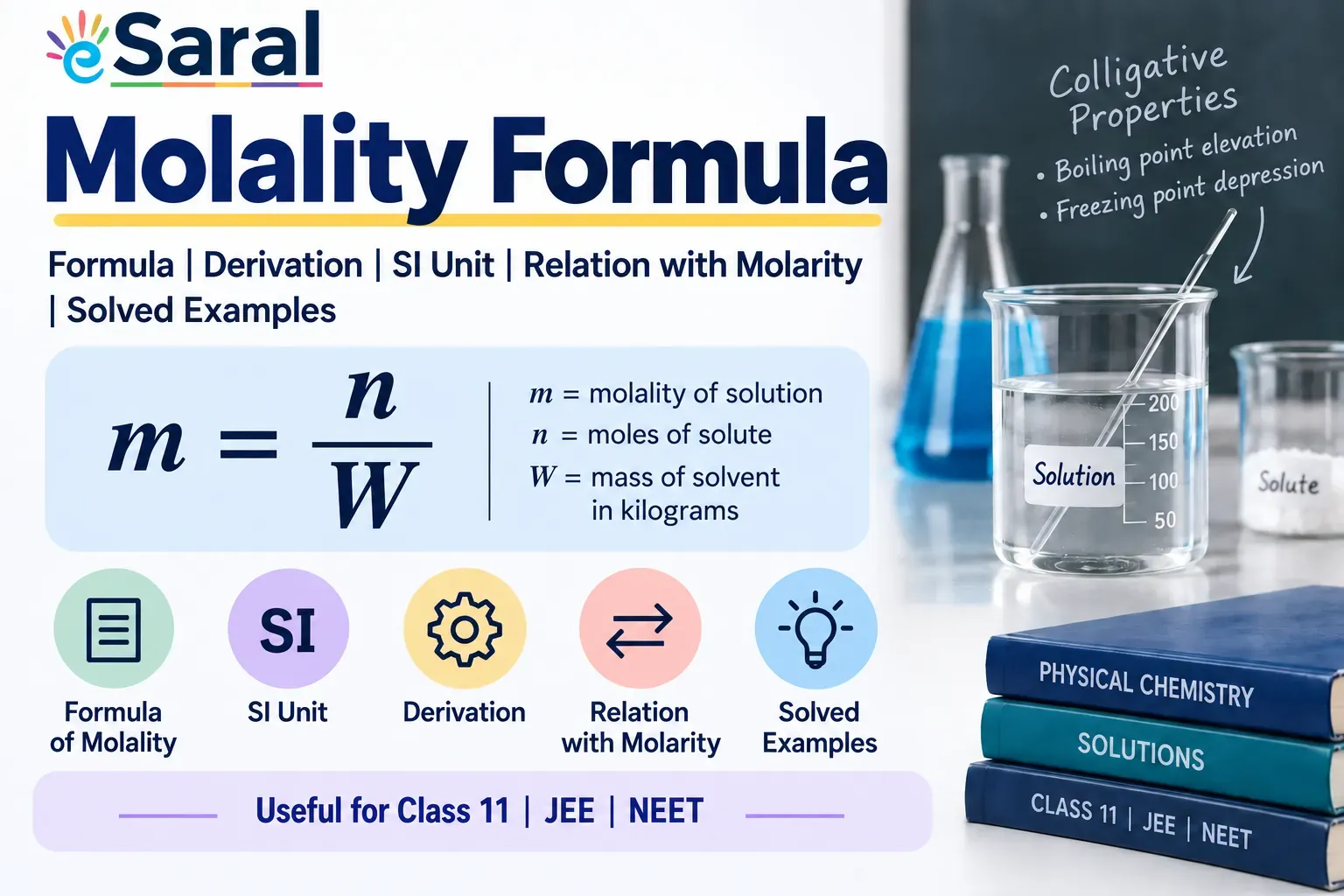
Molality Formula: Formula for Molality, Derivation & Solved Examples
Molality formula is $m = \dfrac{n}{W}$. Learn the formula of molality, its SI unit, derivation, relation with molarity, and solved examples for Class 11, JEE and NEET.
BITSAT Previous Year Question Paper PDF
Download BITSAT previous year question papers PDF. Get year-wise BITSAT PYQs, memory-based papers, exam pattern, and preparation tips to improve your BITSAT preparation.

Teachers’ Day 2026 at eSaral Gurukul: Celebrating the Bond Between Students, Teachers & Mentors
See how Teachers’ Day 2026 was celebrated at eSaral Gurukul, reflecting the bond among students, teachers, and mentors, and the role of guidance beyond academics.
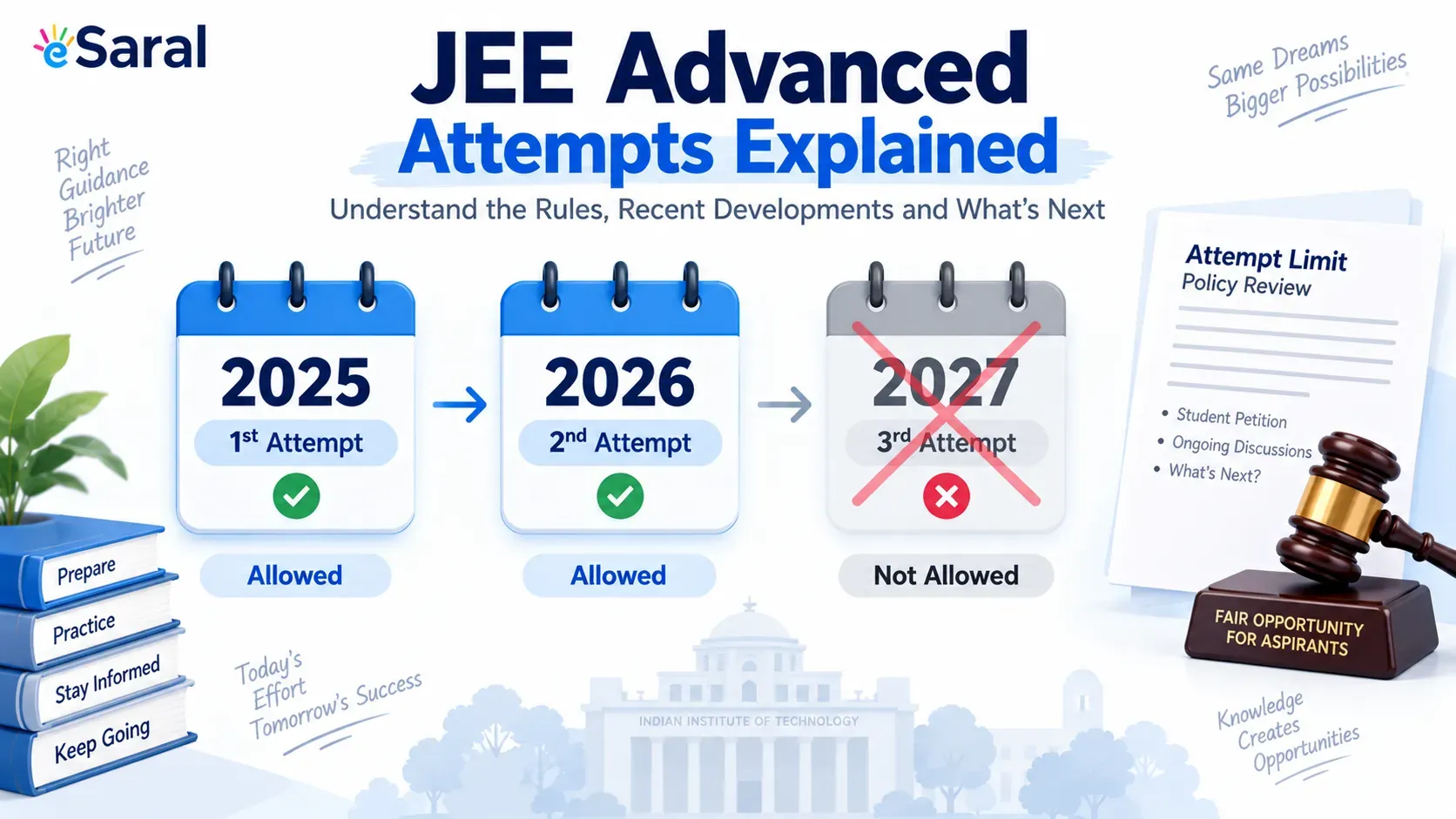
JEE Advanced Attempts: Can You Give It a Third Time? Rules Explained
JEE Advanced attempts: current rule is 2 consecutive years only: full eligibility criteria, the 2025 third-attempt controversy, and the latest 2026 petition news.

Best JEE Preparation App
Best JEE preparation app for Main & Advanced: AI mock tests, live doubt-solving, thousands of practice questions. JEE preparation app for droppers & Class 11-12.
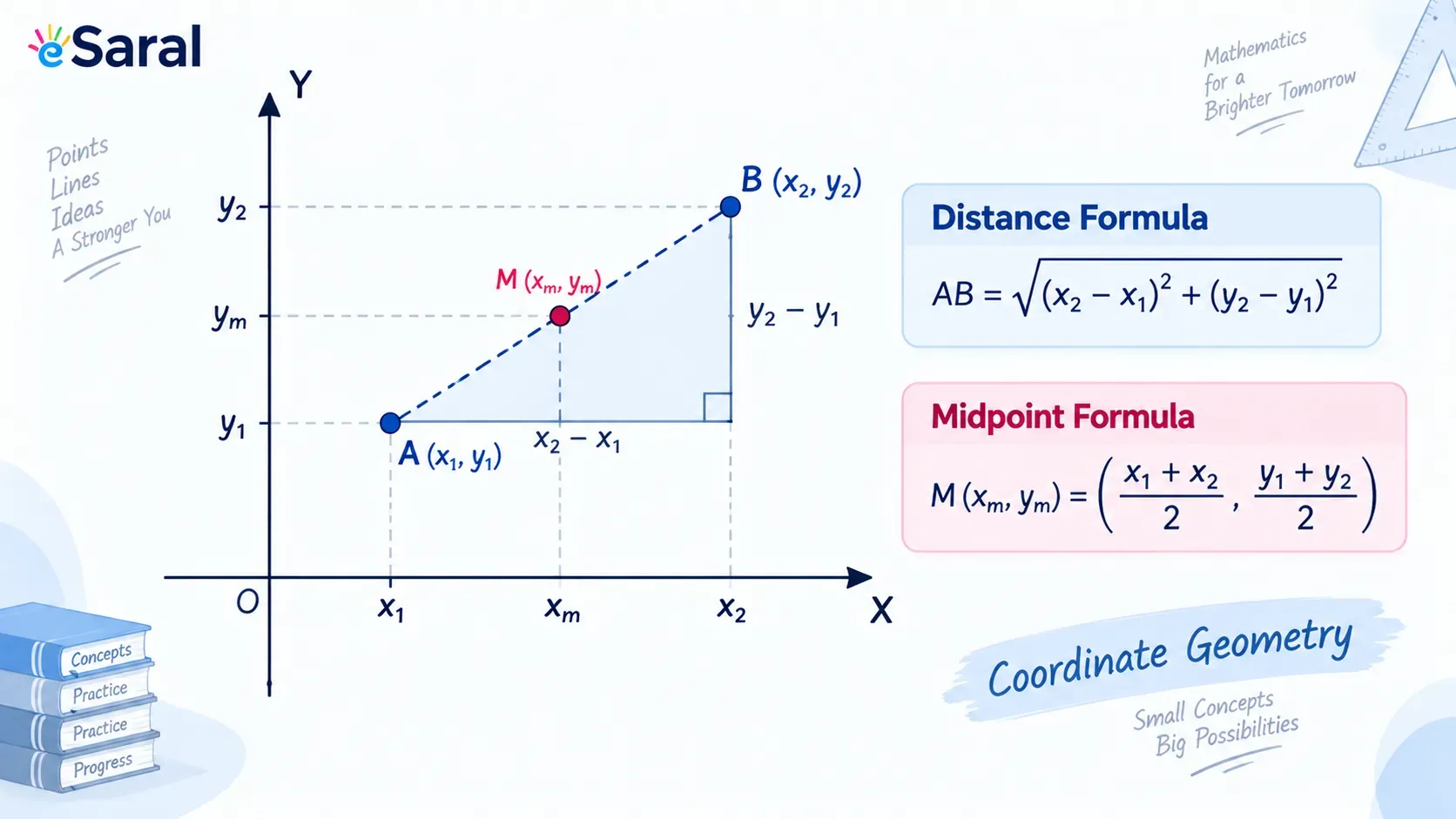
Coordinate Geometry Class 10: Formulas, Notes & Solved Examples
Coordinate geometry class 10: complete CBSE formulas — distance, section, midpoint and area of triangle — with derivation, notes and solved examples.
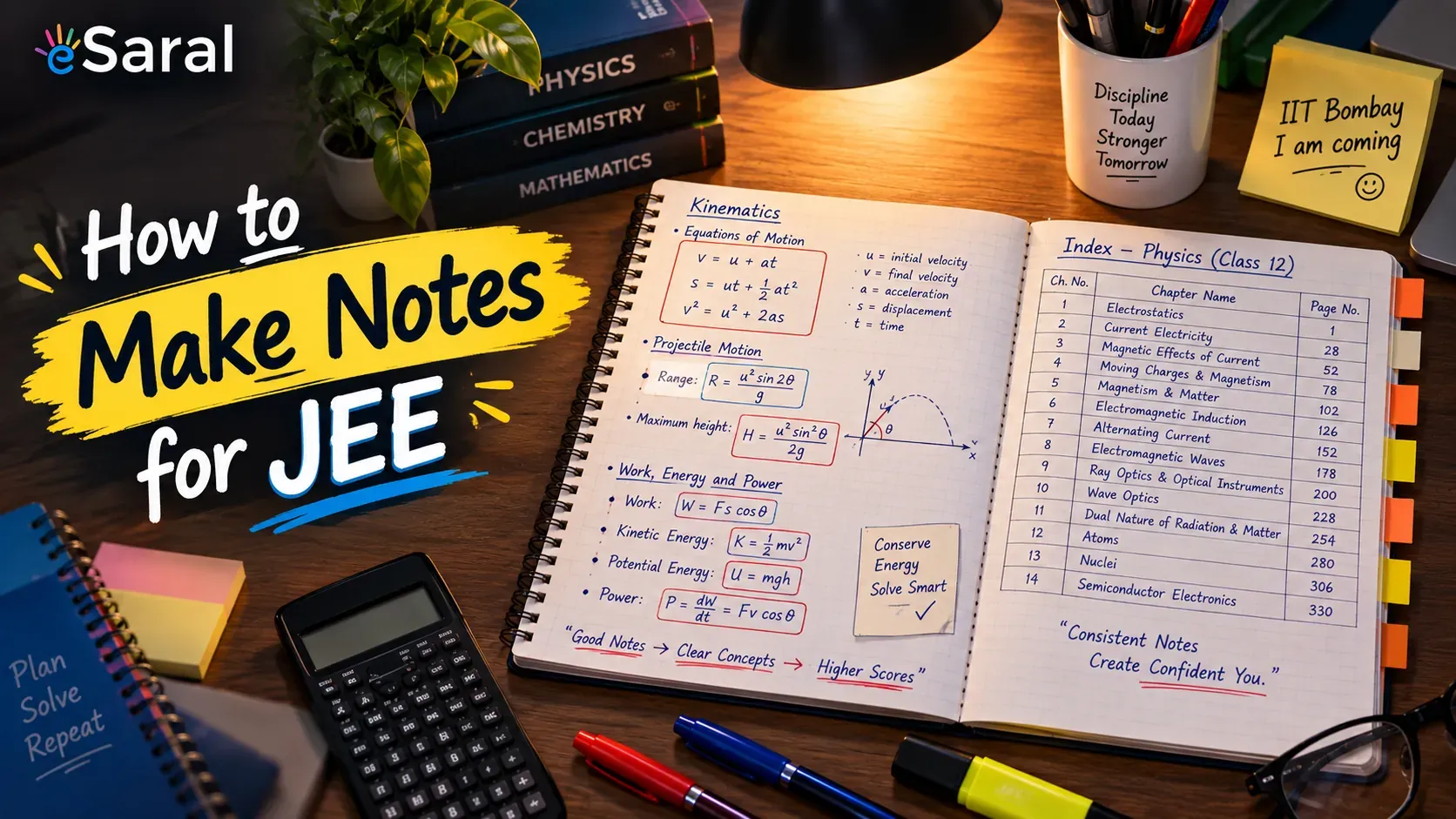
How to make Notes For JEE Smart Notes Strategy of an AIR 41
Learn how to make notes for JEE the way toppers do — indexing, shorthand, and smart short notes for JEE that cut revision time to just 5–7 days.
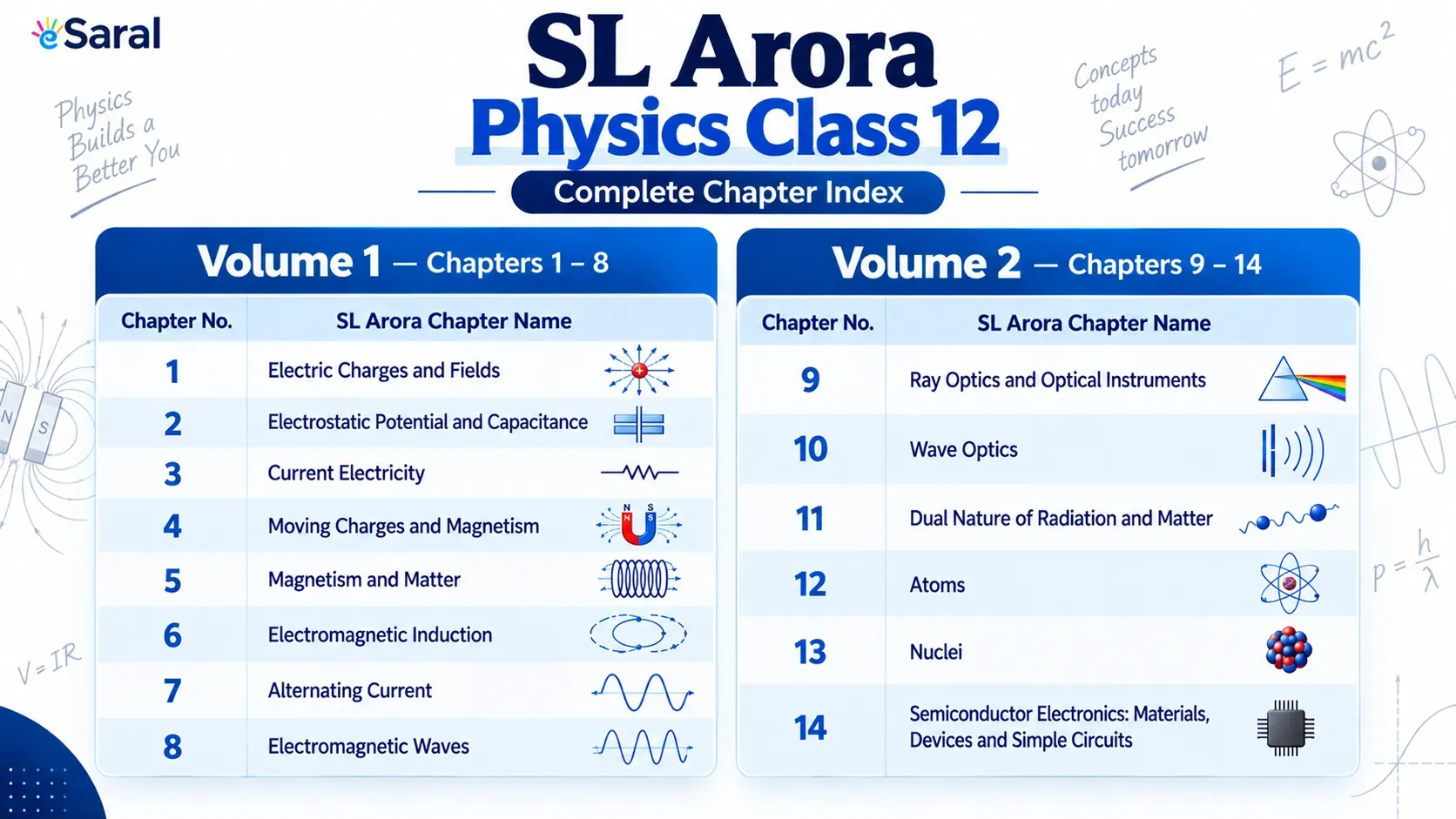
SL Arora Physics Class 12 Index – Chapter List for Volume 1 & 2
SL Arora Physics Class 12 index — complete chapter list for Volume 1 & 2, mapped to NCERT solutions for board, JEE Main, and NEET preparation.