
Parabola - JEE Main Previous Year Question with Solutions

eSaral Academic and Editorial Team
Summary
Parabola questions in JEE Main come from conic sections and test concepts like tangent, normal, focal chord, locus, and director circle. From 2009 to 2024, NTA has asked 1–2 parabola questions per paper. Mastering standard results — such as the focal chord length formula and the condition for a normal — is the fastest way to score full marks in this chapter.

Home > JEE Main Previous Year Questions > Parabola JEE Main Previous Year Questions with Solutions

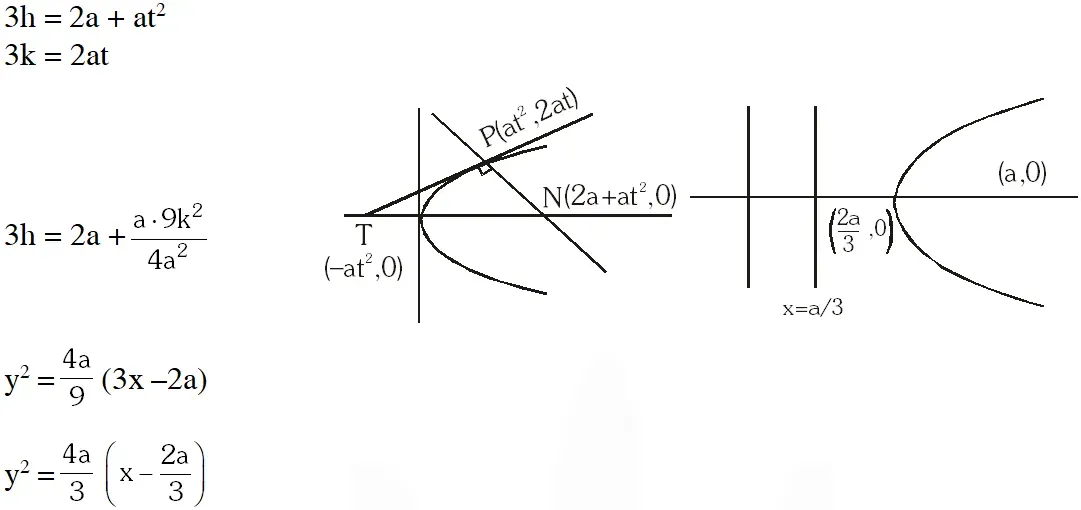
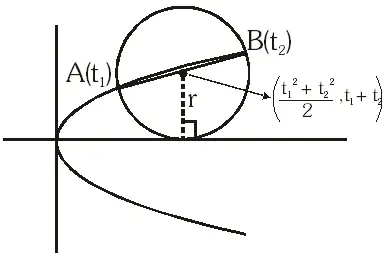
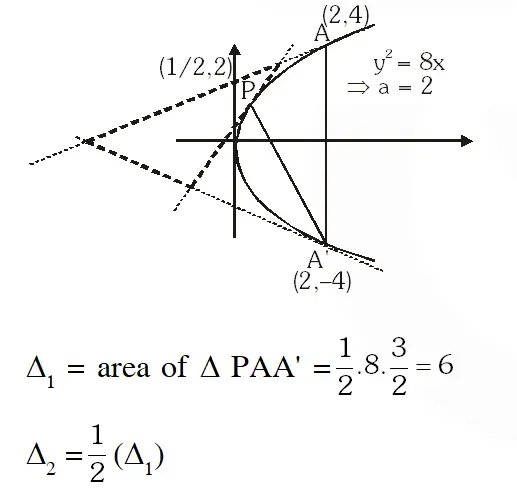
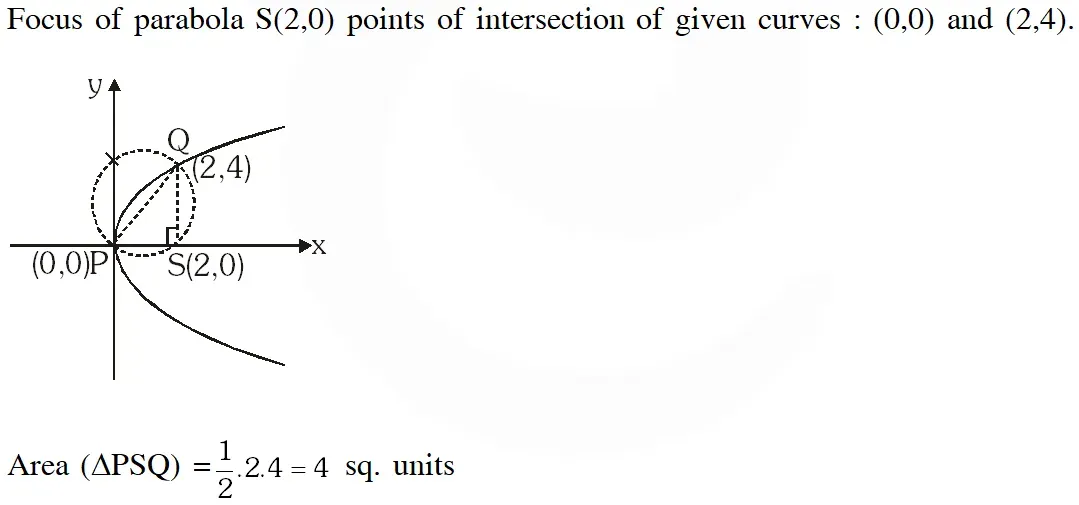
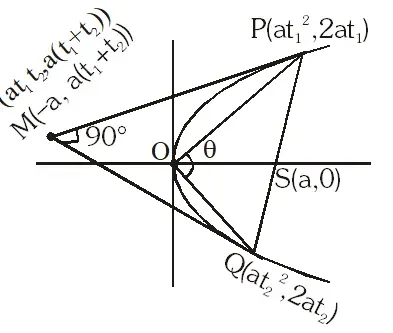
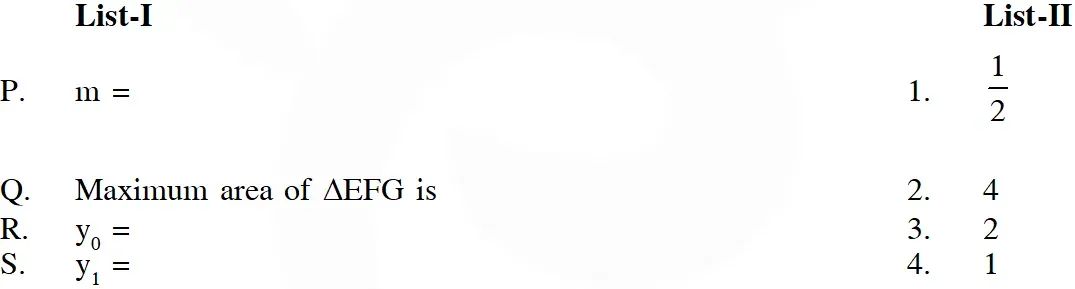
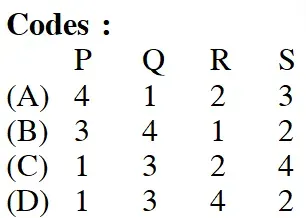
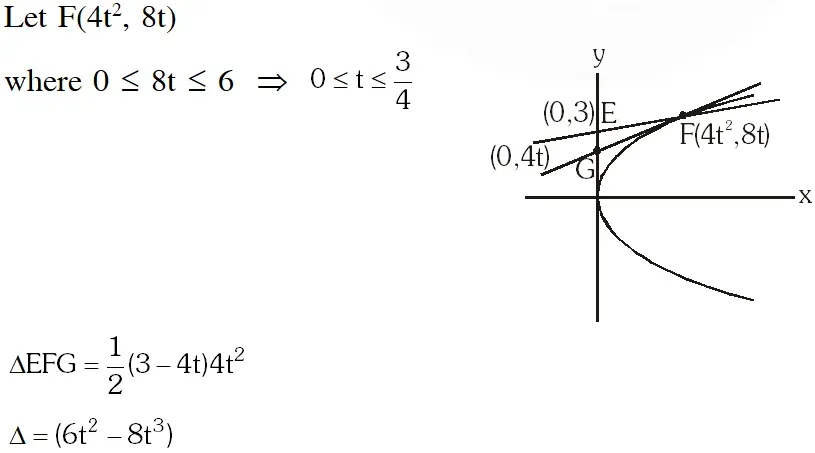
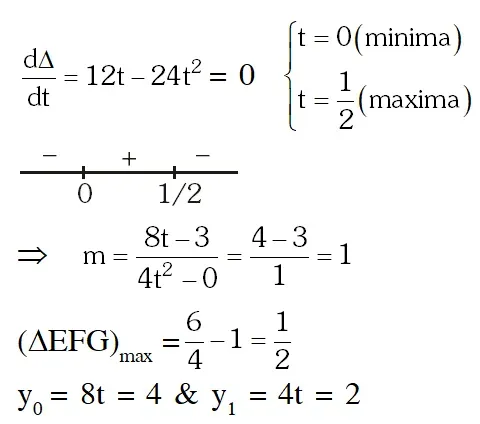
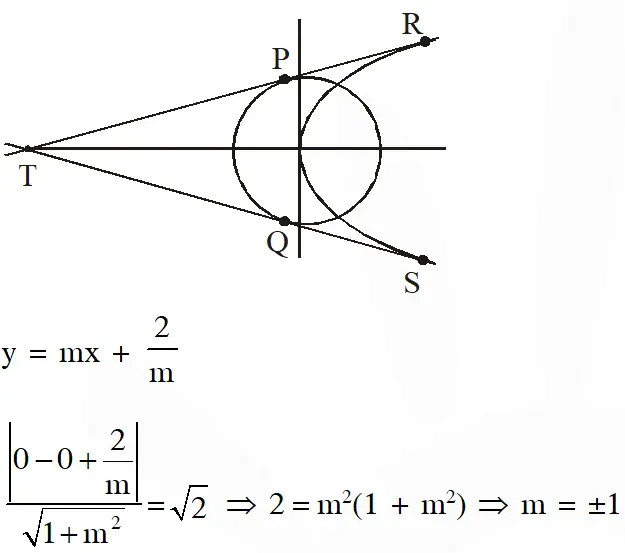
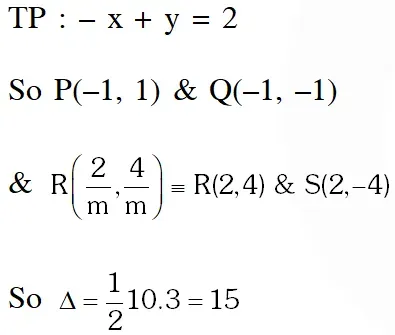
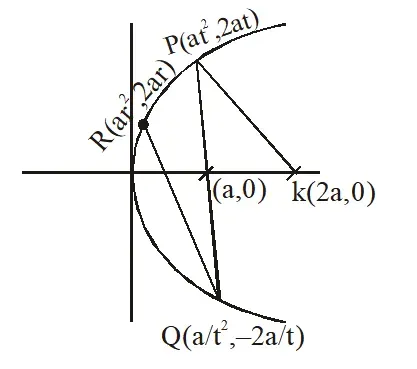
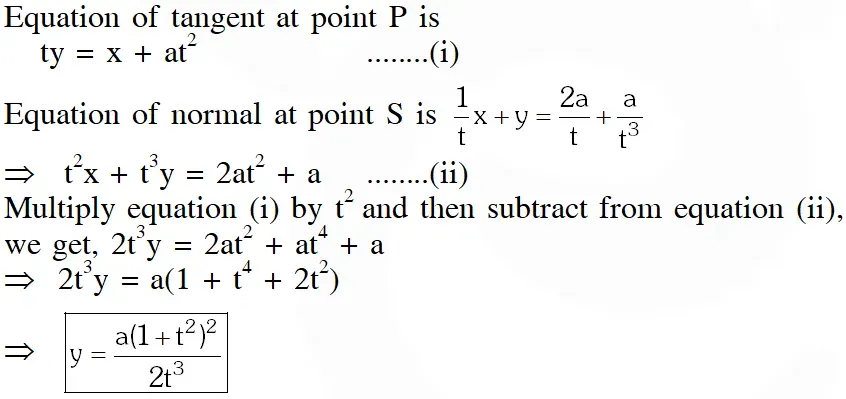
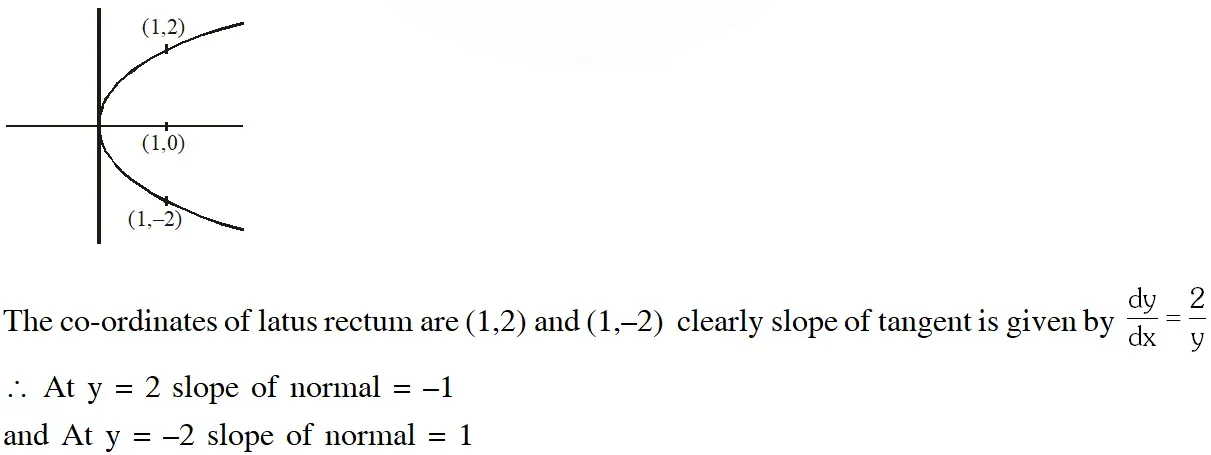
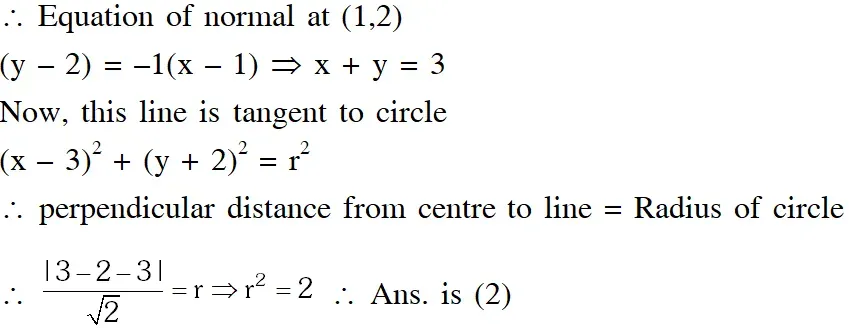
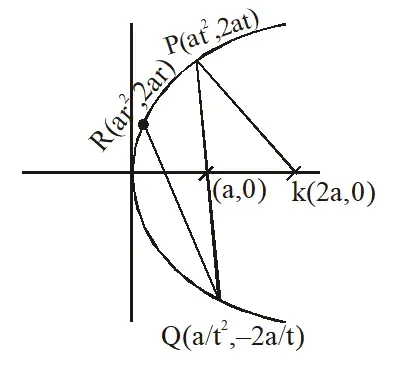
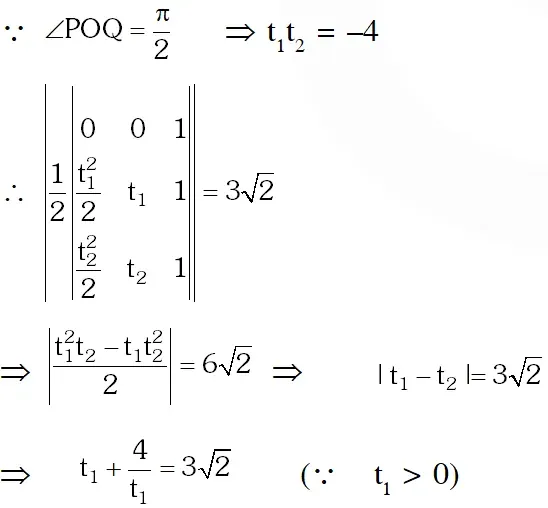
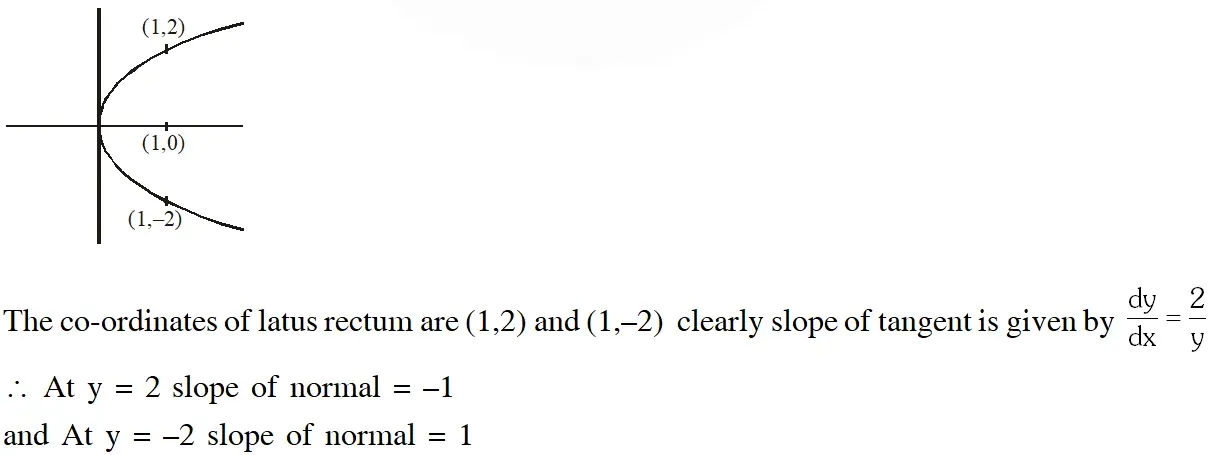
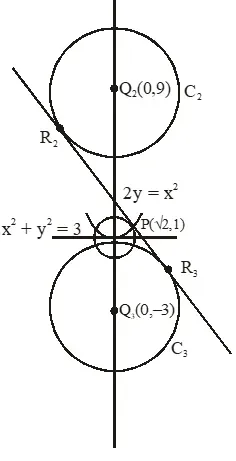
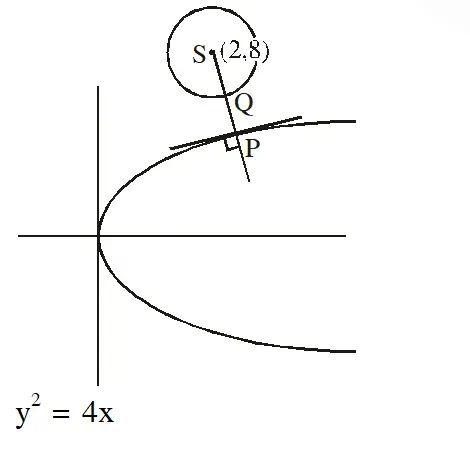
JEE Main Previous Year Question of Math with Solutions are available at eSaral. Practicing JEE Main Previous Year Papers Questions of mathematics will help the JEE aspirants in realizing the question pattern as well as help in analyzing weak & strong areas. eSaral helps the students in clearing and understanding each topic in a better way. eSaral is providing complete chapter-wise notes of Class 11th and 12th both for all subjects. Besides this, eSaral also offers NCERT Solutions, Previous year questions for JEE Main and Advance, Practice questions, Test Series for JEE Main, JEE Advanced and NEET, Important questions of Physics, Chemistry, Math, and Biology and many more. Download eSaral app for free study material and video tutorials. [esquestion] The tangent PT and the normal PN to the parabola $y^{2}$ = 4ax at a point P on it meet its axis at points T and N, respectively. The locus of the centroid of the triangle PTN is a parabola whose (A) vertex is $\left(\frac{2 \mathrm{a}}{3}, 0\right)$ (B) directrix is x = 0 (C) latus rectum is $\frac{2 \mathrm{a}}{3}$ (D) focus is (a, 0) #tag# [JEE 2009, 4] #sol# (A,D) [/esquestion] [esquestion] Let A and B be two distinct point on the parabola $y^{2}$ = 4x. If the axis of the parabola touches a circle of radius r having AB as its diameter, then the slope of the line joining A and B can be – (A) $\frac{-1}{\mathrm{r}}$ (B) $\frac{1}{\mathrm{r}}$ (C) $\frac{2}{\mathrm{r}}$ (D) $\frac{-2}{\mathrm{r}}$ #tag# [JEE 2010,3] #sol# (C,D) $\mathrm{t}_{1}+\mathrm{t}_{2}=\mathrm{r}$ $\frac{2}{\mathrm{r}}=\frac{2}{\mathrm{t}_{1}+\mathrm{t}_{2}}$ similarly $-\frac{2}{\mathrm{r}}$ is also possible [/esquestion] [esquestion] Consider the parabola $\mathrm{y}^{2}=8 \mathrm{x}$. Let $\Delta_{1}$ be the area of the triangle formed by the end points of its latus rectum and the point $\mathrm{P}\left(\frac{1}{2}, 2\right)$ on the parabola, and $\Delta_{2}$ be the area of the triangle formed by drawing tangents at $\mathrm{P}$ and at the end points of the latus rectum. Then $\frac{\Delta_{1}}{\Delta_{2}}$ is #tag# [JEE 2011,4] #sol# 2 [/esquestion] [esquestion] Let (x,y) be any point on the parabola $\mathrm{y}^{2}$ = 4x. Let P be the point that divides the line segment from (0,0) to (x,y) in the ratio 1 : 3. Then the locus of P is- (A) $x^{2}=y$ (B) $\mathrm{y}^{2}=2 \mathrm{x}$ (C) $\mathrm{y}^{2}=\mathrm{x}$ (D) $x^{2}=2 y$ #tag# [JEE 2011,3] #sol# (C) Let P be (h, k) on using section formula $\mathrm{P}\left(\frac{x}{4}, \frac{y}{4}\right)$ $\therefore \quad \mathrm{h}=\frac{x}{4}$ and $\mathrm{k}=\frac{y}{4}$ $\Rightarrow \quad \mathrm{x}=4 \mathrm{h}$ and $\mathrm{y}=4 \mathrm{k}$ $\because \quad(\mathrm{x}, \mathrm{y})$ lies on $\mathrm{y}^{2}=4 \mathrm{x}$ $\therefore \quad 16 \mathrm{k}^{2}=16 \mathrm{h} \quad \Rightarrow \mathrm{k}^{2}=\mathrm{h}$ Locus of point $\mathrm{P}$ is $\mathrm{y}^{2}=\mathrm{x}$ [/esquestion] [esquestion] Let L be a normal to the parabola $\mathrm{y}^{2}=4 \mathrm{x} .$ If $\mathrm{L}$ passes through the point $(9,6),$ then $\mathrm{L}$ is given by $-$ (A) y – x + 3 =0 (B) y + 3x – 33 = 0 (C) y + x – 15 = 0 (D) y – 2x + 12 = 0 #tag# [JEE 2011,3] #sol# (A,B,D) Equation of normal is $\mathrm{y}=\mathrm{mx}-2 \mathrm{m}-\mathrm{m}^{3}$ It passes through the point $(9,6)$ then $6=9 \mathrm{m}-2 \mathrm{m}-\mathrm{m}^{3}$ $\Rightarrow \mathrm{m}^{3}-7 \mathrm{m}+6=0$ $\Rightarrow(\mathrm{m}-1)(\mathrm{m}-2)(\mathrm{m}+3)=0$ $\Rightarrow \quad \mathrm{m}=1,2,-3$ Equations of normals are $\mathrm{y}-\mathrm{x}+3=0, \mathrm{y}+3 \mathrm{x}-33=0$ & $\quad \mathrm{y}-2 \mathrm{x}+12=0$ [/esquestion] [esquestion] Let S be the focus of the parabola $y^{2}=8 x \&$ let PQ be the common chord of the circle $x^{2}+y^{2}-2 x-4 y$ $=0$ and the given parabola. The area of the triangle PQS is #tag# [JEE 2012, 4M] #sol# 4 [/esquestion] Paragraph for Question 7 and 8 Let PQ be a focal chord of the parabolas $\mathrm{y}^{2}=4 \mathrm{ax} .$ The tangents to the parabola at $\mathrm{P}$ and $\mathrm{Q}$ meet at a point lying on the line $\mathrm{y}=2 \mathrm{x}+\mathrm{a}, \mathrm{a}>0 .$ [esquestion] If chord PQ subtends an angle $\theta$ at the vertex of $y^{2}=4 a x,$ then $\tan \theta=$ (A) $\frac{2}{3} \sqrt{7}$ (B) $\frac{-2}{3} \sqrt{7}$ (C) $\frac{2}{3} \sqrt{5}$ (D) $\frac{-2}{3} \sqrt{5}$ #tag# [JEE(Advanced) 2013, 3, (–1)] #sol# (D) Single tangent at the extrimities of a focal chord will intersect on directrix. $\therefore \quad \mathrm{M}\left(-\mathrm{a}, \mathrm{a}\left(\mathrm{t}_{1}+\mathrm{t}_{2}\right)\right)$ lies on $\mathrm{y}=2 \mathrm{x}+\mathrm{a}$ $\mathrm{a}\left(\mathrm{t}_{1}+\mathrm{t}_{2}\right)=-2 \mathrm{a}+\mathrm{a} \quad \Rightarrow \quad \mathrm{t}_{1}+\mathrm{t}_{2}=-1$ $\quad \& \quad \mathrm{t}_{1} \mathrm{t}_{2}=-1$ $\tan \theta=\left(\frac{\frac{2}{t_{1}}-\frac{2}{t_{2}}}{1+\frac{4}{t_{1} t_{2}}}\right)=\left(\frac{2\left(t_{2}-t_{1}\right)}{3}\right)$ $\because\left(t_{2}-t_{1}\right)=\left(t_{2}+t_{1}\right)^{2}-4 t_{1} t_{2}=5$ $t_{2}-t_{1}=\pm \sqrt{5}$ $\therefore \quad \tan \theta=\pm \frac{2 \sqrt{5}}{3}$ but $\theta$ is obtuse because $\mathrm{O}$ is the interior point of the circle for which $\mathrm{PQ}$ is diameter. $\therefore \quad \tan \theta=\frac{-2 \sqrt{5}}{3}$ [/esquestion] [esquestion] Length of chord PQ is (A) 7a (B) 5a (C) 2a (D) 3a #tag# [JEE(Advanced) 2013, 3, (–1)] #sol# (B) $\begin{aligned} \text { Length of focal chord } \\ \mathrm{PQ} &=\mathrm{a}\left(\mathrm{t}_{1}-\mathrm{t}_{2}\right)^{2} \\ &=\mathrm{a}\left[\left(\mathrm{t}_{1}+\mathrm{t}_{2}\right)^{2}-4 \mathrm{t}_{1} \mathrm{t}_{2}\right] \\ &=\mathrm{a}[1+4]=5 \mathrm{a} \end{aligned}$ [/esquestion] [esquestion] A line L: $y=m x+3$ meets $y-$ axis at $E(0,3)$ and the arc of the parabola $y^{2}=16 x, 0 \leq y$ $\leq 6$ at the point $F\left(x_{0}, y_{0}\right)$. The tangent to the parabola at $F\left(x_{0}, y_{0}\right)$ intersects the $y$ -axis at $G\left(0, y_{1}\right) .$ The slope $m$ of the line $L$ is chosen such that the area of the triangle EFG has a local maximum. Match List-I with List-II and select the correct answer using the code given below the lists. #tag# [JEE(Advanced) 2013, 3, (–1)] #sol# (A ) [/esquestion] [esquestion] The common tangents to the circle $\mathrm{x}^{2}+\mathrm{y}^{2}=2$ and the parabola $\mathrm{y}^{2}=8 \mathrm{x}$ touch the circle at the point $\mathrm{P}, \mathrm{Q}$ and the parabola at the points $\mathrm{R}, \mathrm{S}$. Then the area of the quadrilateral PQRS is – (A) 3 (B) 6 (C) 9 (D) 15 #tag# [JEE(Advanced)-2014, 3(–1)] #sol# (D) [/esquestion] Paragraph For Questions 11 and 12 Let a,r,s, t be nonzero real numbers. Let $P\left(a t^{2}, 2 a t\right), Q, R\left(a r^{2}, 2 a r\right)$ and $S\left(a s^{2}, 2 a s\right)$ be distinct points on the parabola $y^{2}=4 a x .$ Suppose that $P Q$ is the focal chord and lines $Q R$ and $P K$ are parallel, where $K$ is the point $(2 a, 0) .$ The value of $r$ is- [esquestion] The value of r is- (A) $-\frac{1}{\mathfrak{t}}$ (B) $\frac{t^{2}+1}{t}$ (C) $\frac{1}{\mathrm{t}}$ (D) $\frac{\mathfrak{t}^{2}-1}{\mathfrak{t}}$ #tag# [JEE(Advanced)-2014, 3(–1)] #sol# (D) $\because \mathrm{PQ}$ is a focal chord $\therefore$ co-ordinates of point $\mathrm{Q}$ are $=\left(\frac{\mathrm{a}}{\mathrm{t}^{2}},-\frac{2 \mathrm{a}}{\mathrm{t}}\right)$ $\mathrm{m}_{\mathrm{QR}}=\frac{2 \mathrm{a}\left(\mathrm{r}+\frac{1}{\mathrm{t}}\right)}{\mathrm{a}\left(\mathrm{r}^{2}-\frac{1}{\mathrm{t}^{2}}\right)}=\frac{2}{\left(\mathrm{r}-\frac{1}{\mathrm{t}}\right)}$ $\mathrm{m}_{\mathrm{PK}}=\frac{2 \mathrm{at}-0}{\mathrm{a}\left(\mathrm{t}^{2}-2\right)}=\frac{2 \mathrm{t}}{\mathrm{t}^{2}-2}$ Given $\mathrm{m}_{\mathrm{QR}}=\mathrm{m}_{\mathrm{PK}}$ $\Rightarrow \frac{2}{\mathrm{r}-\frac{1}{\mathrm{t}}}=\frac{2 \mathrm{t}}{\mathrm{t}^{2}-2} \Rightarrow \mathrm{r}=\frac{\mathrm{t}^{2}-2}{\mathrm{t}}+\frac{1}{\mathrm{t}}$ $\Rightarrow \mathrm{r}=\mathrm{t}-\frac{2}{\mathrm{t}}+\frac{1}{\mathrm{t}} \Rightarrow \mathrm{r}=\frac{\mathrm{t}^{2}-1}{\mathrm{t}}$ [/esquestion] [esquestion] If st = 1, then the tangent at P and the normal at S to the parabola meet at a point whose ordinate is- (A) $\frac{\left(\mathrm{t}^{2}+1\right)^{2}}{2 \mathrm{t}^{3}}$ (B) $\frac{\mathrm{a}\left(\mathrm{t}^{2}+1\right)^{2}}{2 \mathrm{t}^{3}}$ (C) $\frac{\mathrm{a}\left(\mathrm{t}^{2}+1\right)^{2}}{\mathrm{t}^{3}}$ (D) $\frac{\mathrm{a}\left(\mathrm{t}^{2}+2\right)^{2}}{\mathrm{t}^{3}}$ #tag# [JEE(Advanced)-2014, 3(–1)] #sol# (B) [/esquestion] [esquestion] If the normals of the parabola $y^{2}=4 x$ drawn at the end points of its latus rectum are tangents to the circle $(x-3)^{2}+(y+2)^{2}=r^{2},$ then the value of $r^{2}$ is #tag# [JEE 2015, 4M, –0M] #sol# 2 [/esquestion] [esquestion] Let the curve $C$ be the mirror image of the parabola $y^{2}=4 x$ with respect to the line $x+y+4=0 .$ If $A$ and $B$ are the points of intersection of $C$ with the line $y=-5$, then the distance between A and $B$ is #tag# [JEE 2015, 4M, –0M] #sol# 4 Let there be a point $\left(\mathrm{t}^{2}, 2 \mathrm{t}\right)$ on $\mathrm{y}^{2}=4 \mathrm{x}$ Clearly its reflection in $\mathrm{x}+\mathrm{y}+4=0$ is given by $$ \frac{\mathrm{x}-\mathrm{t}^{2}}{1}=\frac{\mathrm{y}-2 \mathrm{t}}{1}=\frac{-2\left(\mathrm{t}^{2}+2 \mathrm{t}+4\right)}{2} $$ $\therefore \quad \mathrm{x}=-(2 \mathrm{t}+4) \quad \& \mathrm{y}=-\left(\mathrm{t}^{2}+4\right)$ Now, $\mathrm{y}=-5 \quad \Rightarrow \quad \mathrm{t}=\pm 1$ $\therefore \quad \mathrm{x}=-6 \quad$ or $\quad \mathrm{x}=-2$ $\therefore \quad$ Distance between $\mathrm{A} \& \mathrm{B}=4$ [/esquestion] [esquestion] Let $P$ and $Q$ be distinct points on the parabola $y^{2}=2 x$ such that a circle with $P Q$ as diameter passes through the vertex $O$ of the parabola. If $P$ lies in the first quadrant and the area of the triangle $\Delta O P Q$ is $3 \sqrt{2},$ then which of the following is (are) the coordinates of $P ?$ (A) $(4,2 \sqrt{2})$ (B) $(9,3 \sqrt{2})$ (C) $\left(\frac{1}{4}, \frac{1}{\sqrt{2}}\right)$ (D) $(1, \sqrt{2})$ #tag# [JEE 2015, 4M, –2M] #sol# (A,D) [/esquestion] [esquestion] The circle $C_{1}: x^{2}+y^{2}=3,$ with centre at $O,$ intersects the parabola $x^{2}=2 y$ at the point $P$ in the first quadrant. Let the tangent to the circle $C_{1}$ at $P$ touches other two circles $C_{2}$ and $C_{3}$ at $R_{2}$ and $R_{3},$ respectively. Suppose $C_{2}$ and $C_{3}$ have equal radii $2 \sqrt{3}$ and centres $Q_{2}$ and $Q_{3}$ respectively. If $Q_{2}$ and $Q_{3}$ lie on the y-axis, then- (A) $\mathrm{Q}_{2} \mathrm{Q}_{3}=12$ (B) $\mathrm{R}_{2} \mathrm{R}_{3}=4 \sqrt{6}$ (C) area of the triangle $\mathrm{OR}_{2} \mathrm{R}_{3}$ is $6 \sqrt{2}$ (D) area of the triangle $\mathrm{PQ}_{2} \mathrm{Q}_{3}$ is $4 \sqrt{2}$ #tag# [JEE (Advanced) 2016] #sol# (A,B,C) On solving $\mathrm{x}^{2}+\mathrm{y}^{2}=3$ and $\mathrm{x}^{2}=2 \mathrm{y}$ we get point $\mathrm{P}(\sqrt{2}, 1)$ Equation of tangent at $\mathrm{P}$ $\sqrt{2} \cdot \mathrm{x}+\mathrm{y}=3$ Let $\mathrm{Q}_{2}$ be $(0, \mathrm{k})$ and radius is $2 \sqrt{3}$ $\therefore\left|\frac{\sqrt{2}(0)+k-3}{\sqrt{2+1}}\right|=2 \sqrt{3}$ $\therefore \mathrm{k}=9,-3$ $\mathrm{Q}_{2}(0,9)$ and $\mathrm{Q}_{3}(0,-3)$ hence $\mathrm{Q}_{2} \mathrm{Q}_{3}=12$ $\mathrm{R}_{2} \mathrm{R}_{3}$ is internal common tangent of circle $\mathrm{C}_{2}$ and $\mathrm{C}_{3}$ $\begin{aligned} \therefore \mathrm{R}_{2} \mathrm{R}_{3} &=\sqrt{\left(\mathrm{Q}_{2} \mathrm{Q}_{3}\right)^{2}-(2 \sqrt{3}+2 \sqrt{3})^{2}} \\ &=\sqrt{12^{2}-48}=\sqrt{96}=4 \sqrt{6} \end{aligned}$ Perpendicular distance of origin $\mathrm{O}$ from $\mathrm{R}_{2} \mathrm{R}_{3}$ is equal to radius of circle $\mathrm{C}_{1}=\sqrt{3}$ Hence area of $\Delta \mathrm{OR}_{2} \mathrm{R}_{3}=\frac{1}{2} \times\left(\mathrm{R}_{2} \mathrm{R}_{3}\right) \sqrt{3}=\frac{1}{2} \cdot 4 \sqrt{6} \cdot \sqrt{3}=6 \sqrt{2}$ Perpendicular Distance of $\mathrm{P}$ from $\mathrm{Q}_{2} \mathrm{Q}_{3}=\sqrt{2}$ $\therefore$ Area of $\Delta \mathrm{PQ}_{2} \mathrm{Q}_{3}=\frac{1}{2} \times 12 \times \sqrt{2}=6 \sqrt{2}$ [/esquestion] [esquestion] Let $P$ be the point on the parabola $y^{2}=4 x$ which is at the shortest distance from the center Sof the circle $x^{2}+y^{2}-4 x-16 y+64=0$. Let $Q$ be the point on the circle dividing the line segment SP internally. Then- (A) $\mathrm{SP}=2 \sqrt{5}$ (B) $\mathrm{SQ}: \mathrm{QP}=(\sqrt{5}+1): 2$ (C) the $\mathrm{x}$ -intercept of the normal to the parabola at $\mathrm{P}$ is 6 (D) the slope of the tangent to the circle at $\mathrm{Q}$ is $\frac{1}{2}$ #tag# [JEE (Advanced) 2016] #sol# (A,C,D) point $P$ lies on normal to parabola passing through centre of circle $y+t x=2 t+t^{3}$ $8+2 t=2 t+t^{3}$ $t=2$ $t=2$ $P(4,4)$ $S P=\sqrt{(4-2)^{2}+(4-8)^{2}}$ $S P=2 \sqrt{5}$ $\mathrm{SQ}=2$ $\Rightarrow \mathrm{PQ}=2 \sqrt{5}-2$ $\frac{\mathrm{SQ}}{\mathrm{QP}}=\frac{1}{\sqrt{5}-1}=\frac{\sqrt{5}+1}{4}$ To find $\mathrm{x}$ intercept put $\mathrm{y}=0 \mathrm{in}(\mathrm{i})$ $\Rightarrow \mathrm{x}=2+\mathrm{t}^{2}$ $\because=6$ $\because \quad$ Slope of common normal $=-\mathrm{t}=-2$ $\therefore \quad$ Slope of tangent $=\frac{1}{2}$ [/esquestion] [esquestion] If a chord, which is not a tangent, of the parabola $y^{2}=16 x$ has the equation $2 x+y=p,$ and midpoint $(h, k),$ then which of the following is (are) possible value(s) of $p, h$ and $k ?$ (A) p = 5, h = 4, k = –3 (B) p = –1, h = 1, k = –3 (C) p = –2, h = 2, k = –4 (D) p = 2, h = 3, k = –4 #tag# [JEE (Advanced) 2017] #sol# (D) Equation of chord with mid point $(\mathrm{h}, \mathrm{k}):$ $\mathrm{k} \cdot \mathrm{y}-16\left(\frac{\mathrm{x}+\mathrm{h}}{2}\right)=\mathrm{k}^{2}-16 \mathrm{h}$ $\Rightarrow 8 \mathrm{x}-\mathrm{ky}+\mathrm{k}^{2}-8 \mathrm{h}=0$ Comparing with $2 \mathrm{x}+\mathrm{y}-\mathrm{p}=0,$ we get $\mathrm{k}=-4 ; 2 \mathrm{h}-\mathrm{p}=4$ only (D) satisfies above relation. [/esquestion]

After solving Parabola, continue with the remaining Maths topics through the JEE PYQ chapter wise collection.
Curious how often Parabola gets tested? Browse our previous years JEE Main question papers archive and count the questions yourself, session by session.
Frequently Asked Questions
Is the focal chord result t₁t₂ = –1 always true?
Yes, for any focal chord of the parabola y² = 4ax, if the endpoints have parameters t₁ and t₂, then t₁t₂ = –1 always. This result comes directly from substituting the parametric form into the condition that the chord passes through the focus (a, 0).
What is the most important formula for parabola in JEE Main?
The normal in slope form — y = mx – 2am – am³ — is the single most tested formula. Questions on normals through external points (like Q5 above) and co-normal points rely entirely on this. Memorise it with the derivation so you never confuse the signs.
How many questions come from Parabola in JEE Main each year?
JEE Main typically has 1–2 questions from Parabola per session, carrying 3–4 marks each. Across two sessions per year, you can expect 2–4 questions total. Based on NTA's released papers since 2019, Parabola has appeared in every single JEE Main session without exception.
How is the mirror image of a parabola found in JEE Main?
To find the mirror image of a parabola in a line, reflect a general parametric point (at², 2at) using the standard reflection formula. This gives the parametric form of the new curve. Setting y equal to a specific value then finds intersection points — exactly the method used in JEE 2015 Q13 above. Practice this technique with at least 3 examples before your exam.
What is the latus rectum of a parabola and why is it tested?
The latus rectum is the focal chord perpendicular to the axis of a parabola. For y² = 4ax, its length is 4a and its endpoints are (a, 2a) and (a, –2a). It is tested because normals at these endpoints create elegant geometric configurations — as seen in JEE 2015 Q12 above.
Do parabola questions appear in JEE Advanced too?
Yes. JEE Advanced tests parabola at a deeper level — often combining it with circles, locus problems, or paragraph-based formats (like the 2013 and 2014 questions shown above). The 2014 Advanced paper included a two-question paragraph on focal chords with parallel conditions that required multi-step reasoning.
Team eSaral
eSaral Academic and Editorial Team
Team eSaral is the collective author profile for educational content created by eSaral’s teachers and academic contributors. The team draws on expertise from IIT graduates, doctors, experienced educators and subject specialists to develop resources for JEE, NEET and school students. Our articles aim to explain concepts clearly and help students study with confidence.
Related Posts
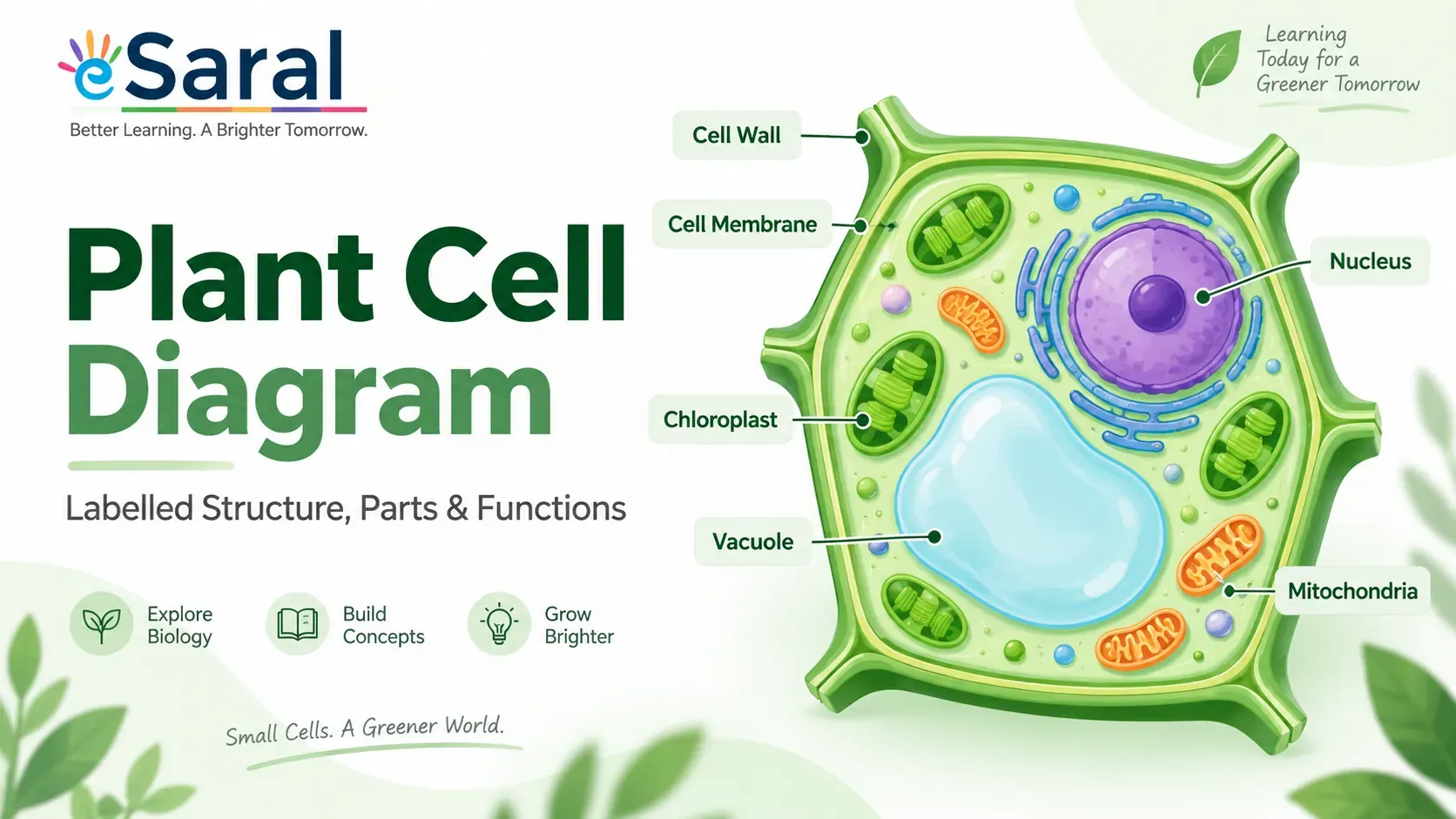
Plant Cell Diagram: Labelled Structure, Parts and Functions
Simple, labelled plant cell diagram with parts and functions. Covers plant cell structure for Class 6, 7, 8, 9, 10 and 11 students, CBSE-aligned.

Saransh Gupta Sir's Visit to IIT Patna: Hostel Life, Placements & Lessons for JEE Aspirants
Inside Saransh Gupta Sir's IIT Patna visit — hostel life, the library, placements, internships, and real advice for JEE aspirants from students living the IIT dream.
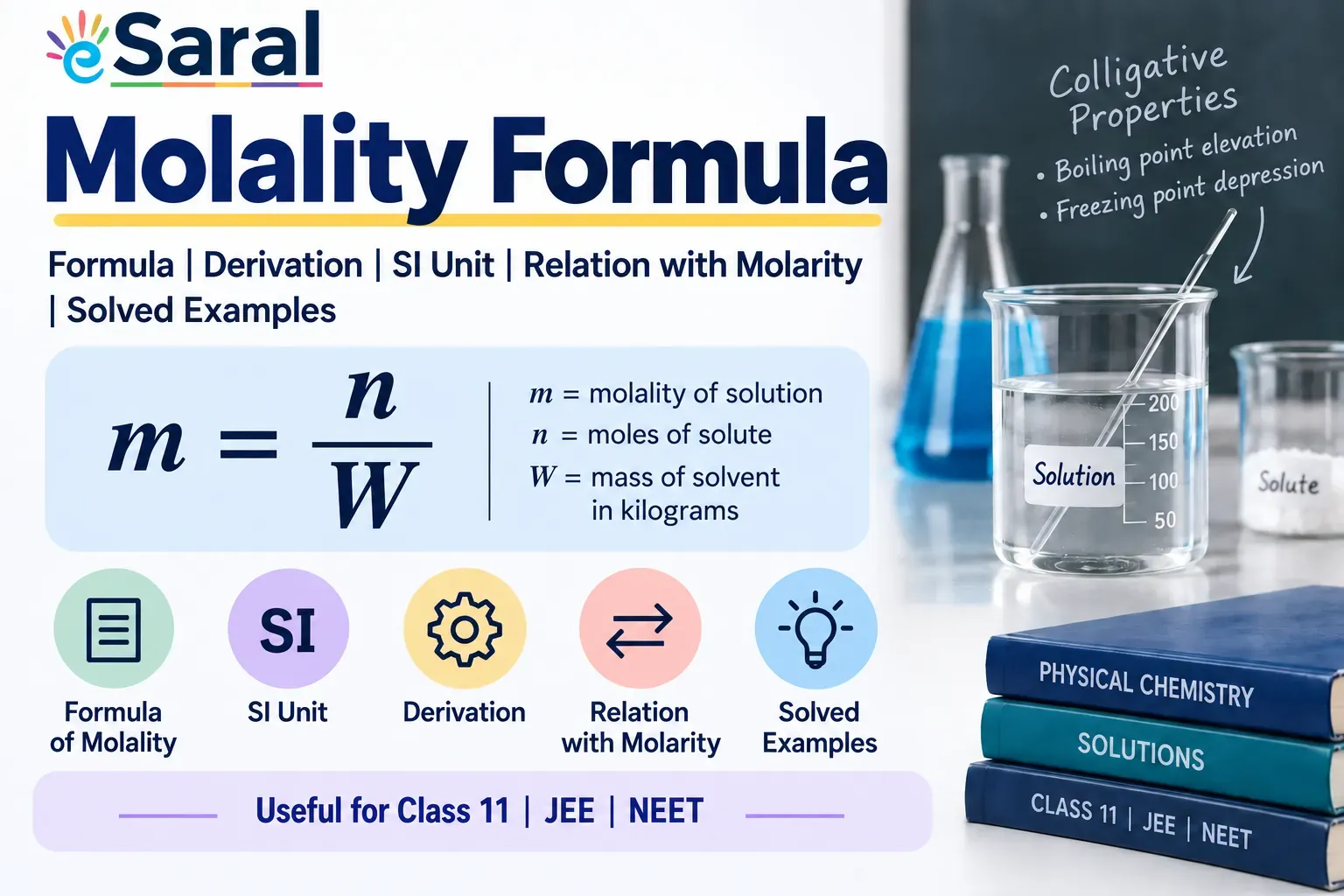
Molality Formula: Formula for Molality, Derivation & Solved Examples
Molality formula is $m = \dfrac{n}{W}$. Learn the formula of molality, its SI unit, derivation, relation with molarity, and solved examples for Class 11, JEE and NEET.

BITSAT Previous Year Question Paper PDF
Download BITSAT previous year question papers PDF. Get year-wise BITSAT PYQs, memory-based papers, exam pattern, and preparation tips to improve your BITSAT preparation.

Teachers’ Day 2026 at eSaral Gurukul: Celebrating the Bond Between Students, Teachers & Mentors
See how Teachers’ Day 2026 was celebrated at eSaral Gurukul, reflecting the bond among students, teachers, and mentors, and the role of guidance beyond academics.
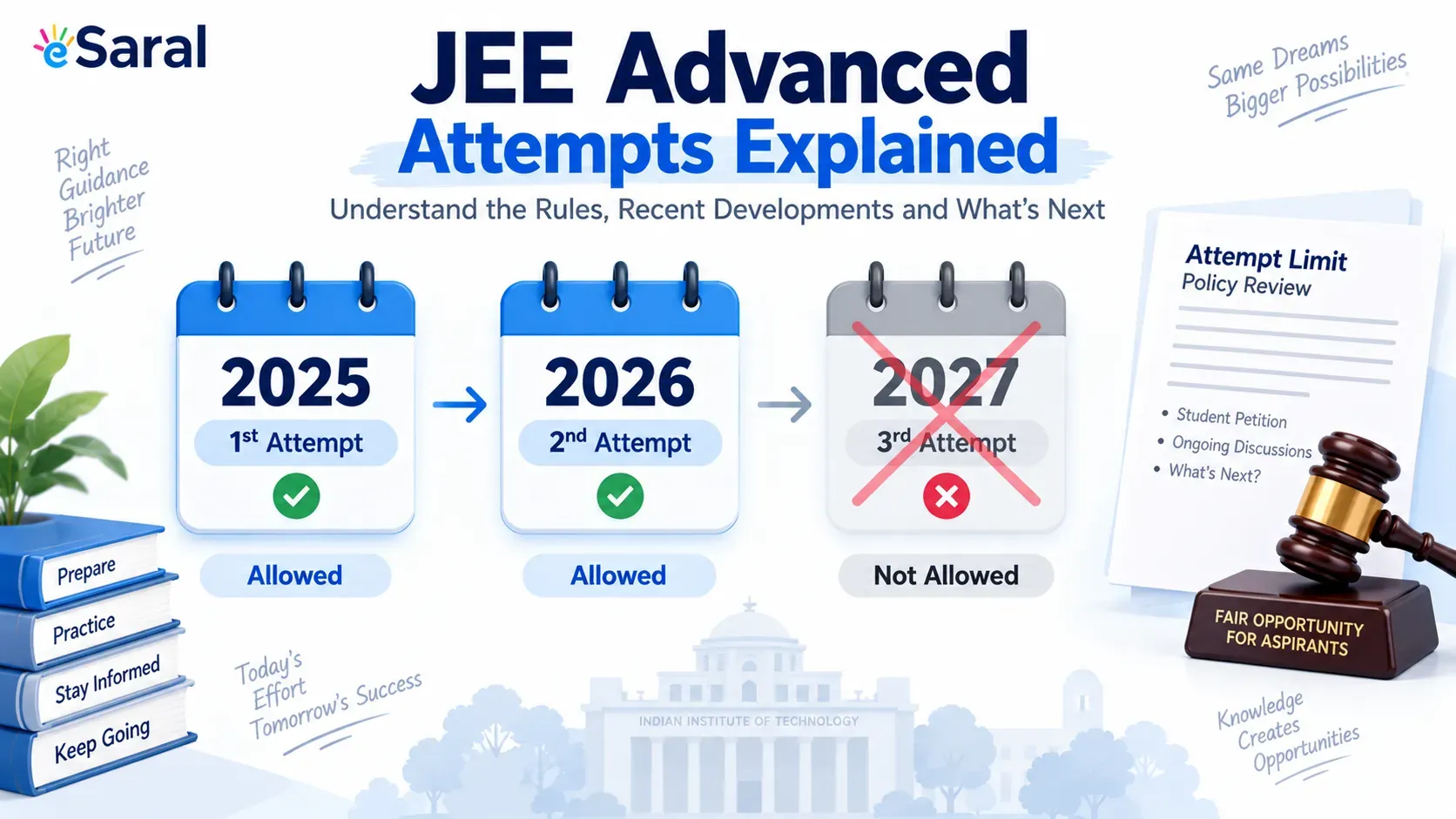
JEE Advanced Attempts: Can You Give It a Third Time? Rules Explained
JEE Advanced attempts: current rule is 2 consecutive years only: full eligibility criteria, the 2025 third-attempt controversy, and the latest 2026 petition news.

Best JEE Preparation App
Best JEE preparation app for Main & Advanced: AI mock tests, live doubt-solving, thousands of practice questions. JEE preparation app for droppers & Class 11-12.
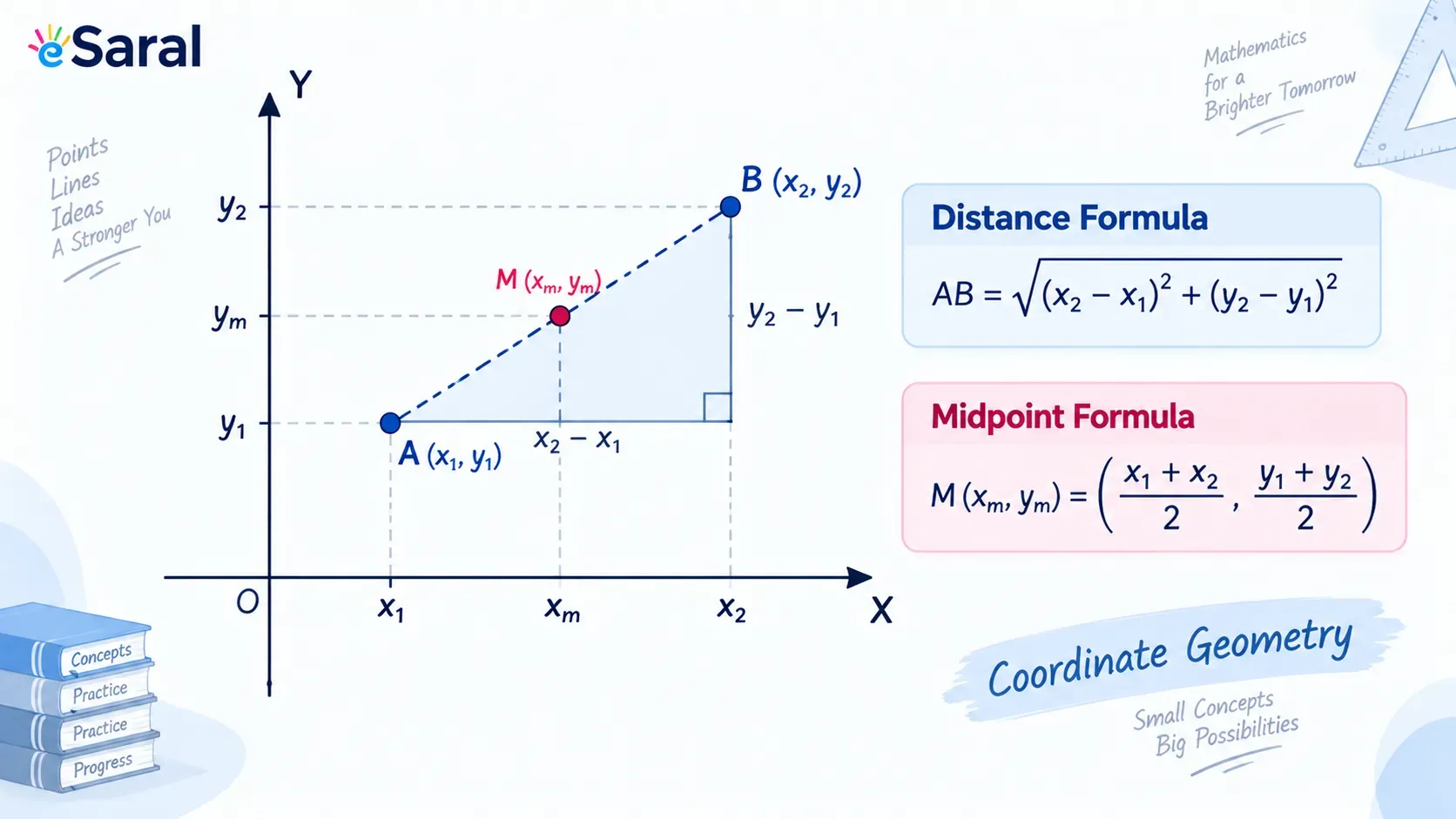
Coordinate Geometry Class 10: Formulas, Notes & Solved Examples
Coordinate geometry class 10: complete CBSE formulas — distance, section, midpoint and area of triangle — with derivation, notes and solved examples.
How to make Notes For JEE Smart Notes Strategy of an AIR 41
Learn how to make notes for JEE the way toppers do — indexing, shorthand, and smart short notes for JEE that cut revision time to just 5–7 days.
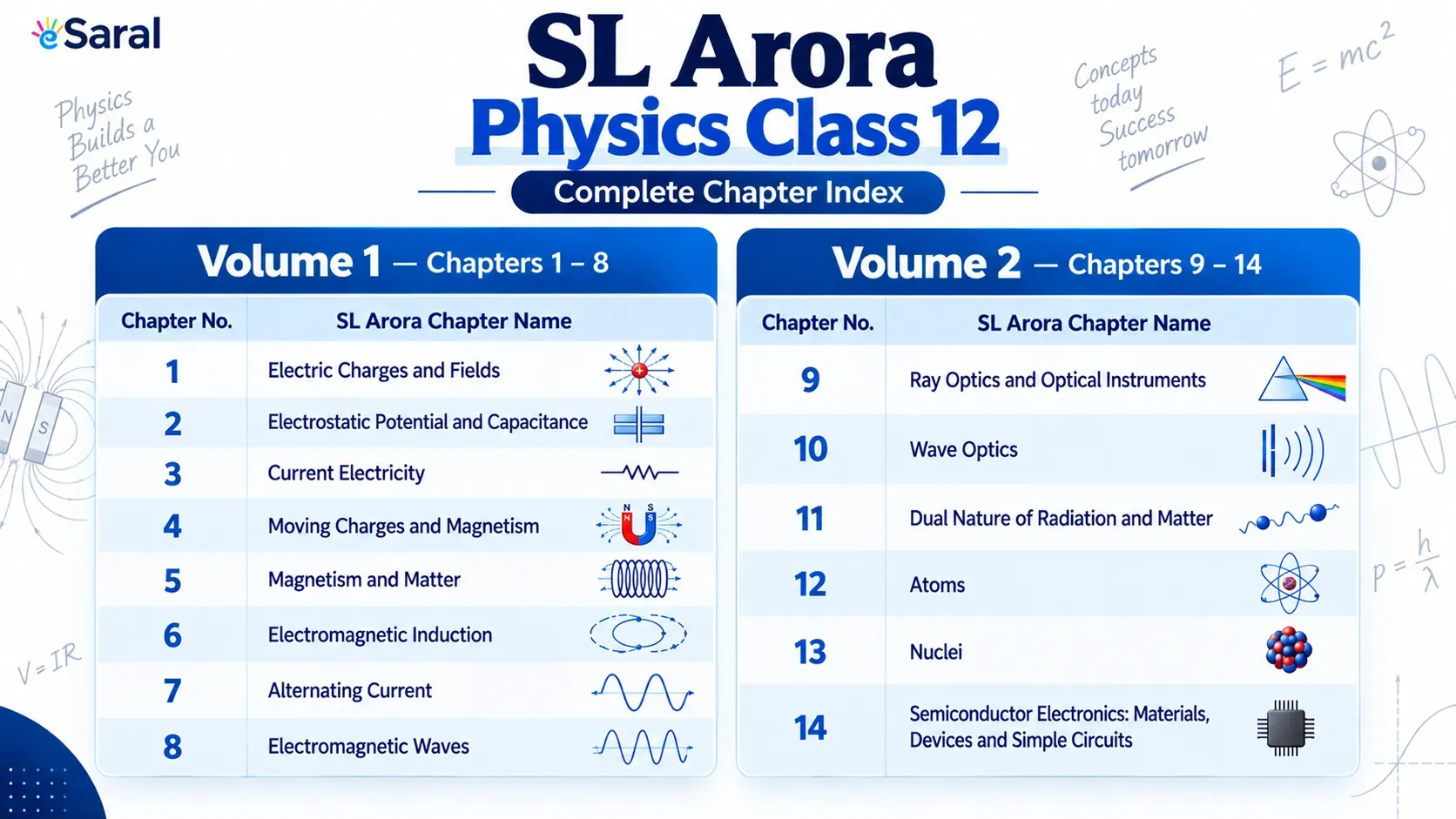
SL Arora Physics Class 12 Index – Chapter List for Volume 1 & 2
SL Arora Physics Class 12 index — complete chapter list for Volume 1 & 2, mapped to NCERT solutions for board, JEE Main, and NEET preparation.