
Sequence-Series - JEE Main Previous Year Question with Solutions
Summary
Sequence and Series questions in JEE Main primarily test Arithmetic Progressions (AP), Geometric Progressions (GP), and Arithmetico-Geometric Progressions (AGP). NTA has asked 1–2 questions per paper from this chapter. Students who master sum formulas, common difference/ratio properties, and AM–GM inequalities typically solve these questions within 2 minutes.

eSaral > JEE Main Maths PYQs > Sequence and Series
[jee-post-banner]
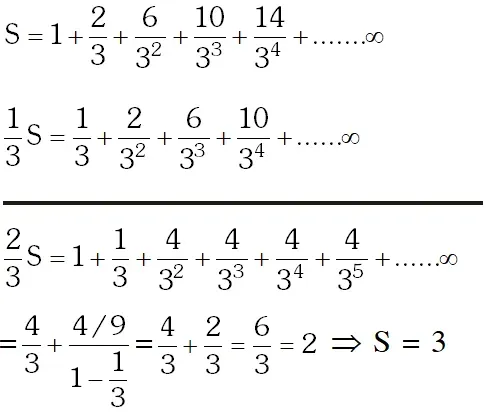
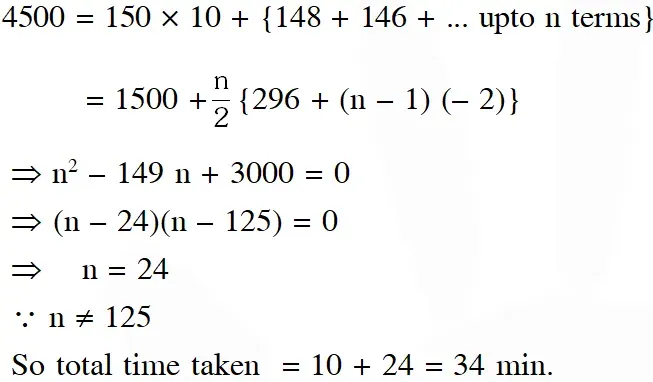
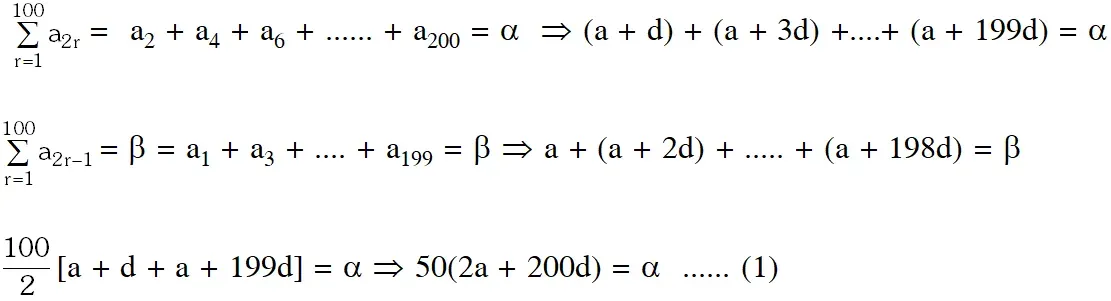
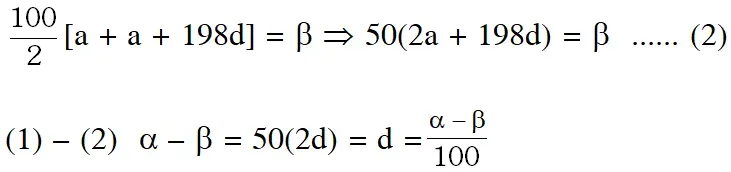
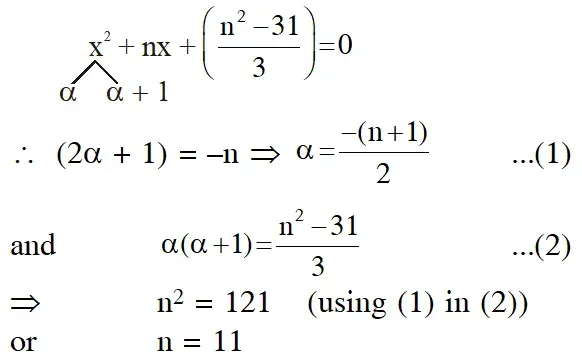
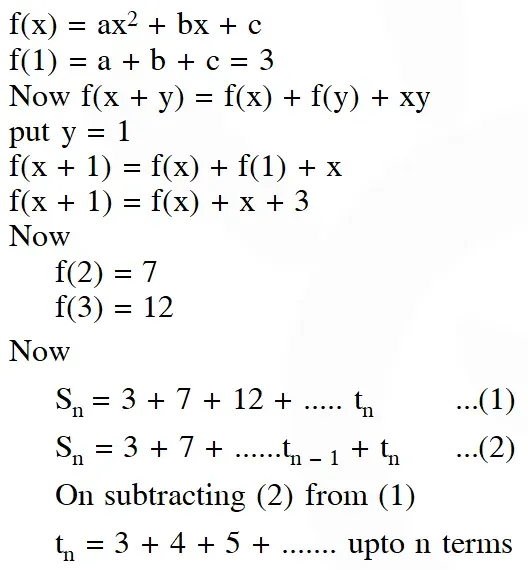
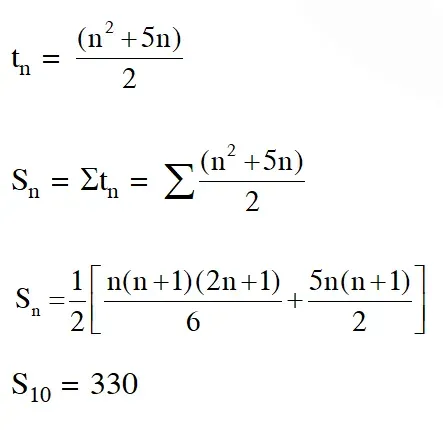
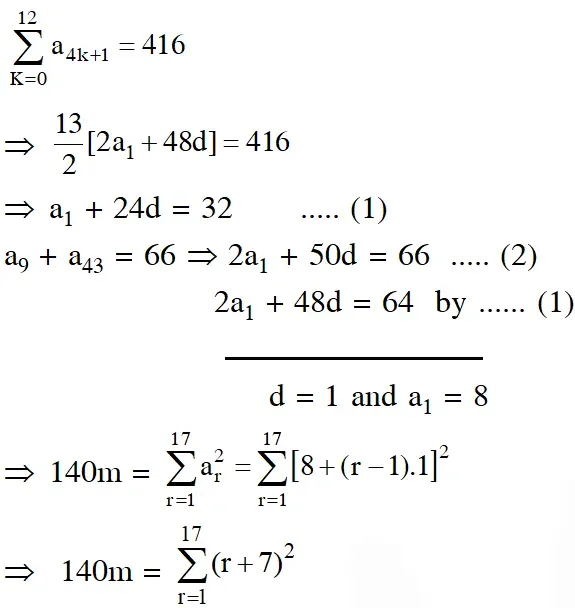
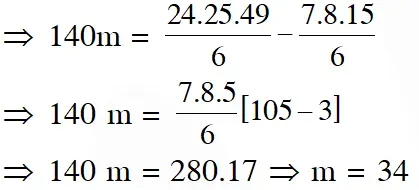
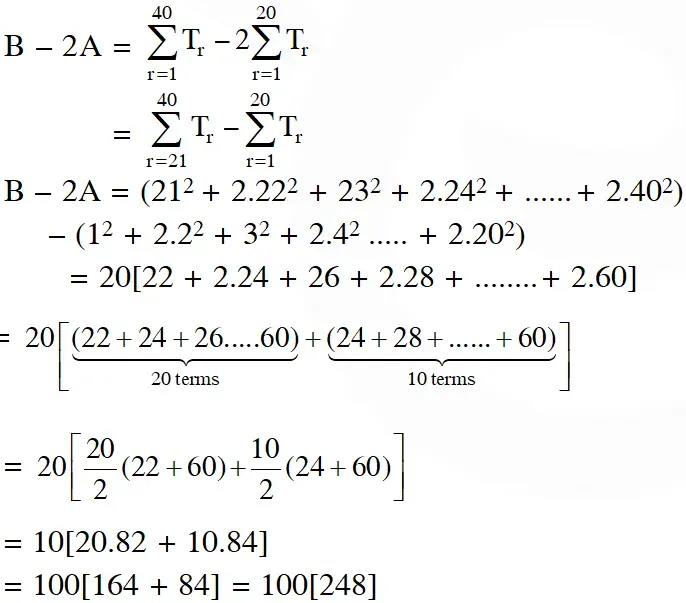
JEE Main Previous Year Question of Math with Solutions are available at eSaral. Practicing JEE Main Previous Year Papers Questions of mathematics will help the JEE aspirants in realizing the question pattern as well as help in analyzing weak & strong areas. eSaral helps the students in clearing and understanding each topic in a better way. eSaral is providing complete chapter-wise notes of Class 11th and 12th both for all subjects. Besides this, eSaral also offers NCERT Solutions, Previous year questions for JEE Main and Advance, Practice questions, Test Series for JEE Main, JEE Advanced and NEET, Important questions of Physics, Chemistry, Math, and Biology and many more. Download eSaral app for free study material and video tutorials. [esquestion] The sum to infinity of the series $1+\frac{2}{3}+\frac{6}{3^{2}}+\frac{10}{3^{3}}+\frac{14}{3^{4}}+\ldots .$ is :- (1) 4 (2) 6 (3) 2 (4) 3 #tag# [AIEEE-2009] #sol# (4) [/esquestion] [esquestion] A person is to count 4500 currency notes. Let a denote the number of notes he counts in the $\mathrm{n}^{\mathrm{th}}$ minute. If $\mathrm{a}_{1}=\mathrm{a}_{2}=\ldots=\mathrm{a}_{10}=150$ and $\mathrm{a}_{10} \mathrm{a}_{11}, \ldots$ are in an AP with common difference - $2,$ then the time taken by him to count all notes is :- (1) 24 minutes (2) 34 minutes (3) 125 minutes (4) 135 minutes #tag# [AIEEE-2010] #sol# (2) [/esquestion] [esquestion] A man saves Rs. 200 in each of the first three months of his service. In each of the subsequent months his saving increases by Rs. 40 more the saving of immediately previous month. His total saving from the start of service will be Rs. 11040 after :- (1) 20 months (2) 21 months (3) 18 months (4) 19 months #tag# [AIEEE-2011] #sol# (2) Saving after first 3 month $=600$ $600+\left\{\frac{240+280+\ldots .}{\text { let } n \text { month }}\right\}=11040$ $| 240+280+\ldots . .$ n terms $|=10440$ n/2 $[480+\ldots . . . \text { n terms }]=10440$ n/2 $[480+(n-1) 40]=10440$ n $\{440+40 n\}=20880$ $\mathrm{n}^{2}+11 \mathrm{n}-522=0$ $\mathrm{n}=18,-29 \quad(-29 \text { rejected })$ Total months $=\mathrm{n}+3$ 18 $+3=21$ Months [/esquestion] [esquestion] Let $a_{n}$ be the $n^{\text {th }}$ term of an A.P. If $\sum_{r=1}^{100} a_{2 r}=\alpha$ and $\sum_{r=1}^{100} a_{2 r-1}=\beta,$ then the common difference of the A.P. is : (1) $\frac{\alpha-\beta}{200}$ (2) $\alpha-\beta$ (3) $\frac{\alpha-\beta}{100}$ (4) $\beta-\alpha$ #tag# [AIEEE-2011] #sol# (3) [/esquestion] [esquestion] Statement-1: The sum of the series $1+(1+2+4)+(4+6+9)+(9+12+16)$ $\quad+\ldots \ldots+(361+380+400)$ is $8000 .$ Statement-2: $\sum_{\mathrm{k}=1}^{\mathrm{n}}\left(\mathrm{k}^{3}-(\mathrm{k}-1)^{3}\right)=\mathrm{n}^{3},$ for any natural number $\mathrm{n}$ (1) Statement-1 is true, Statement-2 is false. (2) Statement- 1 is false, Statement- 2 is true. (3) Statement- 1 is true, Statement-2 is true ; Statement-2 is a correct explanation for Statement-1. (4) Statement-1 is true, Statement-2 is true; Statement-2 is not a correct explanation for Statement- - $1 .$ #tag# [AIEEE-2012] #sol# (4) Statement-1: $\left(1^{3}-0^{3}\right)+\left(2^{3}-1^{3}\right)+\left(3^{3}-2^{3}\right)+\ldots+\left(20^{3}-19^{3}\right)=20^{3}=8000$ Statement-l is true. Statement-2: $\sum_{k=1}^{n} k^{3}-(k-1)^{3}=\left(1^{3}-0^{3}\right)+\left(2^{3}-1^{3}\right)+\left(3^{3}-2^{3}\right)+\ldots . n^{3}+(n-1)^{3}=n^{3}$ Statement-2 is true and Statement-2 is a correct explanation of Statement- $1 .$ [/esquestion] [esquestion] If 100 times the 100th term of an A.P. with non-zero common difference equals the 50 times its 50th term, then the 150th term of this A.P. is : (1) zero (2) –150 (3) 150 times its 50th term (4) 150 #tag# [AIEEE-2012] #sol# (1) [/esquestion] [esquestion] The sum of first 20 terms of the sequence 0.7, 0.77, 0.777, ......, is : (1) $\frac{7}{81}\left(179-10^{-20}\right)$ (2) $\frac{7}{9}\left(99-10^{-20}\right)$ (3) $\frac{7}{81}\left(179+10^{-20}\right)$ (4) $\frac{7}{9}\left(99-10^{-20}\right)$ #tag# [JEE(Main)-2013] #sol# (3) $S=\frac{7}{10}+\frac{77}{100}+\frac{777}{1000}+\ldots \ldots \quad S=\frac{7}{9}\left\{\frac{10-1}{10}+\frac{100-1}{100}+\frac{1000-1}{1000}+\ldots\right\}$ $=\frac{7}{9}\left\{20-\frac{1}{10}\left(\frac{1-10^{-20}}{9 / 10}\right)\right\}=\frac{7}{9}\left\{20-\frac{1}{9}\left(1-10^{-20}\right)\right\}=\frac{7}{81}\left(179+10^{-20}\right)$ [/esquestion] [esquestion] Let $\alpha$ and $\beta$ be the roots of equation $\mathrm{px}^{2}+\mathrm{qx}+\mathrm{r}=0, \mathrm{p} \neq 0 .$ If $\mathrm{p}, \mathrm{q}, \mathrm{r}$ are in A.P. and $\frac{1}{\alpha}+\frac{1}{\beta}=4,$ then the value of $|\alpha-\beta|$ is: (1) $\frac{\sqrt{61}}{9}$ (2) $\frac{2 \sqrt{17}}{9}$ (3) $\frac{\sqrt{34}}{9}$ (4) $\frac{2 \sqrt{13}}{9}$ #tag# [JEE(Main)-2014] #sol# (4) $\frac{\alpha+\beta}{\alpha \beta}=4=-\frac{q}{r} \Rightarrow q=-4 r$ $\because p, q \& r$ are in A.P $2 q=p+r$ $\Rightarrow \quad-8 r=p+r \Rightarrow p=-9 r$ $|\alpha-\beta|=\sqrt{(\alpha+\beta)^{2}-4 \alpha \beta}=\sqrt{\frac{16 r^{2}+36 r^{2}}{p^{2}}}=\sqrt{\frac{52 r^{2}}{p^{2}}}=\sqrt{\frac{52}{81}}=\frac{2 \sqrt{13}}{9}$ [/esquestion] [esquestion] Three positive numbers form an increasing G.P. If the middle term in this G.P. is doubled, the new numbers are in A.P. Then the common ratio of the G.P. is : (1) $\sqrt{2}+\sqrt{3}$ (2) $3+\sqrt{2}$ (3) $2-\sqrt{3}$ (4) $2+\sqrt{3}$ #tag# [JEE(Main)-2014] #sol# (4) Let a, ar, ar $^{2}$ are in G.P $\therefore \quad$ a, 2 ar, $\operatorname{ar}^{2}$ are in AP $\Rightarrow \quad 4$ ar $=a+a r^{2}$ $\Rightarrow \quad r^{2}-4 r+1=0$ $\Rightarrow r=2+\sqrt{3}, 2-\sqrt{3}$ since GP is an increasing G.P $\Rightarrow r=2+\sqrt{3}$ [/esquestion] [esquestion] If $(10)^{9}+2(11)^{1}(10)^{8}+3(11)^{2}(10)^{7}+\ldots \ldots+10(11)^{9}=\mathrm{k}(10)^{9},$ then $\mathrm{k}$ is equal to : (1) $\frac{121}{10}$ (2) $\frac{441}{100}$ (3) 100 (4) 110 #tag# [JEE(Main)-2014] #sol# (3) $\mathrm{S}=10^{9}+2(11)^{1}(10)^{8}+3(11)^{2}(10)^{7}+\ldots+10(11)^{9}$ $\frac{11}{10} \mathrm{S}=(11)(10)^{8}+2(11)^{2}(10)^{7}+\ldots 11^{10}$ $-\frac{\mathrm{S}}{10}=10^{9}+\left(11.10^{8}+11^{2} .10^{7}+\ldots .+11^{9}\right)-11^{10}$ $\begin{aligned}-\frac{\mathrm{S}}{10} &=10^{9}+11.108^{8} \frac{\left(1-\left(\frac{11}{10}\right)^{9}\right)}{\left(1-\frac{11}{10}\right)}-11^{10} \\ &=10^{9}+10^{8} \cdot 11 \frac{\left(10^{9}-11^{9}\right)}{10^{9}(-1)} \cdot 10-11^{10} \\ &=10^{9}+11\left(11^{9}-11^{9}\right) \cdot 10-11^{10} \\ &=10^{9}+11\left(11^{9}-10^{9}\right)-11^{10} \\ \mathrm{S} &=10^{11}=\mathrm{K} 10^{9} \\ \Rightarrow \mathrm{K} &=100 \end{aligned}$ [/esquestion] [esquestion] If $\mathrm{m}$ is the A.M. of two distinct real numbers 1 and $\mathrm{n}(1, \mathrm{n}>1)$ and $\mathrm{G}_{1}, \mathrm{G}_{2}$ and $\mathrm{G}_{3}$ are three geometric means between 1 and $\mathrm{n}$, then $\mathrm{G}_{1}^{4}+2 \mathrm{G}_{2}^{4}+\mathrm{G}_{3}^{4}$ equals – (1) $4 \operatorname{lmn}^{2}$ (2) $41^{2} \mathrm{m}^{2} \mathrm{n}^{2}$ (3) $4 \mathrm{l}^{2} \mathrm{mn}$ (4) $4 \ln ^{2} n$ #tag# [JEE(Main)-2015] #sol# (4) $\ell, \mathrm{G}_{1}, \mathrm{G}_{2}, \mathrm{G}_{3}, \mathrm{n}$ in G.P. Let $\mathrm{r}$ be the common ratio $\Rightarrow \mathrm{r}^{4}=\frac{\mathrm{n}}{\ell}$ Here $\mathrm{G}_{1}^{4}+2 \mathrm{G}_{2}^{4}+\mathrm{G}_{3}^{4}=(\ell \mathrm{r})^{4}+2\left(\ell \mathrm{r}^{2}\right)^{4}+\left(\ell \mathrm{r}^{3}\right)^{4}=\mathrm{n} \ell\left[\ell^{2}+2 \ell \mathrm{n}+\mathrm{n}^{2}\right]=\mathrm{n} \ell(\ell+\mathrm{n})^{2}=\mathrm{n} \ell 4 \mathrm{m}^{2}$ $=4 \mathrm{m}^{2} \mathrm{n} \ell \quad(\because 2 \mathrm{m}=\mathrm{n}+\ell)$ [/esquestion] [esquestion] If the 2nd, 5th and 9th terms of a non-constant A.P. are in G.P., then the common ratio of this G.P.is ( 1)$\frac{7}{4}$ (2) $\frac{8}{5}$ (3) $\frac{4}{3}$ (4) 1 #tag# [JEE(Main)-2016] #sol# (3) Let 'a' be the first term and d be the common difference $2^{\text {nd }} \operatorname{term}=a+d, 5^{\text {th }} \operatorname{term}=a+4 d$, 9th term $=4+8 d$ $\therefore$ Common ratio $=\frac{a+4 d}{a+d}=\frac{a+8 d}{a+4 d}=\frac{4 d}{3 d}=\frac{4}{3}$ [/esquestion] [esquestion] If the sum of the first ten terms of the series $\left(1 \frac{3}{5}\right)^{2}+\left(2 \frac{2}{5}\right)^{2}+\left(3 \frac{1}{5}\right)^{2}+4^{2}+\left(4 \frac{4}{5}\right)^{2}+\ldots,$ is $\frac{16}{5} \mathrm{m}$, then $\mathrm{m}$ is equal to :- (1) 99 (2) 102 (3) 101 (4) 100 #tag# [JEE(Main)-2016] #sol# (3) Given series is $\mathrm{S}=\frac{8^{2}}{5^{2}}+\frac{12^{2}}{5^{2}}+\frac{16^{2}}{5^{2}}+\ldots 10 \mathrm{terms}$ $=\frac{4^{2}}{5^{2}}\left(2^{2}+3^{2}+4^{2}+\ldots .10 \mathrm{terms}\right)$ $=\frac{16}{25}\left(\frac{11.12 .23}{6}-1\right)=\frac{16}{25} \times 505$ $\therefore \mathrm{m}=101$ [/esquestion] [esquestion] If, for a positive integer n, the quadratic equation, $\mathrm{x}(\mathrm{x}+1)+(\mathrm{x}+1)(\mathrm{x}+2)+\ldots \ldots+(\mathrm{x}+\overline{\mathrm{n}-1})(\mathrm{x}+\mathrm{n})$= 10n has two consecutive integral solutions, then n is equal to : (1) 11 (2) 12 (3) 9 (4) 10 #tag# [JEE(Main)-2017] #sol# (1) We have $\sum_{\mathrm{r}=1}^{\mathrm{n}}(\mathrm{x}+\mathrm{r}-1)(\mathrm{x}+\mathrm{r})=10 \mathrm{n}$ $\Rightarrow \sum_{\mathrm{r}=1}^{\mathrm{n}}\left(\mathrm{x}^{2}+(2 \mathrm{r}-1) \mathrm{x}+\left(\mathrm{r}^{2}-\mathrm{r}\right)\right)=10 \mathrm{n}$ $\therefore$ On solving, we get [/esquestion] [esquestion] For any three positive real numbers a, b and $c, 9\left(25 a^{2}+b^{2}\right)+25\left(c^{2}-3 a c\right)=15 b(3 a+c)$ Then : (1) a, b and c are in G.P. (2) b, c and a are in G.P. (3) b, c and a are in A.P. (4) a, b and c are in A.P. #tag# [JEE(Main)-2017] #sol# (3) $(15 a)^{2}+(3 b)^{2}+(5 c)^{2}-(15 a)(5 c)-(15 a)(3 b)-(3 b)(5 c)=0$ $\frac{1}{2}\left[(15 a-3 b)^{2}+(3 b-5 c)^{2}+(5 c-15 a)^{2}\right]=0$ it is possible when $15 a=3 b=5 c$ $\therefore b=\frac{5 c}{3}, a=\frac{c}{3}$ $a+b=2 c$ $\Rightarrow b, c, a$ in A.P. [/esquestion] [esquestion] Let $a, b, c \in R .$ If $f(x)=a x^{2}+b x+c$ is such that $a+b+c=3$ and $f(x+y)=f(x)+f(y)+$ $\mathrm{xy}, \forall \mathrm{x}, \mathrm{y} \in \mathrm{R},$ then $\sum_{\mathrm{n}=1}^{10} \mathrm{f}(\mathrm{n})$ is equal to : (1) 255 (2) 330 (3) 165 (4) 190 #tag# [JEE(Main)-2017] #sol# (2) [/esquestion] [esquestion] Let $a_{1}, a_{2}, a_{3}, \ldots ., a_{49}$ be in A.P. such that $\sum_{\mathrm{k}=0}^{12} \mathrm{a}_{4 \mathrm{k}+1}$ $=416$ and $a_{9}+a_{43}=66 .$ If $a_{1}^{2}+a_{2}^{2}+\ldots \ldots+a_{17}^{2}$ = 140m, then m is equal to- (1) 68 (2) 34 (3) 33 (4) 66 #tag# [JEE(Main)-2018] #sol# (2) [/esquestion] [esquestion] Let A be the sum of the first 20 terms and B be the sum of the first 40 terms of the series $1^{2}+2 \cdot 2^{2}+3^{2}+2 \cdot 4^{2}+5^{2}+2 \cdot 6^{2}+\ldots \ldots \ldots \quad$ If $\mathrm{B}-2 \mathrm{A}=100 \lambda,$ then $\lambda$ is equal to : (1) 248 (2) 464 (3) 496 (4) 232 #tag# [JEE(Main)-2018] #sol# (1) [/esquestion]

For offline Sequence & Series practice, use the JEE PYQ chapter wise page to access this and other chapters.
These Sequence & Series questions are pulled from real exams — see them in their original paper format on our JEE Main previous year question paper page.
Frequently Asked Questions
Can I solve Sequence and Series questions without practising previous year papers?
Technically yes, but practically no. The JEE Main question style has specific patterns — disguised APs, functional equations that reduce to series, and statements about means — that only become recognisable through repeated exposure to past papers. Students who skip previous year questions consistently underperform in this chapter relative to their conceptual preparation level
What formulas must be memorised for Sequence and Series JEE Main?
Essential formulas: sum of n terms of AP (Sₙ = n/2 [2a + (n−1)d]), sum of GP (Sₙ = a(rⁿ−1)/(r−1)), sum to infinity of GP (a/(1−r) for |r|<1), sum of squares (Σn² = n(n+1)(2n+1)/6), sum of cubes (Σn³ = [n(n+1)/2]²), and the AGP standard result. These seven cover 90% of JEE Main questions on this topic.
What is the best way to study Sequence and Series for JEE Main?
Start with NCERT Class 11 theory to solidify definitions. Then solve the previous year questions on this page year-by-year, not topic-by-topic. This trains pattern recognition. Finally, time yourself: each Sequence and Series question in JEE Main should take under 2.5 minutes. If it is taking longer, you need more formula fluency, not more theory.
Is Sequence and Series asked in JEE Advanced too?
Yes. JEE Advanced asks more complex forms — multi-variable progressions, inequalities involving AM–GM–HM, and integer-type problems requiring exact sums. Clearing JEE Main-level questions with full understanding (not just memorised steps) is the right foundation for JEE Advanced preparation.
Which sub-topics of Sequence and Series are most important for JEE Main?
Arithmetic Progressions (AP) are the most frequently tested sub-topic, appearing in 7 of the 18 questions on this page alone. Geometric Progressions (GP) come second. Students should also prepare AGP (Arithmetico-Geometric Progressions) and telescoping sums, as these appear as medium-to-hard questions that can differentiate ranks.
How many questions come from Sequence and Series in JEE Main?
JEE Main typically asks 1–2 questions from Sequence and Series per session. With NTA conducting multiple sessions per year, this chapter can contribute 4–6 questions across the full exam cycle. It is a medium-weightage but highly scoring topic because the question types repeat predictably across years
Team eSaral
Related Posts
Plant Cell Diagram: Labelled Structure, Parts and Functions
Simple, labelled plant cell diagram with parts and functions. Covers plant cell structure for Class 6, 7, 8, 9, 10 and 11 students, CBSE-aligned.

Saransh Gupta Sir's Visit to IIT Patna: Hostel Life, Placements & Lessons for JEE Aspirants
Inside Saransh Gupta Sir's IIT Patna visit — hostel life, the library, placements, internships, and real advice for JEE aspirants from students living the IIT dream.
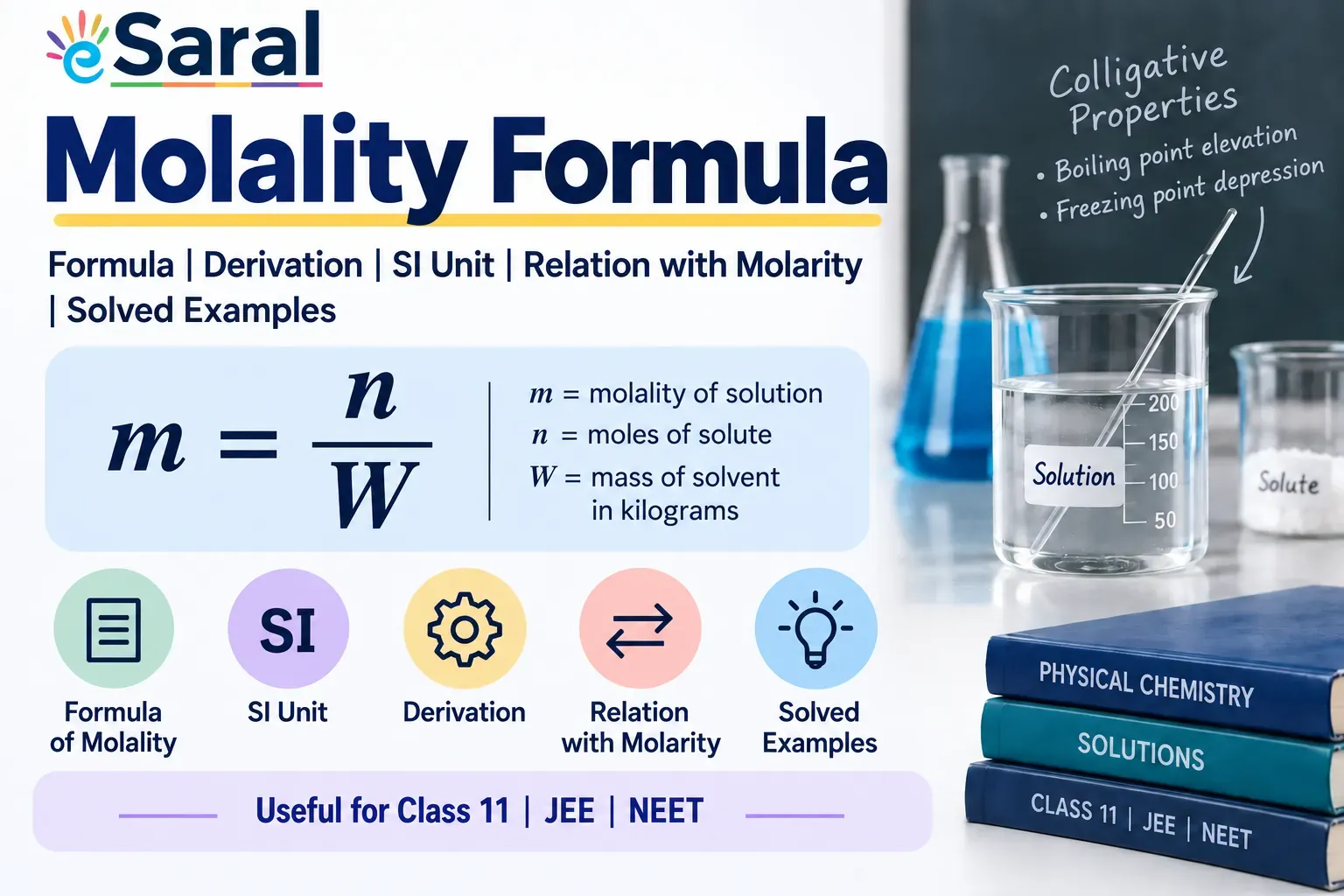
Molality Formula: Formula for Molality, Derivation & Solved Examples
Molality formula is $m = \dfrac{n}{W}$. Learn the formula of molality, its SI unit, derivation, relation with molarity, and solved examples for Class 11, JEE and NEET.
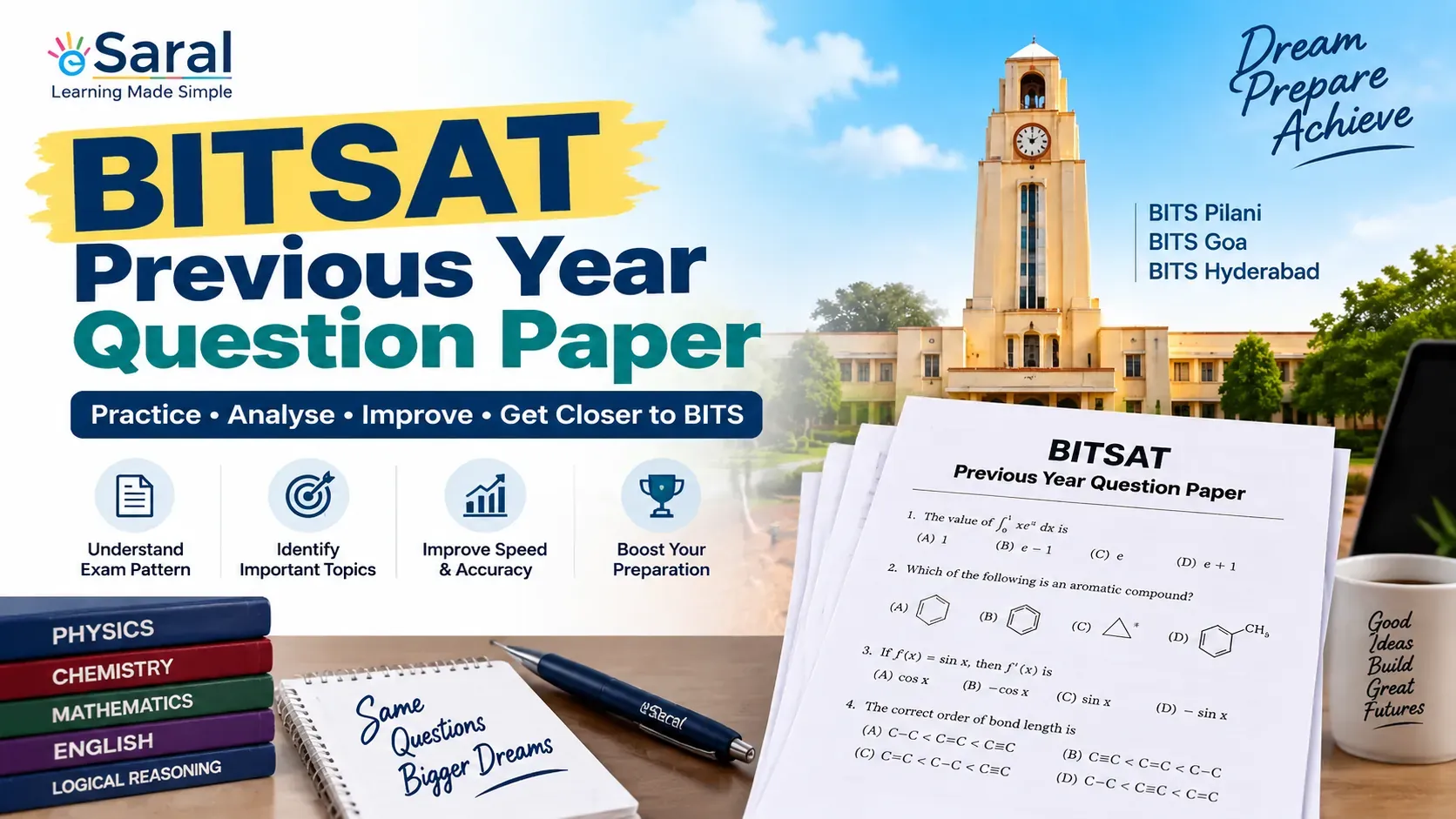
BITSAT Previous Year Question Paper PDF
Download BITSAT previous year question papers PDF. Get year-wise BITSAT PYQs, memory-based papers, exam pattern, and preparation tips to improve your BITSAT preparation.

Teachers’ Day 2026 at eSaral Gurukul: Celebrating the Bond Between Students, Teachers & Mentors
See how Teachers’ Day 2026 was celebrated at eSaral Gurukul, reflecting the bond among students, teachers, and mentors, and the role of guidance beyond academics.
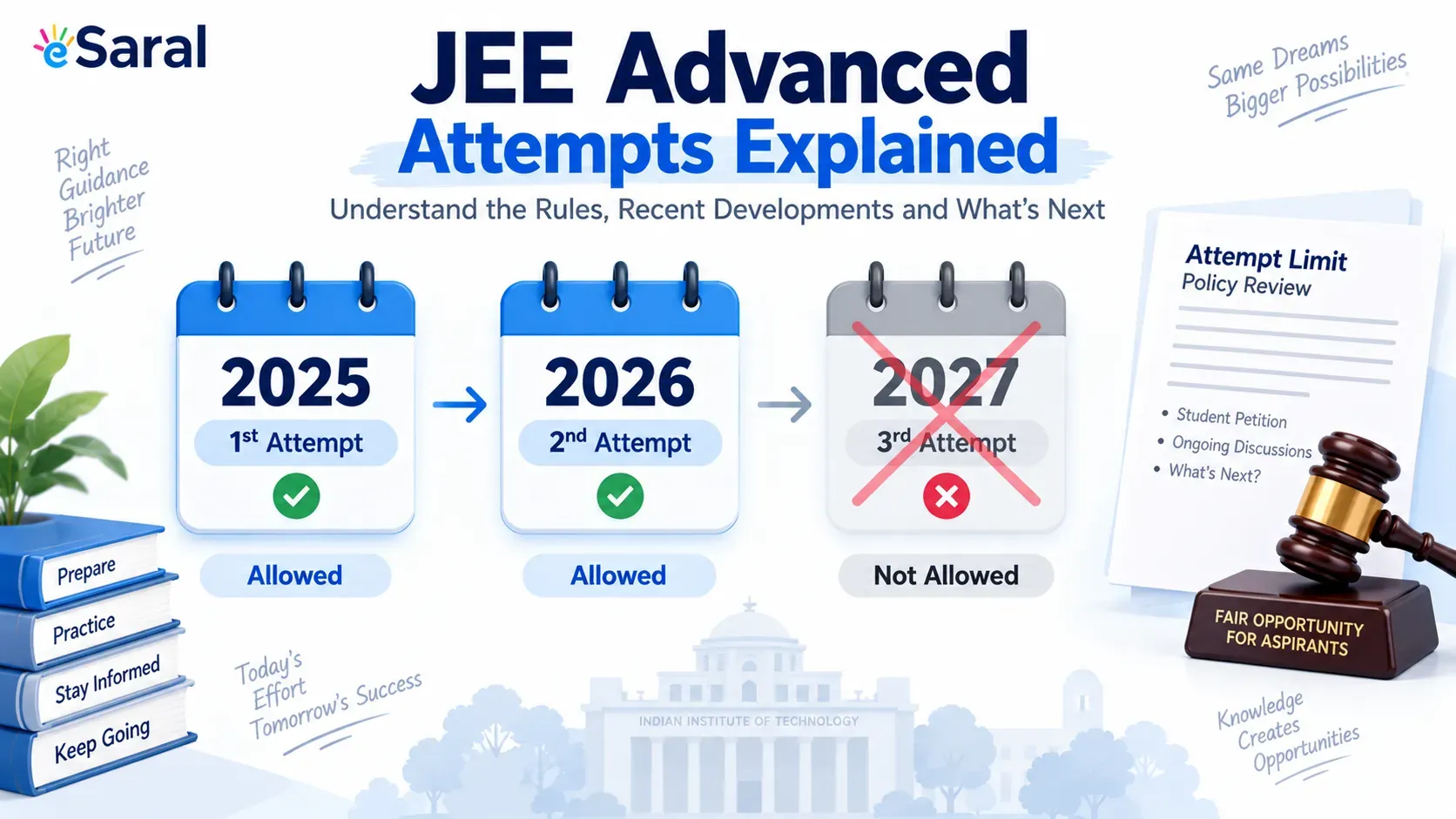
JEE Advanced Attempts: Can You Give It a Third Time? Rules Explained
JEE Advanced attempts: current rule is 2 consecutive years only: full eligibility criteria, the 2025 third-attempt controversy, and the latest 2026 petition news.

Best JEE Preparation App
Best JEE preparation app for Main & Advanced: AI mock tests, live doubt-solving, thousands of practice questions. JEE preparation app for droppers & Class 11-12.
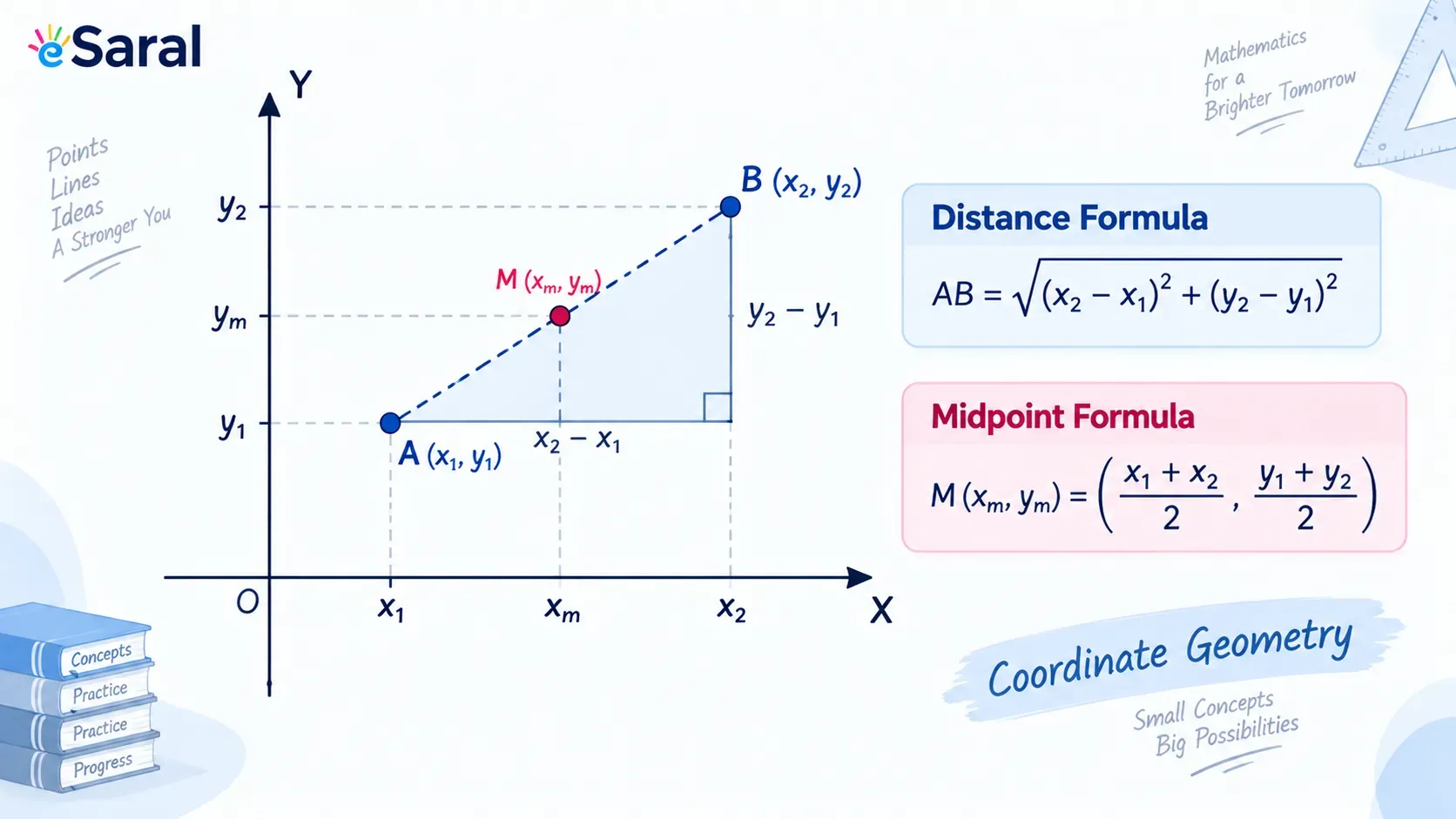
Coordinate Geometry Class 10: Formulas, Notes & Solved Examples
Coordinate geometry class 10: complete CBSE formulas — distance, section, midpoint and area of triangle — with derivation, notes and solved examples.
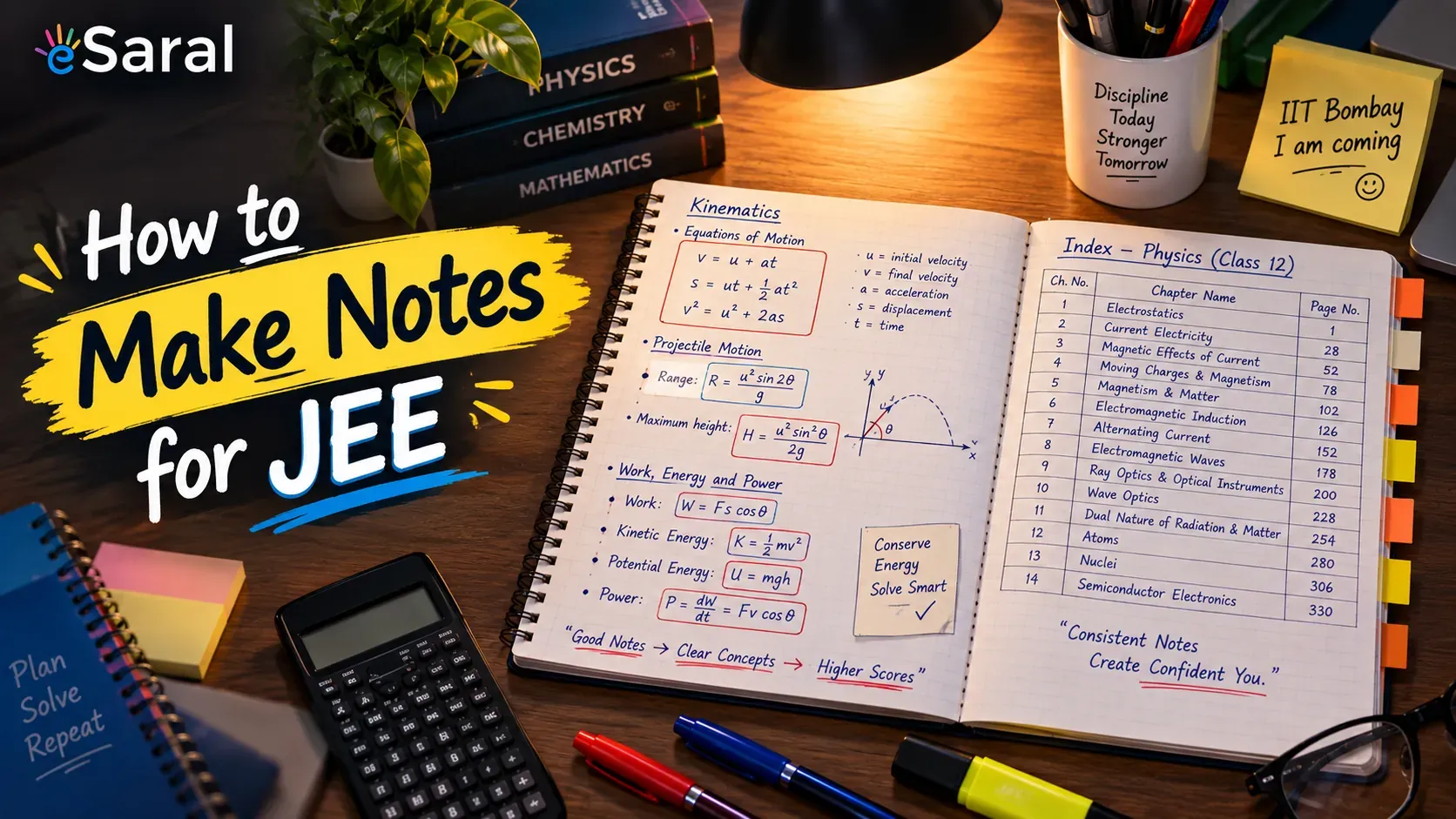
How to make Notes For JEE Smart Notes Strategy of an AIR 41
Learn how to make notes for JEE the way toppers do — indexing, shorthand, and smart short notes for JEE that cut revision time to just 5–7 days.
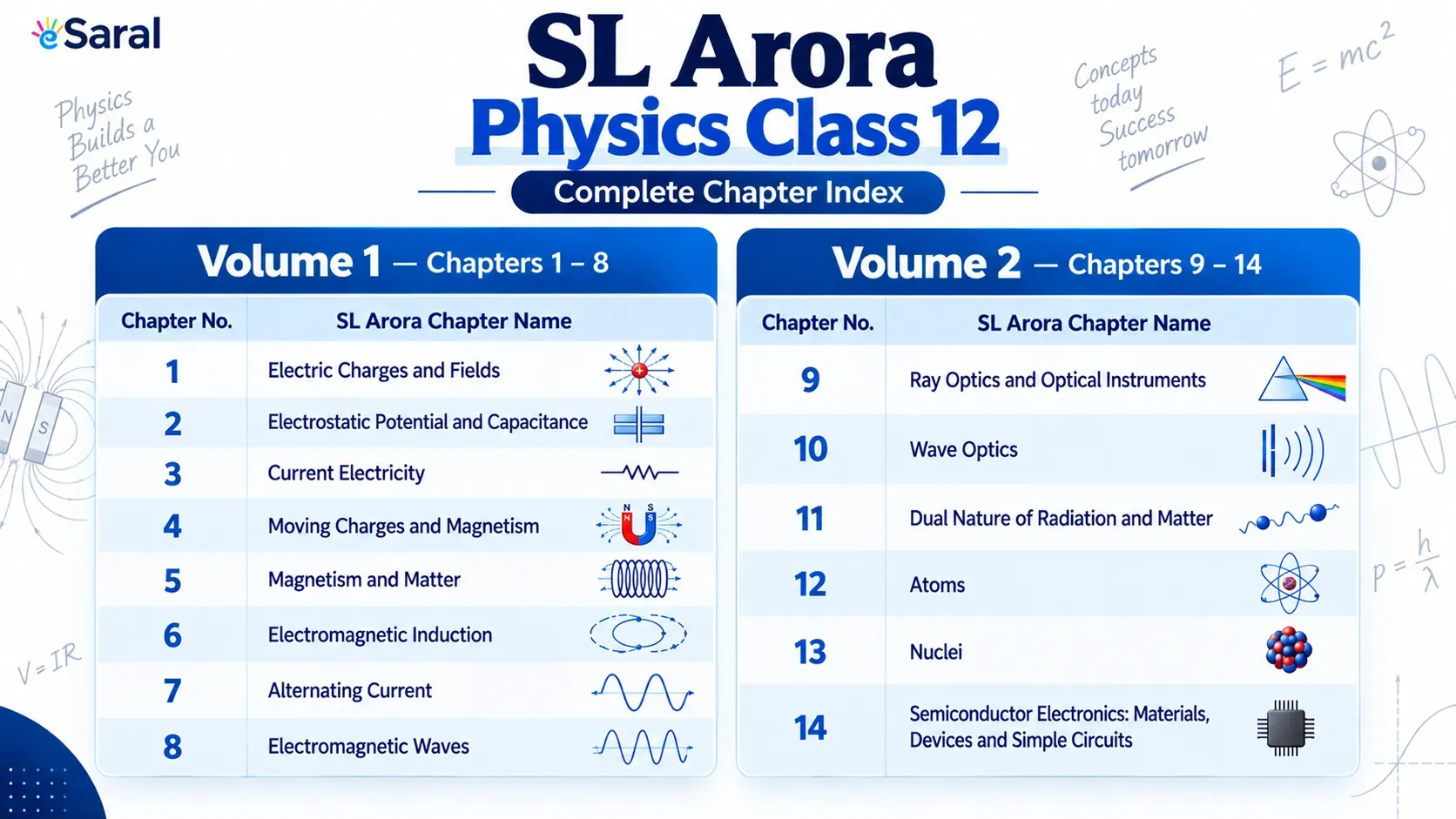
SL Arora Physics Class 12 Index – Chapter List for Volume 1 & 2
SL Arora Physics Class 12 index — complete chapter list for Volume 1 & 2, mapped to NCERT solutions for board, JEE Main, and NEET preparation.