
Simple Harmonic Motion - JEE Main Previous Year Questions with Solutions

eSaral Academic and Editorial Team
Summary
Practice JEE Main & AIEEE Previous Year Questions on Simple Harmonic Motion with detailed solutions to strengthen concepts, improve problem-solving skills, and prepare effectively for upcoming exams.
eSaral › JEE › JEE Main ›Simple Harmonic Motion - JEE Main Previous Year Questions with Solutions

🚀 Checkout eSaral Courses
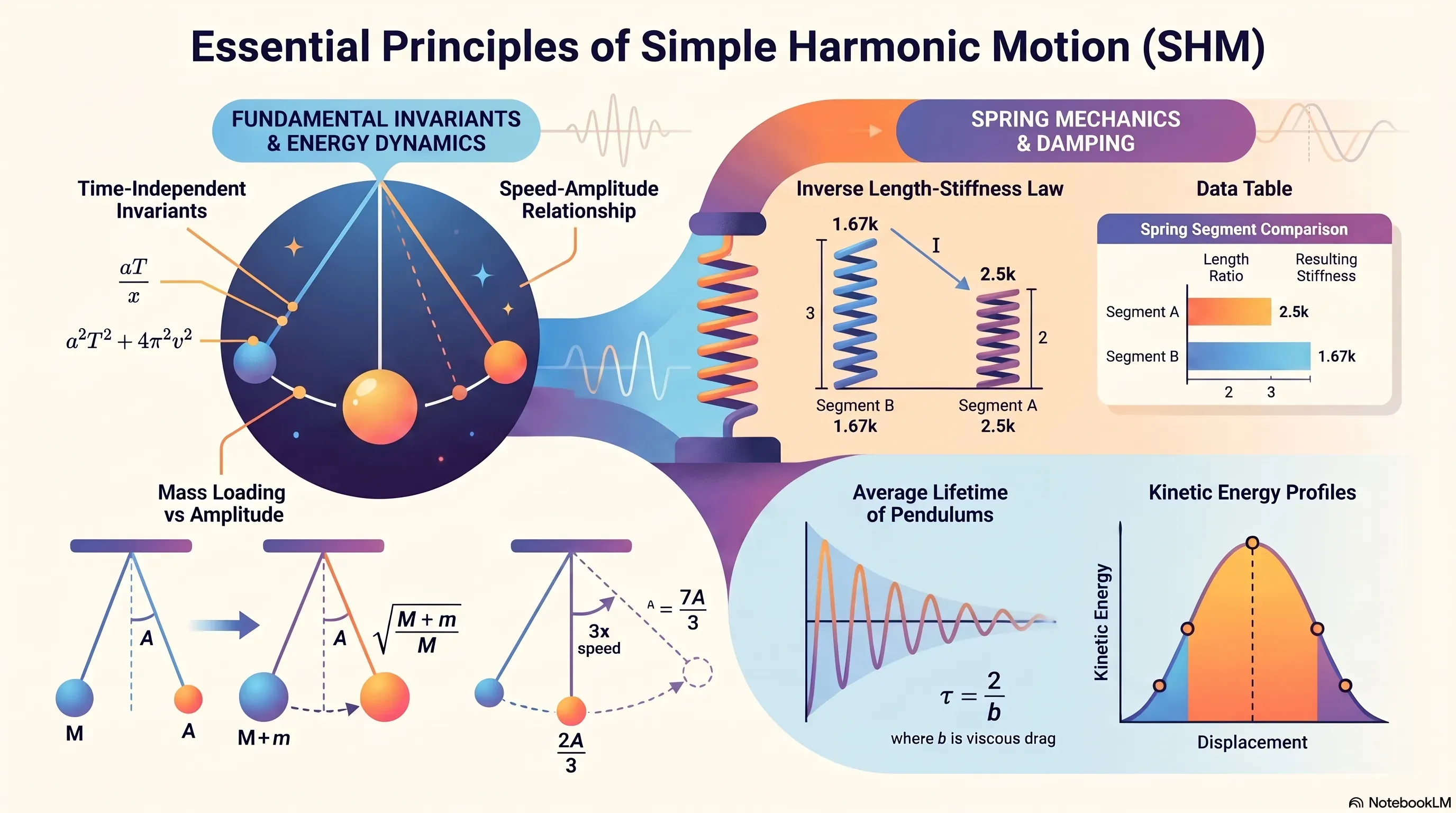
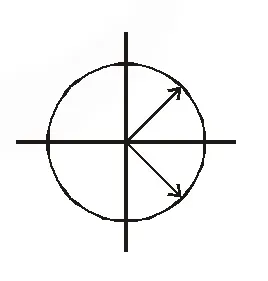
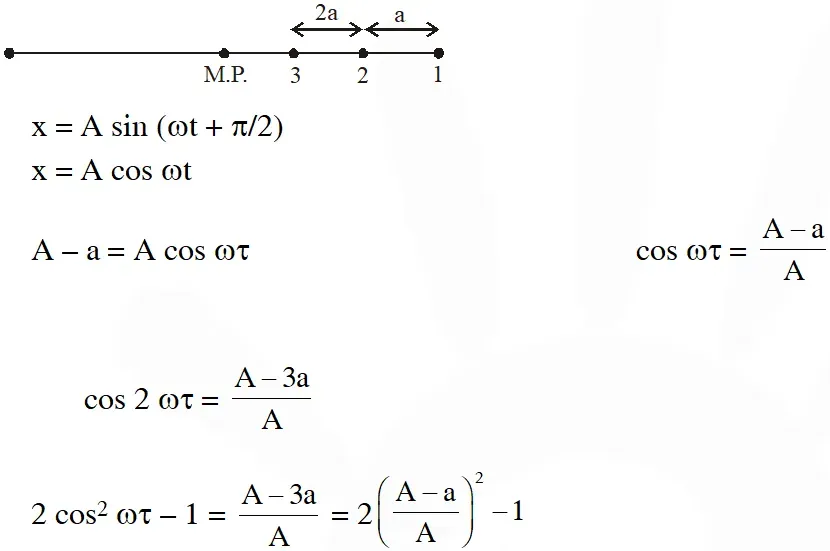
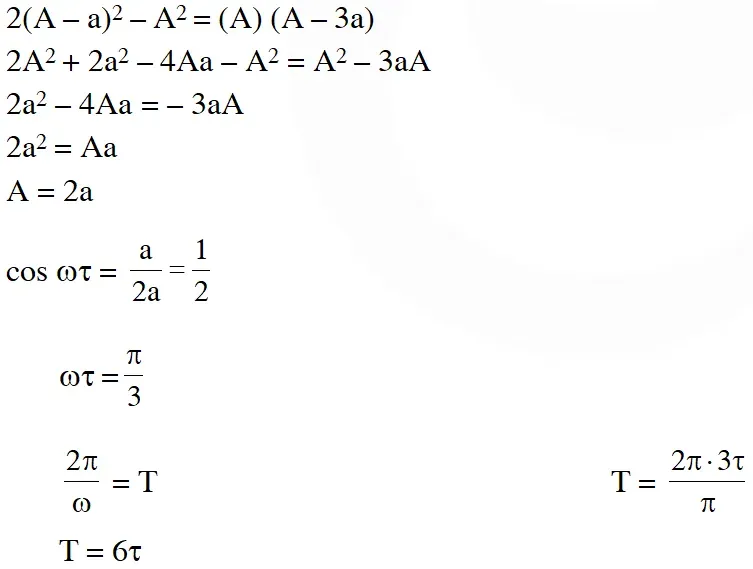
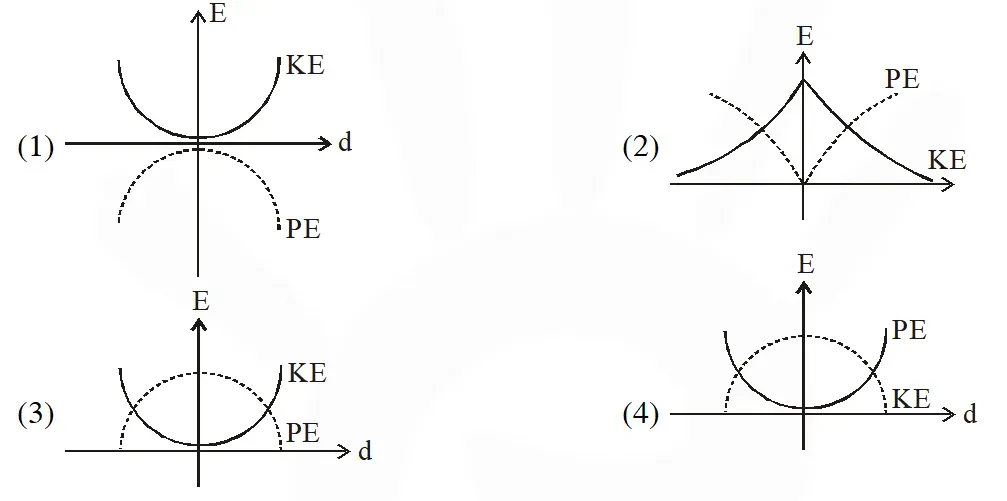
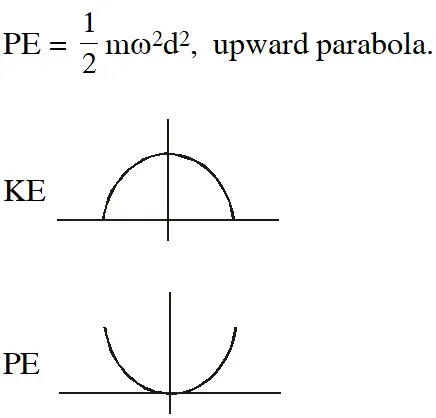
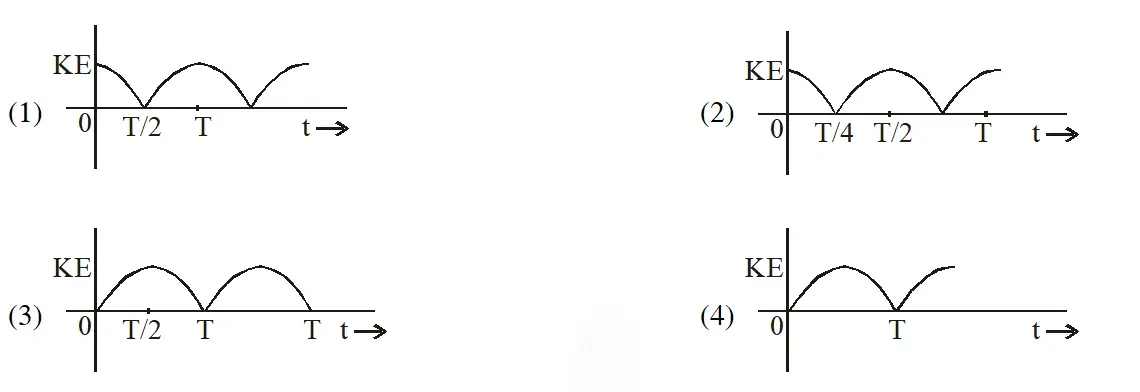
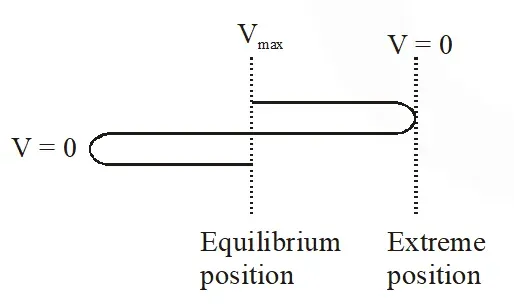
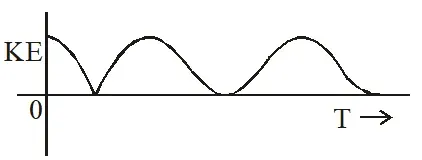
Simulator Previous Years AIEEE/JEE Mains Questions [esquestion] If x, v and a denote the displacement, the velocity and the acceleration of a particle executing simple harmonic motion of time period T, then, which of the following does not change with time ? $(1) \mathrm{aT}+2 \pi \mathrm{v}$ (2) $\frac{\mathrm{aT}}{\mathrm{v}}$ (3) $a^{2} \mathrm{T}^{2}+4 \pi^{2} \mathrm{v}^{2}$ (4) $\frac{\mathrm{aT}}{\mathrm{x}}$ #tag# [AIEEE-2009] #sol# (3,4) \frac{\mathrm{aT}}{\mathrm{x}}=\frac{\omega^{2} \mathrm{xT}}{\mathrm{x}}=\frac{4 \pi^{2}}{\mathrm{T}}=\mathrm{constant} \mathrm{a}^{2} \mathrm{T}^{2}+4 \pi^{2} \mathrm{v}^{2} =\left(\omega^{2} \mathrm{x}\right)^{2} \mathrm{T}^{2}+4 \pi^{2} \omega^{2}\left(\mathrm{A}^{2}-\mathrm{x}^{2}\right) =\left(\frac{4 \pi}{\mathrm{T}^{2}}\right)^{2} \mathrm{x}^{2} \cdot \mathrm{T}^{2}+4 \pi^{2} \cdot \frac{4 \pi^{2}}{\mathrm{T}^{2}} \cdot\left(\mathrm{A}^{2}-\mathrm{x}^{2}\right) $=\frac{16 \pi^{2}}{\mathrm{T}^{2}} \mathrm{A}^{2}=$ constant [/esquestion] [esquestion] A mass M, attached to a horizontal spring, executes S.H.M. with amplitude $\mathrm{A}_{1}$. When the mass M passes through its mean position then a smaller mass m is placed over it and both of them move together with amplitude $\mathrm{A}_{2}$. The ratio of $\left(\frac{\mathrm{A}_{1}}{\mathrm{A}_{2}}\right)$ is :- ( 1)$\left(\frac{\mathrm{M}}{\mathrm{M}+\mathrm{m}}\right)^{1 / 2}$ ( 2)$\left(\frac{\mathrm{M}+\mathrm{m}}{\mathrm{M}}\right)^{1 / 2}$ (3) $\frac{\mathrm{M}}{\mathrm{M}+\mathrm{m}}$ (4) $\frac{\mathrm{M}+\mathrm{m}}{\mathrm{M}}$ #tag# [AIEEE-2011] #sol# (2) Energy of simple harmonic oscillator is constant. $\Rightarrow \frac{1}{2} \mathrm{M} \omega^{2} \mathrm{A}_{1}^{2}=\frac{1}{2}(\mathrm{m}+\mathrm{M}) \omega^{2} \mathrm{A}_{2}^{2}$ $\frac{\mathrm{A}_{1}^{2}}{\mathrm{A}_{2}^{2}}=\frac{\mathrm{M}+\mathrm{m}}{\mathrm{M}}$ $\therefore \frac{\mathrm{A}_{1}}{\mathrm{A}_{2}}=\sqrt{\frac{\mathrm{M}+\mathrm{m}}{\mathrm{M}}}$ [/esquestion] [esquestion] Two particles are executing simple harmonic motion of the same amplitude A and frequency along the x-axis. Their mean position is separated by distance $\mathrm{X}_{0}\left(\mathrm{X}_{0}>\mathrm{A}\right)$. If the maximum separation between them is $\left(\mathrm{X}_{0}+\mathrm{A}\right)$, the phase difference between their motion is :- (1) $\frac{\pi}{4}$ (2) $\frac{\pi}{6}$ (3) $\frac{\pi}{2}$ (4) $\frac{\pi}{3}$ #tag# [AIEEE-2011] #sol# (4) $\mathrm{x}_{1}=\mathrm{A} \sin \left(\omega \mathrm{t}+\phi_{1}\right)$ $\mathrm{x}_{2}=\mathrm{A} \sin \left(\omega \mathrm{t}+\phi_{2}\right)$ $\mathrm{x}_{1}-\mathrm{x}_{2}=\mathrm{A}\left[2 \sin \left[\omega \mathrm{t}+\frac{\phi_{1}+\phi_{2}}{2}\right] \sin \left[\frac{\phi_{1}-\phi_{2}}{2}\right]\right]$ $\mathrm{A}=2 \mathrm{A} \sin \left(\frac{\phi_{1}-\phi_{2}}{2}\right)$ $\frac{\phi_{1}-\phi_{2}}{2}=\frac{\pi}{6}$ $\phi_{1}=\frac{\pi}{3}$ [/esquestion] [esquestion] If a spring of stiffness' $\mathrm{k}^{\prime}$ 'is cut into two parts' 'A' and 'B' of length $\ell_{\mathrm{A}}: \ell_{\mathrm{B}}=2: 3,$ then the stiffness of spring 'A' is given by :- (1) $\frac{5}{2} \mathrm{k}$ (2) $\frac{3 k}{5}$ (3) $\frac{2 \mathrm{k}}{5}$ (4) k #tag# [AIEEE-2011] #sol# (1) We know that, $\mathrm{k} \propto \frac{1}{\ell_{0}}$ $\therefore \mathrm{k}_{\mathrm{A}}=\frac{5}{2} \mathrm{k}$ [/esquestion] [esquestion] If a simple pendulum has Significant amplitude (up to a factor of 1/ e of original) only in the period between $\mathrm{t}=0 \mathrm{s}$ to $\mathrm{t}=\tau \mathrm{s}$, then $\tau$ may be called the average life ofthe pendulum. When the spherical bob of the pendulum suffers a retardation (due to viscous drag) proportional to its velocity, with 'b' as the constant of proportionality, the average lifetime ofthe pendulum is (assuming damping is small) in seconds: (1) $\frac{1}{b}$ (2) $\frac{2}{\mathrm{b}}$ (3) $\frac{0.693}{\mathrm{b}}$ (4) b #tag# [AIEEE-2012] #sol# (2) Average life $=\tau=\frac{2}{\mathrm{b}}$ [/esquestion] [esquestion] The amplitude of adamped oscillator decreases to 0.9 times its original magnitude in 5s. In another 10s it will decrease to a times its original magnitude, where a equals (1) 0.81 (2) 0.729 (3) 0.6 (4) 0.7 #tag# [JEE Main-2013] #sol# (2) $\mathrm{A}=\mathrm{A}_{0} \mathrm{e}^{-\mathrm{t} / \mathrm{e}} \Rightarrow \frac{\mathrm{A}_{2}}{\mathrm{A}_{1}}=\frac{\mathrm{e}^{-\mathrm{t}_{2} / \mathrm{e}}}{\mathrm{e}^{-\mathrm{t} / \mathrm{e}}}=\frac{\left(\frac{\mathrm{t}_{1}-\mathrm{t}_{2}}{\tau}\right)}{\mathrm{e}}=\frac{-10}{\mathrm{c}}$ Also $0.9=\mathrm{A}_{0} \mathrm{e}^{-5 / \mathrm{c}} \Rightarrow \mathrm{e}^{-5 / \mathrm{c}}=0.9$ so $\mathrm{A}_{2}=\left(0.9 \mathrm{A}_{0}\right)(0.9)^{2}=0.729 \mathrm{A}_{0}$ [/esquestion] [esquestion] A particle moves with simple harmonic motion in a straight line. In first $\tau$ s, after starting from rest it travels a distance a, and in next $\tau$ s it travels $2 a,$ in same direction, then : (1) Amplitude of motion is 4a (2) Time period of oscillation is $6 \tau$ (3) Amplitude of motion is 3a (4) Time period of oscillation is $8 \tau$ #tag# [JEE Mains-2014] #sol# (4) [/esquestion] [esquestion] For a simple pendulum, a graph is plotted between its kinetic energy (KE) and potential energy (PE) against its displacement d. Which one of the following represents these correctly ? (graphs are schematic and not drawn to scale) #tag# [JEE Mains-2015] #sol# (4) $\mathrm{KE}=\frac{1}{2} \mathrm{m} \omega^{2}\left[\mathrm{A}^{2}-\mathrm{d}^{2}\right],$ downward parabola [/esquestion] [esquestion] A particle performs simple harmonic motion with amplitude A. Its speed is trebled at the instant that it is at a distance $\frac{2 \mathrm{A}}{3}$ from equilibrium position. The new amplitude of the motion is :- (1) $\frac{7 \mathrm{A}}{3}$ (2) $\frac{\mathrm{A}}{3} \sqrt{41}$ (3) 3A (4) A $\sqrt{3}$ #tag# [JEE Mains-2016] #sol# (1) Let new amplitude is A' initial velocity $\mathrm{v}^{2}=\omega^{2}\left(\mathrm{A}^{2}-\left(\frac{2 \mathrm{A}}{3}\right)^{2}\right) \quad \ldots(1)$ Where $\mathrm{A}$ is initial amplitude $\& \omega$ is angular frequency. Final velocity $(3 \mathrm{v})^{2}=\omega^{2}\left(\mathrm{A}^{\prime 2}-\left(\frac{2 \mathrm{A}}{3}\right)^{2}\right) \quad \ldots(2)$ From equation & equation (2) $\frac{1}{9}=\frac{A^{2}-\frac{4 A^{2}}{9}}{A^{\prime 2}-\frac{4 A^{2}}{9}}$ $\mathrm{A}^{\prime}=\frac{7 \mathrm{A}}{3}$ [/esquestion] [esquestion] A particle is executing simple harmonic motion with a time period T. AT time t = 0, it is at its position of equilibrium. The kinetic energy-time graph of the particle will look like #tag# [JEE Mains-2017] #sol# (2) Time taken to reach the extreme position from equilibrium position is $\frac{\mathrm{T}}{4}$. Velocity is maximum at equilibrium position and zero at extreme position. $\mathrm{V}=\mathrm{A} \omega \cos \omega \mathrm{t}$ $\mathrm{K.E.}=\frac{1}{2} \mathrm{mv}^{2}$ (m is the mass of particle and v is the velocity of particle $\mathrm{K.E.}=\frac{1}{2} \mathrm{mA}^{2} \omega^{2} \cos ^{2} \omega \mathrm{t}$ Hence graph of K.E. v/s time is square cos function [/esquestion] [esquestion] frequency of $10^{12} / \mathrm{sec} .$ What is the force constant of the bonds connecting one atom with the other ? (Mole wt. of silver $=108$ and Avagadro number $=6.02 \times 10^{23} \mathrm{gm}$ mole $^{-1}$ ) (1) 7.1 N/m (2) 2.2 N/m (3) 5.5 N/m (4) 6.4 N/m #tag# [JEE Mains-2018] #sol# (1) Time period of SHM is given by $\mathrm{T}=2 \pi \sqrt{\frac{\mathrm{m}}{\mathrm{k}}}$ frequency $=\frac{1}{2 \pi} \sqrt{\frac{\mathrm{k}}{\mathrm{m}}}=10^{12}$ where m = mass of one atom $=\frac{108}{\left(6.02 \times 10^{23}\right)} \times 10^{-3} \mathrm{kg}$ $\frac{1}{2 \pi} \sqrt{\frac{\mathrm{k}}{108 \times 10^{-3}} \times 6.02 \times 10^{23}}=10^{12}$ On solving K = 7.1 N/m [/esquestion]
Simple Harmonic Motion connects with several other Physics topics, and the JEE Mains PYQ chapter-wise PDF download page keeps them organised for practice.
If full mock-exam conditions suit you better than isolated Simple Harmonic Motion questions, our previous years JEE Main question papers is the natural next step.
Frequently Asked Questions
How many questions from Simple Harmonic Motion appear in JEE Main?
JEE Main typically includes 1 to 2 questions from the Oscillations chapter, which covers Simple Harmonic Motion, damped oscillations, and forced oscillations. Over the past 10 years of papers published by NTA, SHM has been one of the most consistently tested topics in the Mechanics and Waves unit of Physics.
What are the most important SHM topics for JEE Main?
The highest-priority sub-topics for JEE Main are: energy conservation in SHM (especially mass-addition problems), phase difference between two SHM particles, spring constant problems (cutting and combination), graphs of KE and PE versus displacement, and damped oscillation amplitude decay. These five areas account for over 80% of SHM questions asked between 2009 and 2024.
How do I find the new amplitude when a mass is added at the mean position in SHM?
When a mass m is placed on a mass M at the mean position with zero relative velocity, the velocity of the system does not change at that instant. Use v_max(new) = v_max(old), i.e., A₁ω₁ = A₂ω₂. Since ω changes with total mass, you get A₂ = A₁√[M/(M+m)], making the ratio A₁/A₂ = √[(M+m)/M].
What is the time period of a spring when it is cut into two pieces?
Spring constant is inversely proportional to length: k ∝ 1/L. If a spring of stiffness k is cut into lengths in ratio m:n, the shorter piece (length proportional to m) has stiffness k(m+n)/m and the longer piece has stiffness k(m+n)/n. The two pieces in series will give back the original k as a check.
Why does the KE–time graph in SHM have period T/2 and not T?
Kinetic energy in SHM equals ½mA²ω²cos²(ωt) when the particle starts from the equilibrium position. The cos² function completes two full cycles for every one cycle of displacement. This means KE reaches its maximum value twice per oscillation — once in each half-cycle — giving the KE graph a period of T/2.
Team eSaral
eSaral Academic and Editorial Team
Team eSaral is the collective author profile for educational content created by eSaral’s teachers and academic contributors. The team draws on expertise from IIT graduates, doctors, experienced educators and subject specialists to develop resources for JEE, NEET and school students. Our articles aim to explain concepts clearly and help students study with confidence.
Related Posts

Plant Cell Diagram: Labelled Structure, Parts and Functions
Simple, labelled plant cell diagram with parts and functions. Covers plant cell structure for Class 6, 7, 8, 9, 10 and 11 students, CBSE-aligned.

Saransh Gupta Sir's Visit to IIT Patna: Hostel Life, Placements & Lessons for JEE Aspirants
Inside Saransh Gupta Sir's IIT Patna visit — hostel life, the library, placements, internships, and real advice for JEE aspirants from students living the IIT dream.
Molality Formula: Formula for Molality, Derivation & Solved Examples
Molality formula is $m = \dfrac{n}{W}$. Learn the formula of molality, its SI unit, derivation, relation with molarity, and solved examples for Class 11, JEE and NEET.

BITSAT Previous Year Question Paper PDF
Download BITSAT previous year question papers PDF. Get year-wise BITSAT PYQs, memory-based papers, exam pattern, and preparation tips to improve your BITSAT preparation.

Teachers’ Day 2026 at eSaral Gurukul: Celebrating the Bond Between Students, Teachers & Mentors
See how Teachers’ Day 2026 was celebrated at eSaral Gurukul, reflecting the bond among students, teachers, and mentors, and the role of guidance beyond academics.

JEE Advanced Attempts: Can You Give It a Third Time? Rules Explained
JEE Advanced attempts: current rule is 2 consecutive years only: full eligibility criteria, the 2025 third-attempt controversy, and the latest 2026 petition news.

Best JEE Preparation App
Best JEE preparation app for Main & Advanced: AI mock tests, live doubt-solving, thousands of practice questions. JEE preparation app for droppers & Class 11-12.
Coordinate Geometry Class 10: Formulas, Notes & Solved Examples
Coordinate geometry class 10: complete CBSE formulas — distance, section, midpoint and area of triangle — with derivation, notes and solved examples.

How to make Notes For JEE Smart Notes Strategy of an AIR 41
Learn how to make notes for JEE the way toppers do — indexing, shorthand, and smart short notes for JEE that cut revision time to just 5–7 days.
SL Arora Physics Class 12 Index – Chapter List for Volume 1 & 2
SL Arora Physics Class 12 index — complete chapter list for Volume 1 & 2, mapped to NCERT solutions for board, JEE Main, and NEET preparation.