
Surface Chemistry - JEE Advanced Previous Year Questions with Solutions

eSaral Academic and Editorial Team
Summary
Surface Chemistry JEE Advanced Previous Year Questions covers key concepts of adsorption, colloids, emulsions, coagulation, surface tension, and Brownian motion through exam-oriented PYQs to strengthen conceptual understanding and problem-solving skills.
eSaral › JEE › JEE Main ›Surface Chemistry - JEE Advanced Previous Year Questions with Solutions

🚀 Checkout eSaral Courses
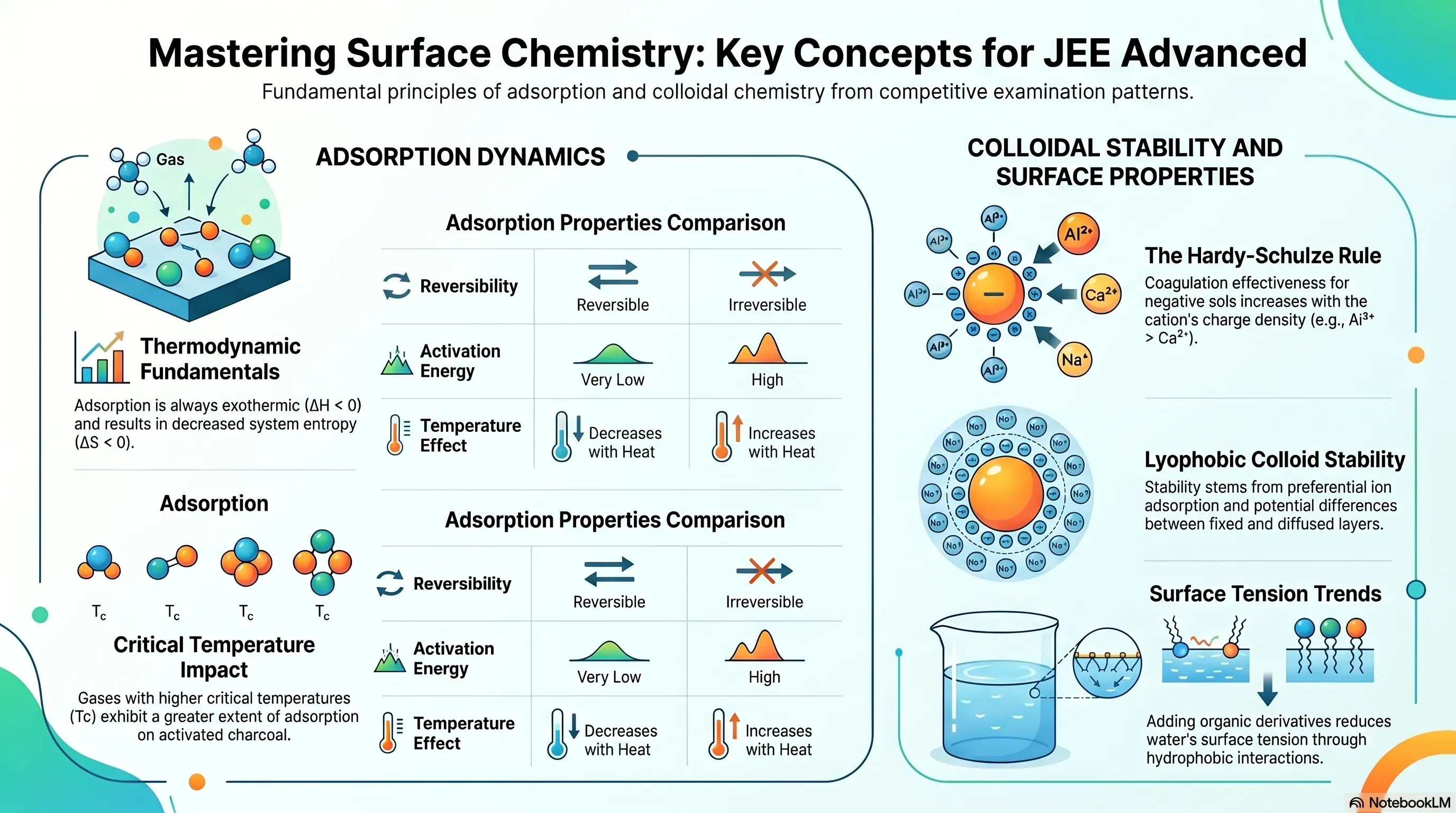
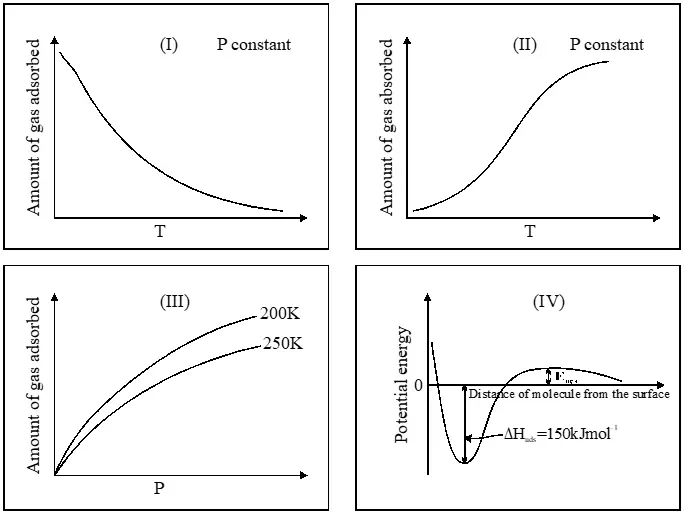
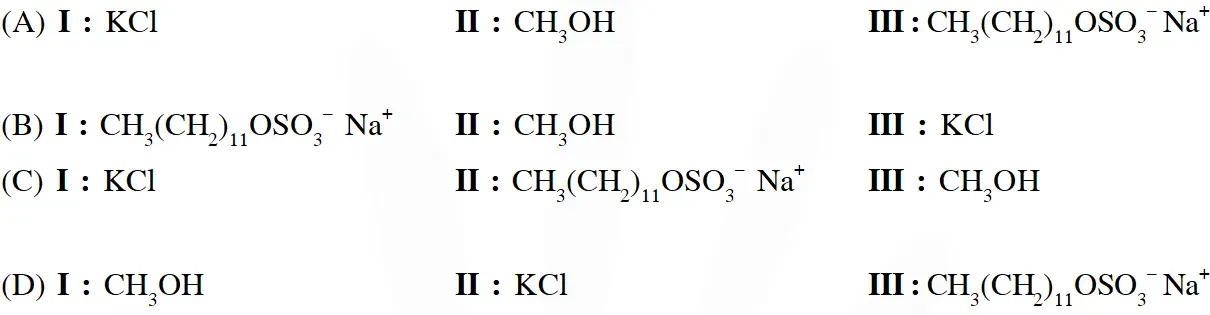
JEE Advanced Previous Year Questions of Chemistry with Solutions are available at eSaral. Practicing JEE Advanced Previous Year Papers Questions of Chemistry will help the JEE aspirants in realizing the question pattern as well as help in analyzing weak & strong areas. Simulator Previous Years JEE Advance Questions [esquestion] Among the electrolytes $\mathrm{Na}_{2} \mathrm{SO}_{4}, \mathrm{CaCl}_{2}, \mathrm{Al}_{2}\left(\mathrm{SO}_{4}\right)_{3}$ and $\mathrm{NH}_{4} \mathrm{Cl}$, the most effective coagulation agent for $\mathrm{Sb}_{2} \mathrm{S}_{3}$ sol is (A) $\mathrm{Na}_{2} \mathrm{SO}_{4}$ (B) $\mathrm{CaCl}_{2}$ (C) $\mathrm{Al}_{2}\left(\mathrm{SO}_{4}\right)_{3}$ (D) $\mathrm{NH}_{4} \mathrm{Cl}$ #tag# JEE 2009 #sol# (C) $\mathrm{Sb}_{2} \mathrm{S}_{3}$ forms negatively charged sol. Hence cation with greatest charge density is most effective in bringing about coagulation C.F. Hardy sulz rule. [/esquestion] [esquestion] The correct statement(s) pertaining to the adsorption of a gas on a solid surface is (are) - (A) Adsorption is always exothermic (B) Physisorption may transform into chemisorption at high temperature (C) Physisorption increases with increasing temperature but chemisorption decreases with increasing temperature (D) Chemisorption is more exothermic than physisorption, however it is very slow due to higher energy of activation #tag# JEE 2011 #sol# (A,B,D) general properties. [/esquestion] [esquestion] Choose the correct reason(s) for the stability of the lyophobic colloidal particle. (A) Preferential adsorption of ions on their surface from the solution (B) Preferential adsorption of solvent on their surface from the solution (C) Attraction between different particles having opposite charges on their surface (D) Potential difference between the fixed layer and the diffused layer of opposite charges around the colloidal particles #tag# JEE 2012 #sol# (A,D) Theory Based [/esquestion] [esquestion] The given graphs / data I, II, III and IV represent general trends observed for different physisorption and chemisorption processes under mild conditions of temperature and pressure. Which of the following choice(s) about I, II, III and IV is (are) correct ? (A) I is physisorption and II is chemisorption (B) I is physisorption and III is chemisorption (C) IV is chemisorption and II is chemisorption (D) IV is chemisorption and III is chemisorption #tag# JEE 2012 #sol# (A,C) For physical adsorption $\rightarrow$ favourable conditions is decrease in temp. for chemical adsorption $\rightarrow$ chemical bond Occurs $\rightarrow$ PE $\downarrow$ with bonding and increase in temp.. [/esquestion] [esquestion] Methylene blue, from its aqueous solution, is adsorbed on activated charcoal at $25^{\circ} \mathrm{C}$. For this process, the correct statement is (A) The adsorption requires activation at $25^{\circ} \mathrm{C}$ (B) The adsorption is accompanied by a decrease in enthalpy (C) The adsorption increases with increase of temperature (D) The adsorption is irreversible #tag# JEE Adv. 2013 #sol# (B) Explanation for physical adsorption • Activation energy is very low • Physical adsorption is an exothermic process • Physical adsorption decreases with increase in temperature • Physical adsorption is reversible [/esquestion] [esquestion] The qualitative sketches I , II and III given below show the variation of surface tension with molar concentration of three different aqueous solutions of KCl, $\mathrm{CH}_{3} \mathrm{OH}$ and $\mathrm{CH}_{3}\left(\mathrm{CH}_{2}\right)_{11} \mathrm{OSO}_{3}^{-} \mathrm{Na}^{+}$ at room temperature. The correct assignment of the sketches is – #tag# JEE Adv. 2016 #sol# (D) Water has large surface tension due to very strong interaction. Generally adding organic derivatives to water decreases its surface tension due to hydrophobic interaction. In case III, hydrophobic interaction is stronger than case I causing surface tension to decrease more rapidly. [/esquestion] [esquestion] The correct statement(s) about surface properties is (are) (A) Cloud is an emulsion type of colloid in which liquid is dispersed phase and gas is dispersion medium (B) Adsorption is accompanied by decrease in enthalpy and decrease in entropy of the system. (C) Brownian motion of colloidal particles does not depend on the size of the particles but depends on viscosity of the solution. (D) The critical temperatures of ethane and nitrogen and 563 K and 126 K, respectively. The adsorption of ethane will be more than that of nitrogen on same amount of activated charcoal at a given temperature. #tag# JEE Adv. 2017 #sol# (B,D) (A) Emulsion is liquid in liquid type colloid. (B) For adsorption, $\Delta \mathrm{H}<0 \& \Delta \mathrm{S}<0$ (C) Smaller the size and less viscous the dispersion medium, more will be the brownian motion. (D) Higher the $\mathrm{T}_{\mathrm{C}}$ , greater will be the extent of adsorption. [/esquestion]
For year-wise practice after Surface Chemistry - JEE Advanced PYQs (Chemistry), explore the JEE Advanced PYQ archive.
Frequently Asked Questions
How many questions from Surface Chemistry appear in JEE Advanced each year?
Surface Chemistry typically contributes 1 to 2 questions per JEE Advanced paper. These are usually multi-correct type from Physical Chemistry. While not the heaviest chapter by weightage, the questions are highly conceptual and yield easy marks for well-prepared students.
What are the most important topics in Surface Chemistry for JEE Advanced?
The four most tested topics are: (1) Hardy-Schulze rule and coagulation, (2) physisorption vs. chemisorption differences, (3) stability of lyophobic colloids and zeta potential, and (4) surface tension variation with concentration. Every question from 2009–2017 maps to one of these four areas.
Is NCERT enough for Surface Chemistry in JEE Advanced?
NCERT is the mandatory starting point — all fundamental definitions, examples, and concept frameworks come from it. However, for multi-correct and graph-based JEE Advanced questions, NCERT alone is not sufficient. You must practice PYQs and understand the reasoning behind each option, not just the correct answer.
What is the difference between physisorption and chemisorption in JEE Advanced context?
Physisorption uses weak Van der Waals forces, is reversible, non-specific, and decreases with rising temperature. Chemisorption forms actual chemical bonds, is specific, irreversible, more exothermic, and requires activation energy. Both are always exothermic — this is a non-negotiable fact for JEE Advanced.
Why does ethane adsorb more than nitrogen on activated charcoal?
Ethane has a much higher critical temperature (563 K) compared to nitrogen (126 K), meaning it has stronger intermolecular attractions and is more easily condensable. Greater ease of liquefaction directly corresponds to greater extent of adsorption on a solid surface. This principle was tested directly in JEE Advanced 2017.
Team eSaral
eSaral Academic and Editorial Team
Team eSaral is the collective author profile for educational content created by eSaral’s teachers and academic contributors. The team draws on expertise from IIT graduates, doctors, experienced educators and subject specialists to develop resources for JEE, NEET and school students. Our articles aim to explain concepts clearly and help students study with confidence.
Related Posts
Plant Cell Diagram: Labelled Structure, Parts and Functions
Simple, labelled plant cell diagram with parts and functions. Covers plant cell structure for Class 6, 7, 8, 9, 10 and 11 students, CBSE-aligned.
Saransh Gupta Sir's Visit to IIT Patna: Hostel Life, Placements & Lessons for JEE Aspirants
Inside Saransh Gupta Sir's IIT Patna visit — hostel life, the library, placements, internships, and real advice for JEE aspirants from students living the IIT dream.
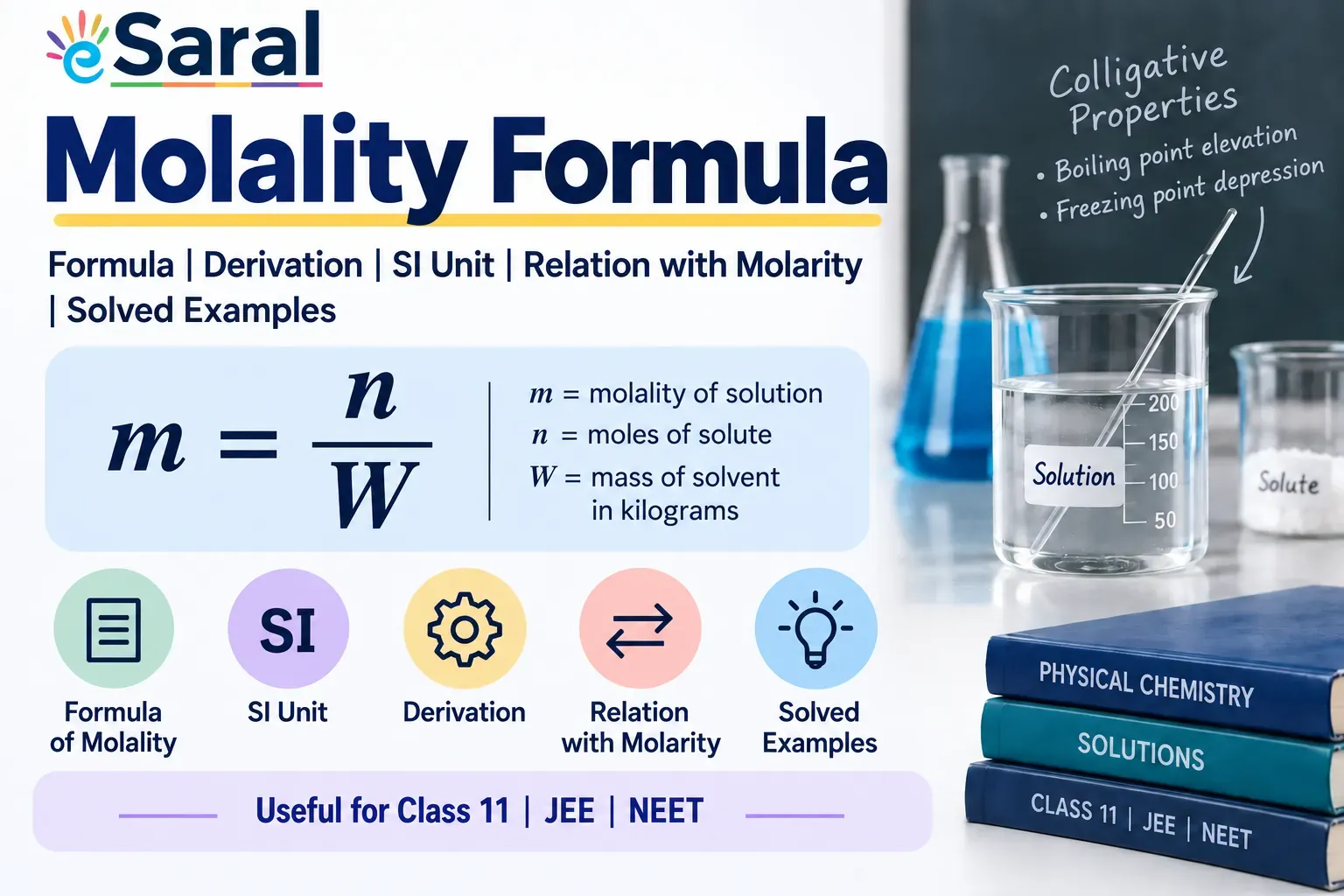
Molality Formula: Formula for Molality, Derivation & Solved Examples
Molality formula is $m = \dfrac{n}{W}$. Learn the formula of molality, its SI unit, derivation, relation with molarity, and solved examples for Class 11, JEE and NEET.
BITSAT Previous Year Question Paper PDF
Download BITSAT previous year question papers PDF. Get year-wise BITSAT PYQs, memory-based papers, exam pattern, and preparation tips to improve your BITSAT preparation.

Teachers’ Day 2026 at eSaral Gurukul: Celebrating the Bond Between Students, Teachers & Mentors
See how Teachers’ Day 2026 was celebrated at eSaral Gurukul, reflecting the bond among students, teachers, and mentors, and the role of guidance beyond academics.

JEE Advanced Attempts: Can You Give It a Third Time? Rules Explained
JEE Advanced attempts: current rule is 2 consecutive years only: full eligibility criteria, the 2025 third-attempt controversy, and the latest 2026 petition news.

Best JEE Preparation App
Best JEE preparation app for Main & Advanced: AI mock tests, live doubt-solving, thousands of practice questions. JEE preparation app for droppers & Class 11-12.
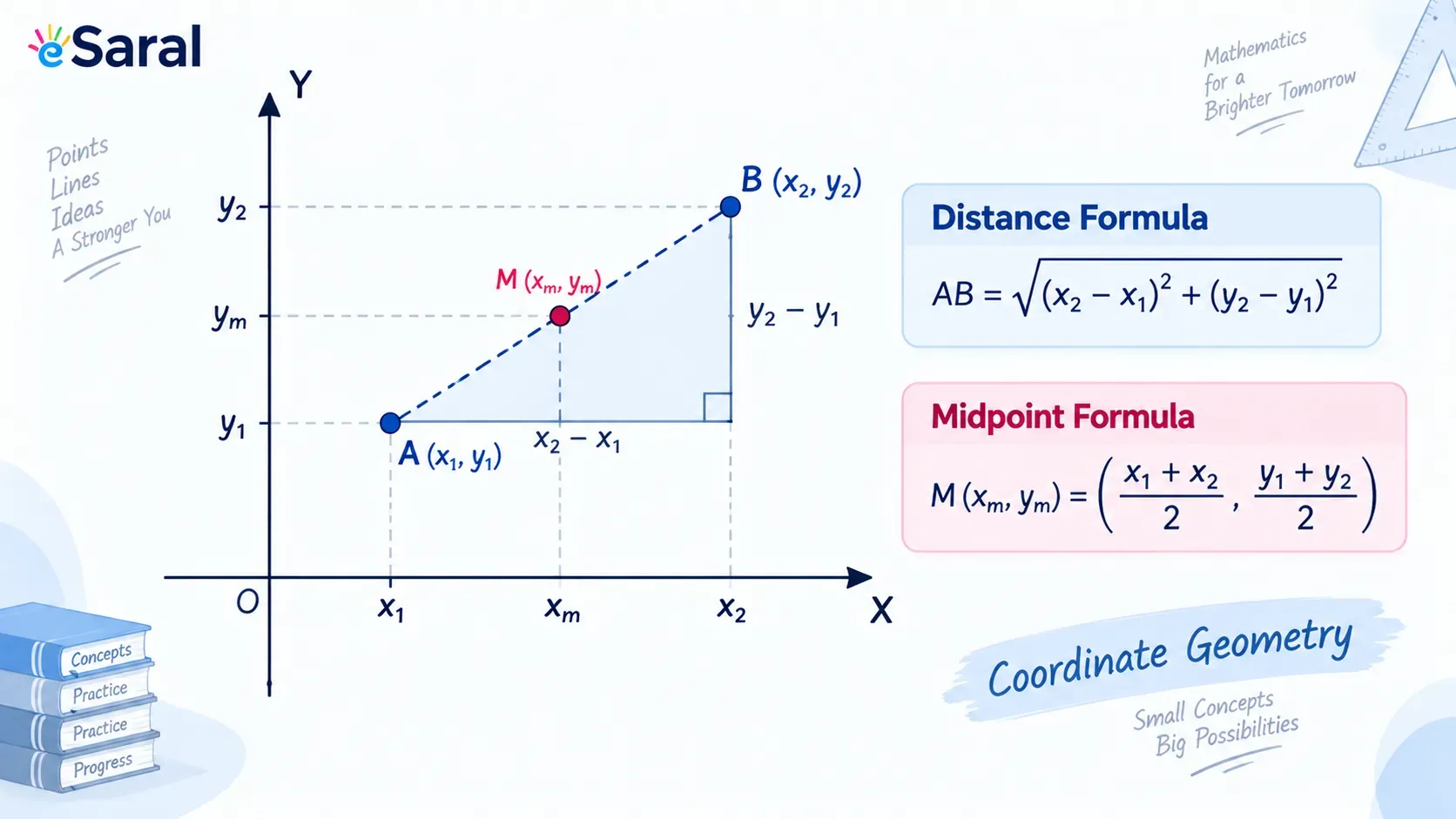
Coordinate Geometry Class 10: Formulas, Notes & Solved Examples
Coordinate geometry class 10: complete CBSE formulas — distance, section, midpoint and area of triangle — with derivation, notes and solved examples.

How to make Notes For JEE Smart Notes Strategy of an AIR 41
Learn how to make notes for JEE the way toppers do — indexing, shorthand, and smart short notes for JEE that cut revision time to just 5–7 days.
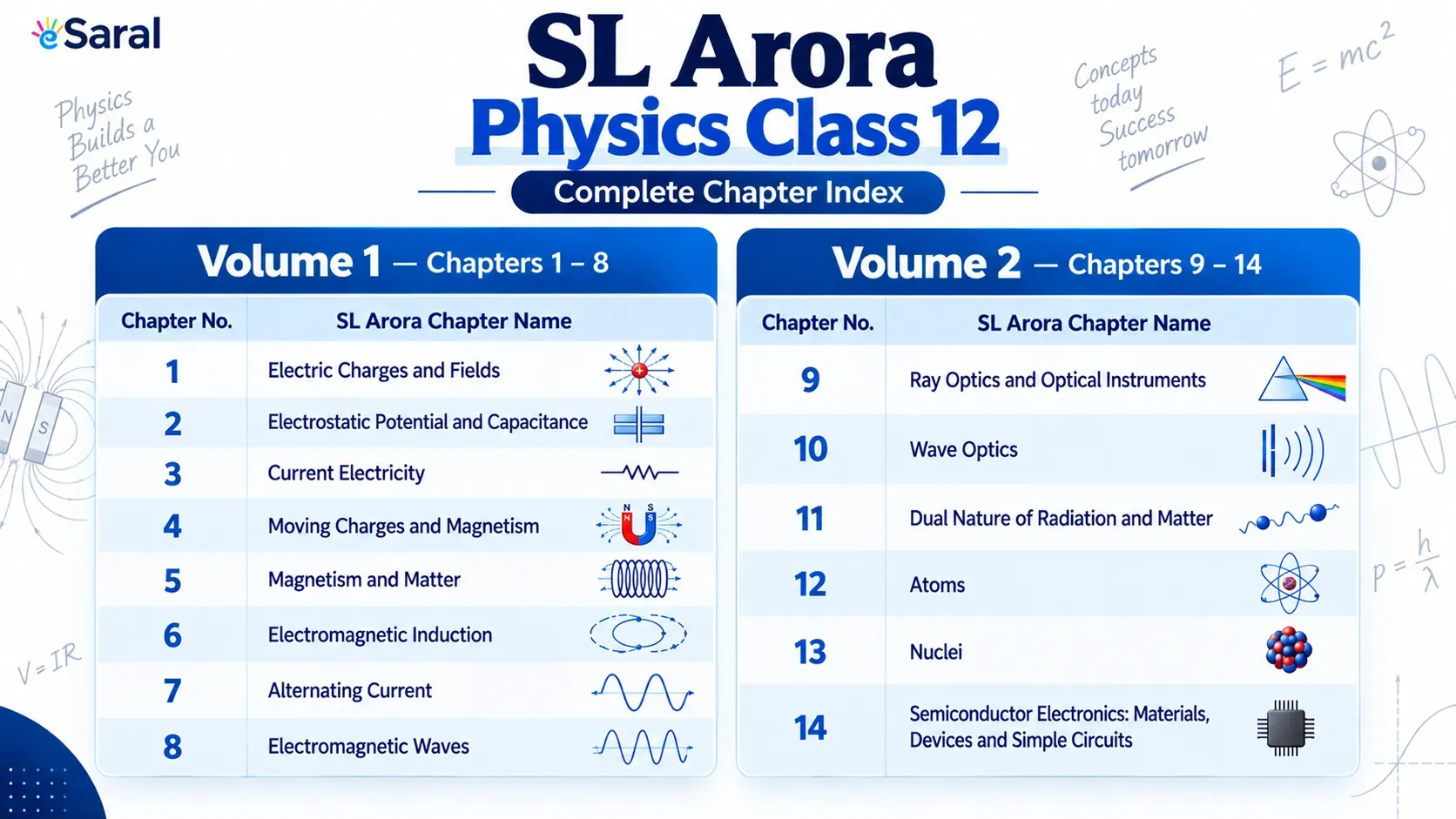
SL Arora Physics Class 12 Index – Chapter List for Volume 1 & 2
SL Arora Physics Class 12 index — complete chapter list for Volume 1 & 2, mapped to NCERT solutions for board, JEE Main, and NEET preparation.