
Thermodynamics - JEE Main Previous Year Questions with Solutions

eSaral Academic and Editorial Team
Summary
Thermodynamics questions in JEE Main are asked every year, covering Carnot engine efficiency, adiabatic and isochoric processes, the first law of thermodynamics, and specific heat ratios. This page collects all AIEEE and JEE Main previous year questions on Thermodynamics, complete with correct answer keys.

Home> JEE Main Previous Year Questions > Thermodynamics JEE Main Previous Year Questions

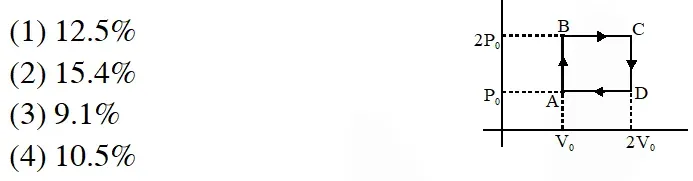
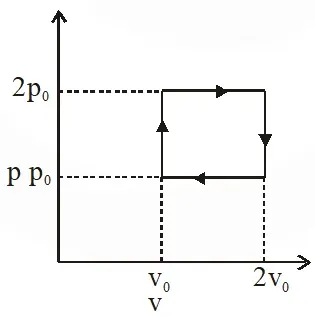
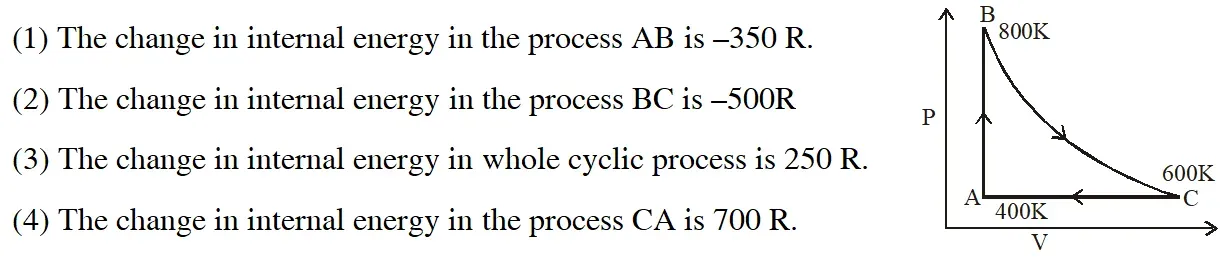
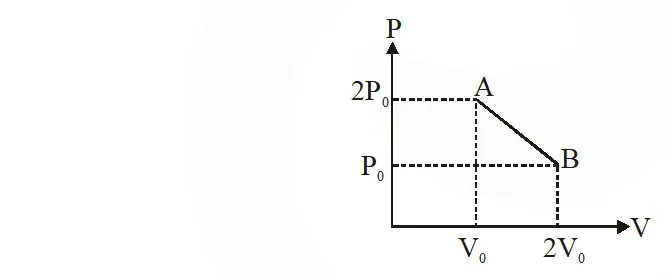
JEE Main Previous Year Question of Physics with Solutions are available here. Practicing JEE Main Previous Year Papers Questions of Physics will help all the JEE aspirants in realizing the question pattern as well as help in analyzing their weak & strong areas. Get detailed Class 11th &12th Physics Notes to prepare for Boards as well as competitive exams like IIT JEE, NEET etc. eSaral helps the students in clearing and understanding each topic in a better way. eSaral is providing complete chapter-wise notes of Class 11th and 12th both for all subjects. Besides this, eSaral also offers NCERT Solutions, Previous year questions for JEE Main and Advance, Practice questions, Test Series for JEE Main, JEE Advanced and NEET, Important questions of Physics, Chemistry, Math, and Biology and many more. Download eSaral app for free study material and video tutorials. Simulator Previous Years AIEEE/JEE Main Questions [esquestion] Assuming the gas to be ideal the work done on the gas in taking it from A to B is :- (1) 400 R (2) 500 R (3) 200 R (4) 300 #tag# [AIEEE-2009] #sol# (1) [/esquestion] [esquestion] The work done on the gas in taking it from D to A is :- (1) –690 R (2) +690 R (3) –414 R (4) +414 R #tag# [AIEEE-2009] #sol# (4) [/esquestion] [esquestion] The net work done on the gas in the cycle ABCDA is :- (1) 1076 R (2) 1904 R (3) Zero (4) 276 R #tag# [AIEEE-2009] #sol# (4) [/esquestion] [esquestion] A diatomic ideal gas is used in a carnot engine as the working substance. If during the adiabatic expansion part of the cycle the volume of the gas increases from V to 32 V, the efficiency of the engine is :- (1) 0.25 (2) 0.5 (3) 0.75 (4) 0.99 #tag# [AIEEE-2010] #sol# (3) [/esquestion] [esquestion] A Carnot engine operating between temperatures $\mathrm{T}_{1}$ and $\mathrm{T}_{2}$ has efficientcy $\frac{1}{6} .$ When $\mathrm{T}_{2}$ is lowered by $62 \mathrm{K},$ its efficiency increases to $\frac{1}{3} .$ Then $\mathrm{T}_{1}$ and $\mathrm{T}_{2}$ are, respectively:- (1) 330 K and 268 K (2) 310 K and 248 K (3) 372 K and 310 K (4) 372 K and 330 K #tag# [AIEEE-2011] #sol# (3) [/esquestion] [esquestion] The specific heat capacity of a metal at low temperautre (T) is given as $\mathrm{C}_{\mathrm{p}}\left(\mathrm{kJk}^{-1} \mathrm{kg}^{-1}\right)=32\left(\frac{\mathrm{T}}{400}\right)^{3}$ A 100 gram vessel of this metal is to be cooled from 20°K to 4°K by a special refrigerator operating at room temperature (27°C). The amount of work required to cool the vessel is:- (1) equal to 0.002 kJ (2) greater than 0.148 kJ (3) between 0.148 kJ and 0.028 kJ (4) less than 0.028 kJ #tag# [AIEEE-2011] #sol# (3) [/esquestion] [esquestion] A container with insulating walls is divided into two equal parts by a partition fitted with a valve. One part is filled with an ideal gas at a pressure P and temperature T, whereas the other part is completely evacuated. If the valve is suddenly opened, the pressure and temperature of the gas will be :- (1) $\frac{\mathrm{P}}{2}, \mathrm{T}$ (2) $\frac{\mathrm{P}}{2}, \frac{\mathrm{T}}{2}$ (3) P, T (4) $\mathrm{P}, \frac{\mathrm{T}}{2}$ #tag# [AIEEE-2011] #sol# (1) [/esquestion] [esquestion] Helium gas goes through a cycle ABCDA (consisting of two isochoric and two isobaric lines) as shown in figure. Efficiency of this cycle is nearly (Assume the gas to be close to ideal gas) :- #tag# [AIEEE-2012] #sol# (2) [/esquestion] [esquestion] A Carnot engine, whose efficiency is 40% takes in heat from a source maintained at a temperature of 500 K. It is desired to have an engine of efficiency 60%. Then, the intake temperature for the same exhaust (sink) temperature must be :- (1) 600 K (2) efficiency of Carnot engine cannot be made larger than 50% (3) 1200 K (4) 750 K #tag# [AIEEE-2012] #sol# (4) [/esquestion] [esquestion] The above p-v diagram represents the thermodynamic cycle of an engine, operating with an ideal monoatomic gas. The amount of heat, extracted from the source in a single cycle is : (1) $\mathrm{p}_{0} \mathrm{v}_{0}$ ( 2)$\left(\frac{13}{2}\right) \mathrm{p}_{0} \mathrm{v}_{0}$ ( 3)$\left(\frac{11}{2}\right) \mathrm{p}_{0} \mathrm{v}_{0}$ (4) $4 \mathrm{p}_{0} \mathrm{v}_{0}$ #tag# [jEE-Mains-2013] #sol# (2) [/esquestion] [esquestion] One mole of diatomic ideal gas undergoes a cyclic process ABC as shown in figure. The process BC is adiabatic. The temperatures at A, B and C are 400 K, 800 K and 600 K respectively. Choose the correct statement : #tag# [jEE-Mains-2014] #sol# (2) [/esquestion] [esquestion] Consider a spherical shell of radius R at temperature T. The black body radiation inside it can be considered as an ideal gas of photons with internal energy per unit volume $\mathrm{u}=\frac{\mathrm{U}}{\mathrm{V}} \propto \mathrm{T}^{4}$ and pressure $\mathrm{p}=\frac{1}{3}\left(\frac{\mathrm{U}}{\mathrm{v}}\right)$. If the shell now undergoes an adiabatic expansion the relation between T and R is – (1) $\mathrm{T} \propto \frac{1}{\mathrm{R}}$ (2) $\mathrm{T} \propto \frac{1}{\mathrm{R}^{3}}$ (3) T $\propto \mathrm{e}^{-\mathrm{R}}$ (4) $\mathrm{T} \propto \mathrm{e}^{-3 \mathrm{R}}$ #tag# [jEE-Mains-2015] #sol# (1) [/esquestion] [esquestion] 'n' moles of an ideal gas undergoes a process $\mathrm{A} \rightarrow \mathrm{B}$ as shown in the figure. The maximum temperature of the gas during the process will be : (1) $\frac{9 \mathrm{P}_{0} \mathrm{V}_{0}}{\mathrm{nR}}$ (1) $\frac{9 \mathrm{P}_{0} \mathrm{V}_{0}}{\mathrm{nR}}$ (3) $\frac{3 \mathrm{P}_{0} \mathrm{V}_{0}}{2 \mathrm{nR}}$ (4) $\frac{9 \mathrm{P}_{0} \mathrm{V}_{0}}{2 \mathrm{nR}}$ #tag# [jEE-Mains-2016] #sol# (2) [/esquestion] [esquestion] An ideal gas undergoes a quasi static, reversible process in which its molar heat capacity C remains constant. If during this process the relation of pressure P and volume V is given by $\mathrm{P} \mathrm{V}^{\mathrm{n}}$ = constant, then n is given by (Here $\mathrm{C}_{\mathrm{P}}$ and $\mathrm{C}_{\mathrm{v}}$ are molar specific heat at constant pressure and constant volume, respectively) :- (1) $\mathrm{n}=\frac{\mathrm{C}-\mathrm{C}_{\mathrm{V}}}{\mathrm{C}-\mathrm{C}_{\mathrm{P}}}$ (2) $\mathrm{n}=\frac{\mathrm{C}_{\mathrm{P}}}{\mathrm{C}_{\mathrm{V}}}$ (3) $\quad \mathrm{n}=\frac{\mathrm{C}-\mathrm{C}_{\mathrm{P}}}{\mathrm{C}-\mathrm{C}_{\mathrm{V}}}$ (4) $\mathrm{n}=\frac{\mathrm{C}_{\mathrm{P}}-\mathrm{C}}{\mathrm{C}-\mathrm{C}_{\mathrm{V}}}$ #tag# [jEE-Mains-2016] #sol# (3) [/esquestion] [esquestion] $\mathrm{C}_{\mathrm{p}}$ and $\mathrm{C}_{\mathrm{v}}$ are specific heats at constant pressure and constant volume respectively. It is observed that $\mathrm{C}_{\mathrm{p}}-\mathrm{C}_{\mathrm{v}}=$ = a for hydrogen gas $\mathrm{C}_{\mathrm{p}}-\mathrm{C}_{\mathrm{v}}=$ = b for nitrogen gas The correct relation between a and b is : (1) a = 14 b (2) a = 28 b (3) $a=\frac{1}{14} b$ (4) a = b #tag# [jEE-Mains-2017] #sol# (1) [/esquestion] [esquestion] Two moles of an ideal monoatomic gas occupies a volume V at $27^{\circ}$ C. The gas expands adiabatically to a volume 2V. Calculate (a) the final temperature of the gas and (b) change in its internal energy. (1) (a) 195 K (b) –2.7 kJ (2) (a) 189 K (b) –2.7 kJ (3) (a) 195 K (b) 2.7 kJ (4) (a) 189 K (b) 2.7 kJ #tag# [jEE-Mains-2018] #sol# (2) [/esquestion]
Thermodynamics is part of a larger Physics practice set; browse the JEE PYQ chapter wise archive to continue across chapters.
These Thermodynamics questions are pulled from real exams — see them in their original paper format on our JEE Main previous year question paper page.
Frequently Asked Questions
Is NCERT enough for Thermodynamics in JEE Main?
NCERT is necessary but not sufficient. NCERT builds the conceptual framework — definitions, laws, and basic derivations. JEE Main questions then apply these concepts to multi-step numerical problems and graph-based analysis. After mastering NCERT, practise previous year questions and timed mock tests to bridge the gap. Start with NCERT Solutions for Class 11 Physics as the foundation
What are the most important topics in Thermodynamics for JEE Main?
The highest-priority topics are Carnot engine efficiency, work done in cyclic processes using P-V diagrams, adiabatic expansion (TV^(γ-1) = constant), and the relationship between Cp and Cv using Mayer's relation. Together, these cover roughly 70% of all thermodynamics questions asked in JEE Main
How many questions come from Thermodynamics in JEE Main?
JEE Main typically includes 1 to 3 questions from Thermodynamics in each session. The exact number varies by paper, but the chapter has appeared in every year from 2009 to 2023 without exception. Based on NTA's official syllabus, it falls under Unit 6 of JEE Main Physics and carries consistent weightage of 4–12 marks per session.
How do I remember the sign convention for work done in JEE Main Thermodynamics?
JEE Main follows the physics convention: W is work done by the gas. So in expansion, W > 0 (gas loses energy doing work). In compression, W < 0 (work is done on the gas, increasing its energy). The First Law then reads ΔU = Q – W. Some Chemistry textbooks use ΔU = Q + W (where W is work done on the gas) — this is the opposite sign convention, so always confirm which one the question is using.
What does free expansion mean and why is the temperature unchanged?
Free expansion occurs when a gas expands into a vacuum — there is no external pressure to push against, so the gas does zero work (W = 0). Since the container is insulated, heat exchange is also zero (Q = 0). By the First Law, ΔU = Q – W = 0, meaning internal energy and therefore temperature remain unchanged. Only pressure and volume change.
What is the Carnot efficiency formula used in JEE Main?
The Carnot efficiency formula is η = 1 – T₂/T₁, where T₁ is the temperature of the hot source and T₂ is the temperature of the cold sink, both in Kelvin. This is the maximum possible efficiency for any heat engine operating between those two temperatures. JEE Main questions typically give you either the efficiency or one temperature and ask you to find the other.
Team eSaral
eSaral Academic and Editorial Team
Team eSaral is the collective author profile for educational content created by eSaral’s teachers and academic contributors. The team draws on expertise from IIT graduates, doctors, experienced educators and subject specialists to develop resources for JEE, NEET and school students. Our articles aim to explain concepts clearly and help students study with confidence.
Related Posts
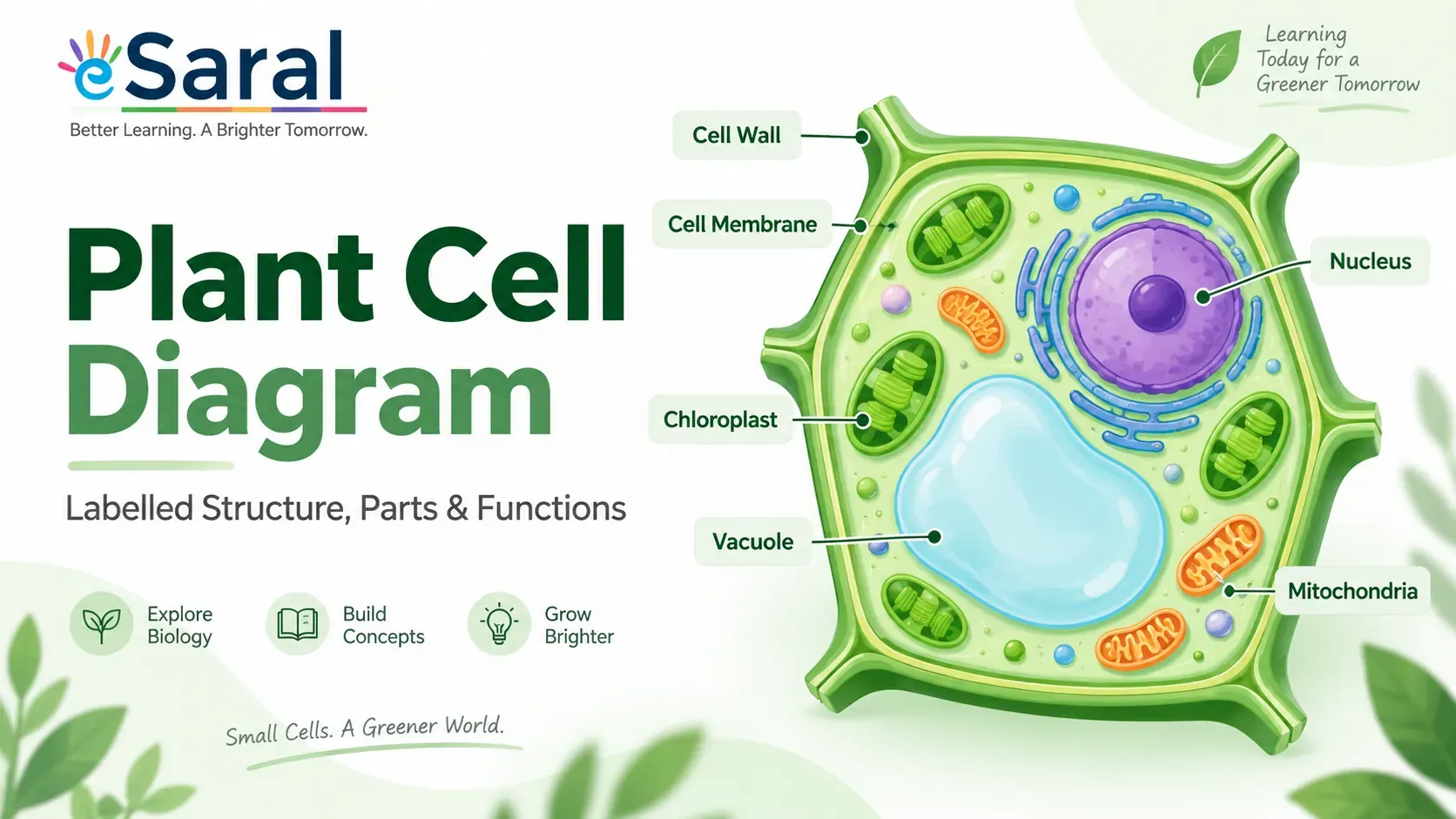
Plant Cell Diagram: Labelled Structure, Parts and Functions
Simple, labelled plant cell diagram with parts and functions. Covers plant cell structure for Class 6, 7, 8, 9, 10 and 11 students, CBSE-aligned.
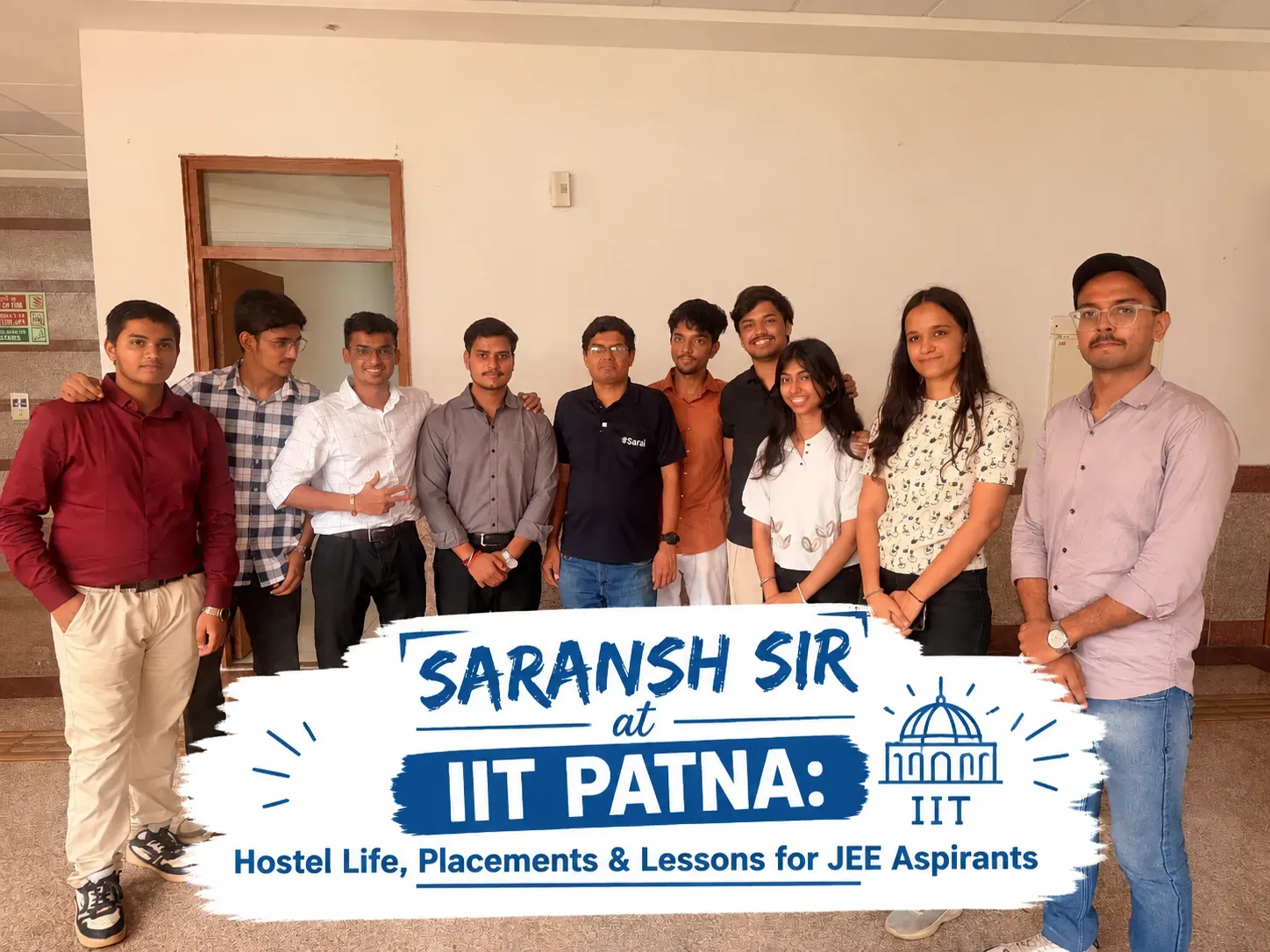
Saransh Gupta Sir's Visit to IIT Patna: Hostel Life, Placements & Lessons for JEE Aspirants
Inside Saransh Gupta Sir's IIT Patna visit — hostel life, the library, placements, internships, and real advice for JEE aspirants from students living the IIT dream.
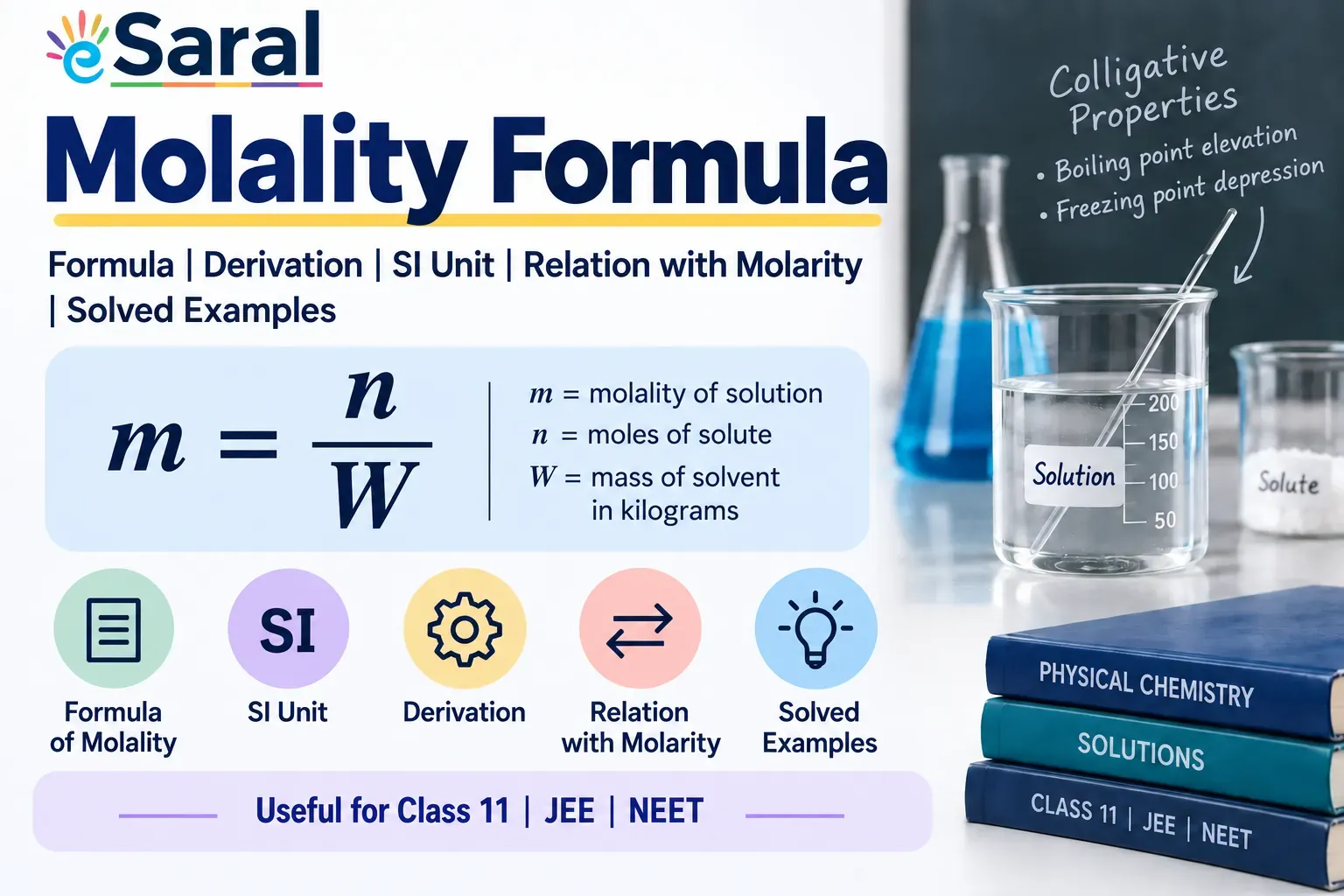
Molality Formula: Formula for Molality, Derivation & Solved Examples
Molality formula is $m = \dfrac{n}{W}$. Learn the formula of molality, its SI unit, derivation, relation with molarity, and solved examples for Class 11, JEE and NEET.
BITSAT Previous Year Question Paper PDF
Download BITSAT previous year question papers PDF. Get year-wise BITSAT PYQs, memory-based papers, exam pattern, and preparation tips to improve your BITSAT preparation.

Teachers’ Day 2026 at eSaral Gurukul: Celebrating the Bond Between Students, Teachers & Mentors
See how Teachers’ Day 2026 was celebrated at eSaral Gurukul, reflecting the bond among students, teachers, and mentors, and the role of guidance beyond academics.
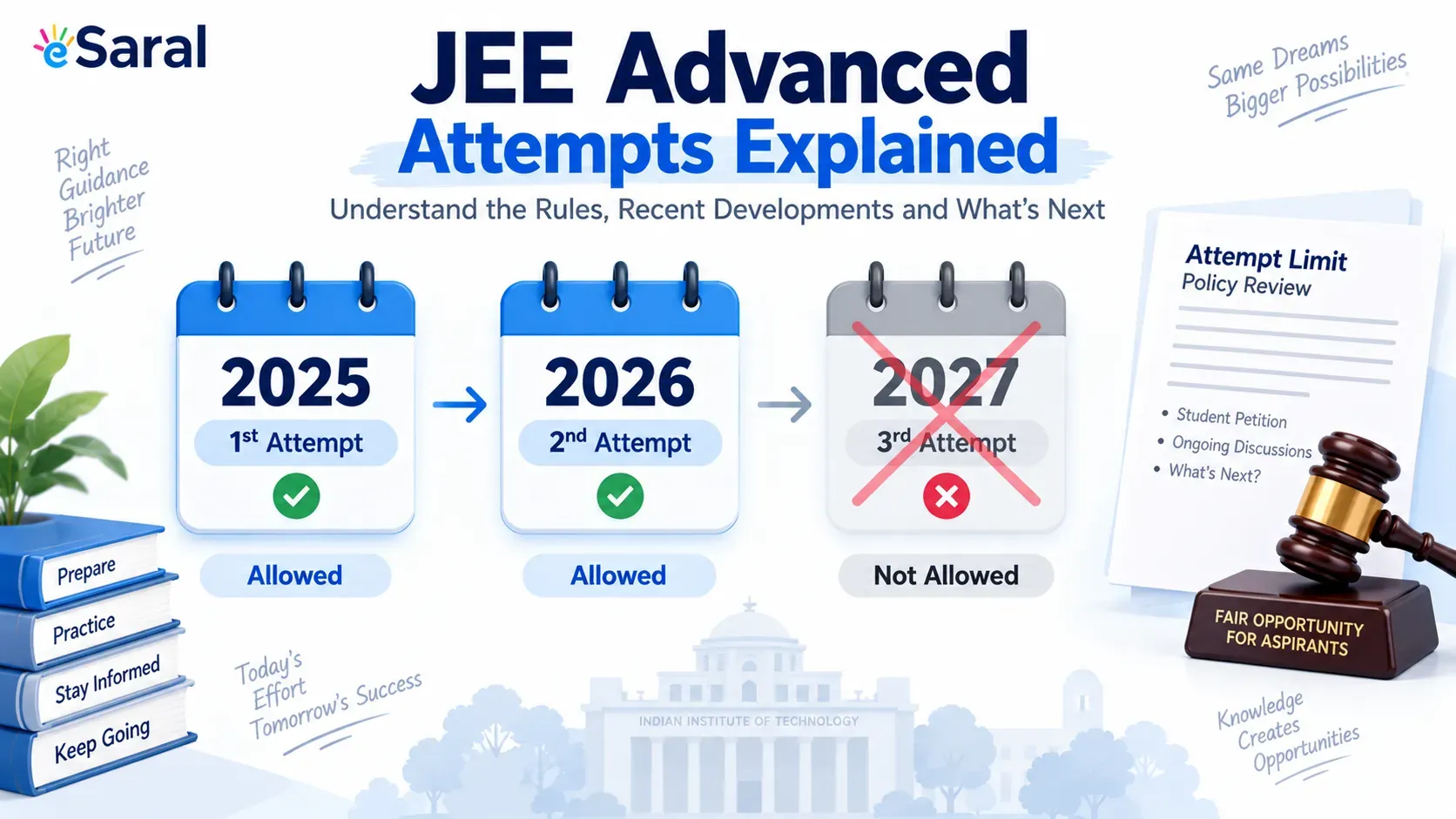
JEE Advanced Attempts: Can You Give It a Third Time? Rules Explained
JEE Advanced attempts: current rule is 2 consecutive years only: full eligibility criteria, the 2025 third-attempt controversy, and the latest 2026 petition news.

Best JEE Preparation App
Best JEE preparation app for Main & Advanced: AI mock tests, live doubt-solving, thousands of practice questions. JEE preparation app for droppers & Class 11-12.
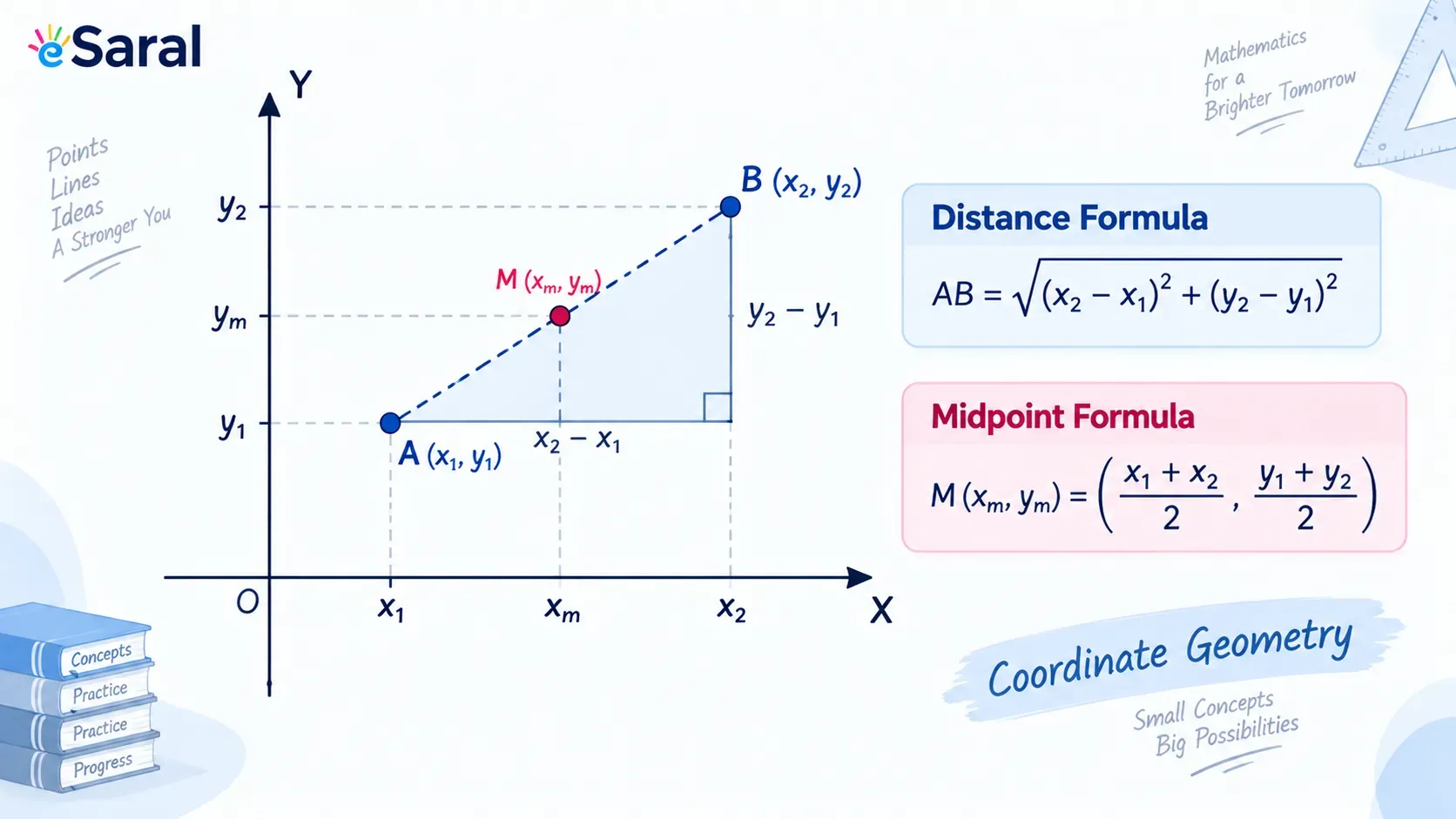
Coordinate Geometry Class 10: Formulas, Notes & Solved Examples
Coordinate geometry class 10: complete CBSE formulas — distance, section, midpoint and area of triangle — with derivation, notes and solved examples.
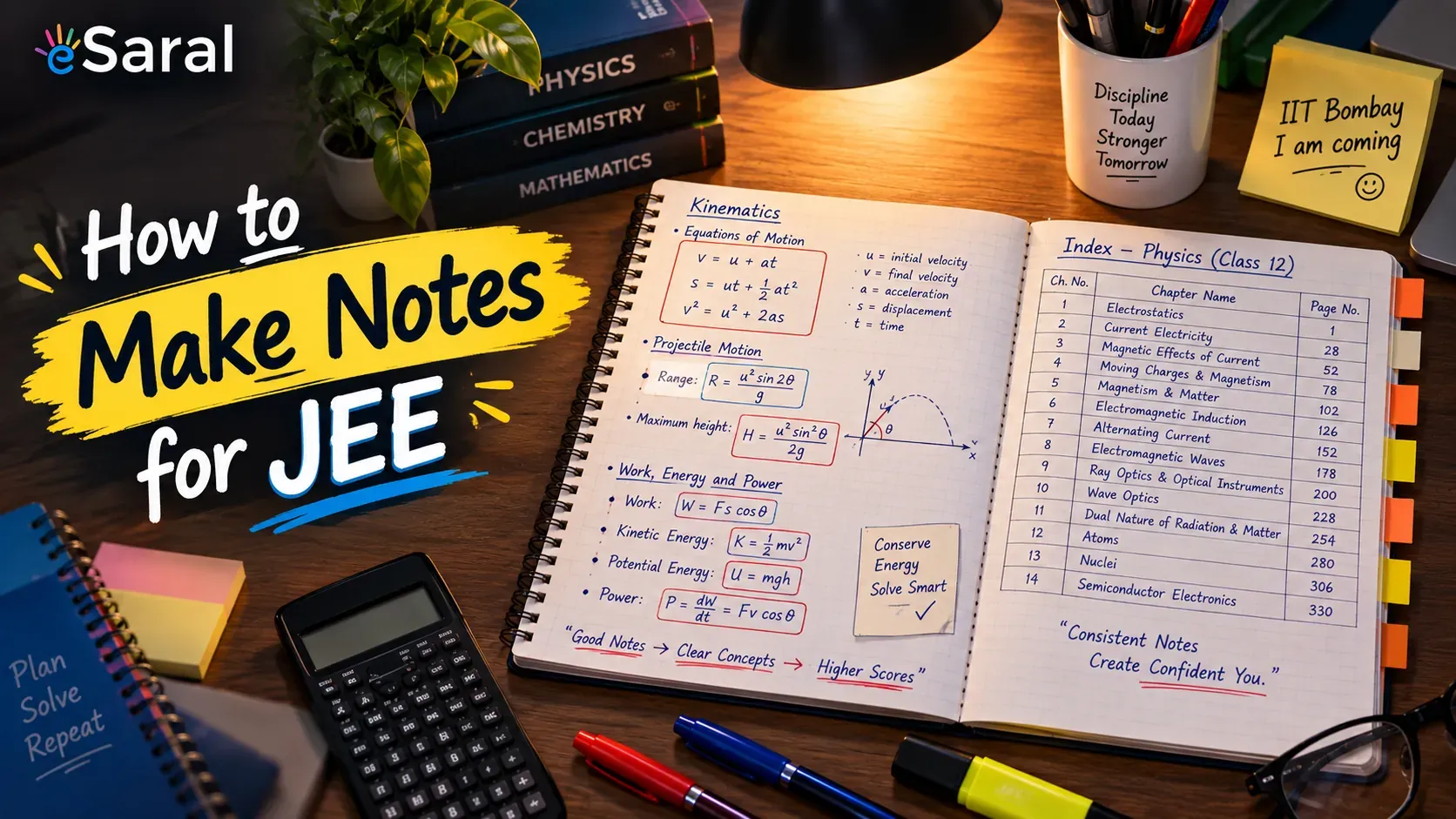
How to make Notes For JEE Smart Notes Strategy of an AIR 41
Learn how to make notes for JEE the way toppers do — indexing, shorthand, and smart short notes for JEE that cut revision time to just 5–7 days.
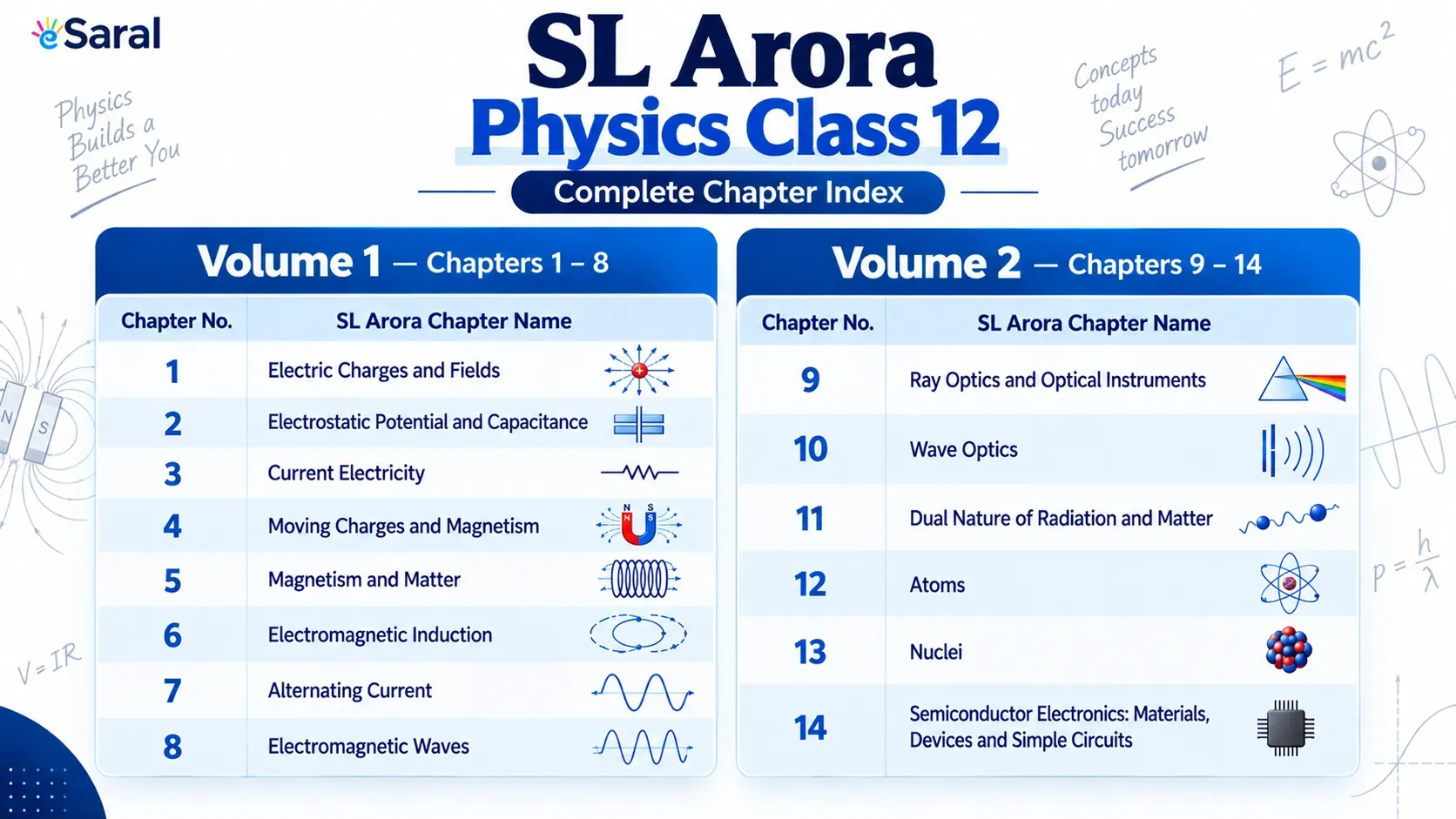
SL Arora Physics Class 12 Index – Chapter List for Volume 1 & 2
SL Arora Physics Class 12 index — complete chapter list for Volume 1 & 2, mapped to NCERT solutions for board, JEE Main, and NEET preparation.