
Trigonometric Equation - JEE Advanced Previous Year Questions with Solutions

eSaral Academic and Editorial Team
Summary
Trigonometric Equations is an important JEE Mathematics chapter that focuses on solving complex trigonometric identities and equations using transformations, inverse trigonometric concepts, and advanced problem-solving techniques, supported by previous-year JEE questions.
eSaral › JEE › JEE Main ›Trigonometric Equation

🚀 Checkout eSaral Courses
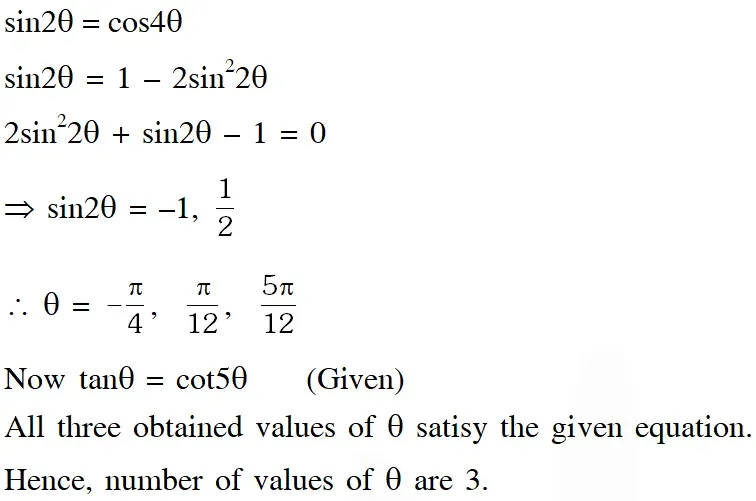
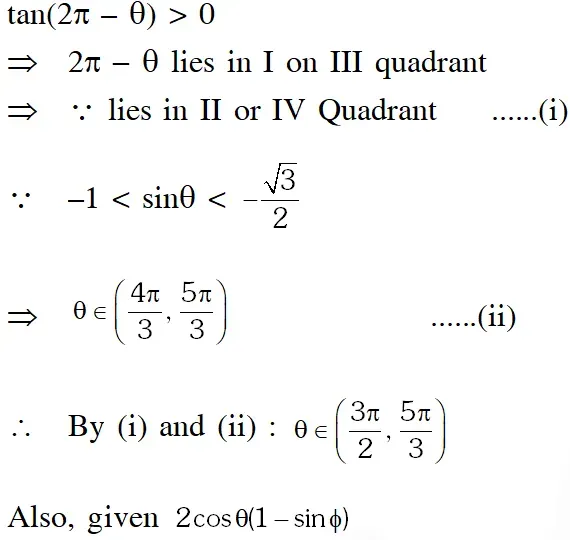
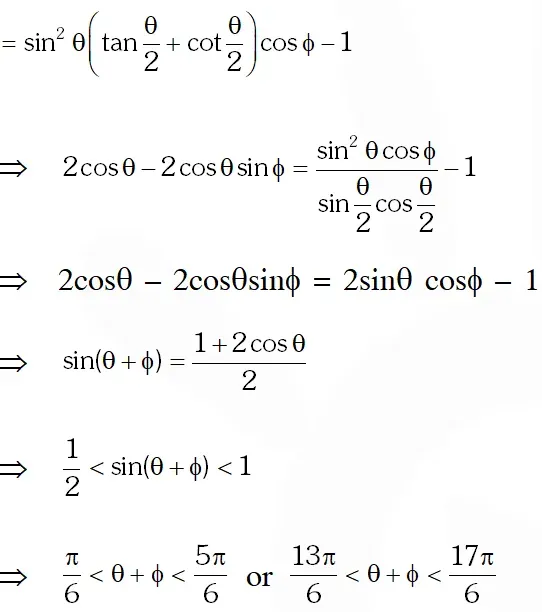
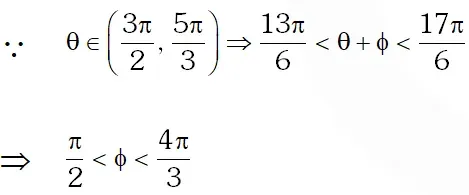
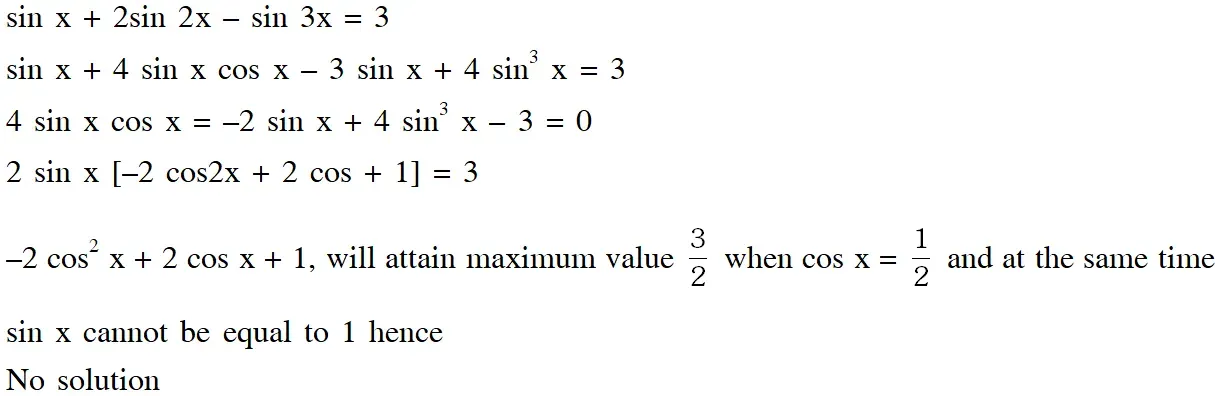
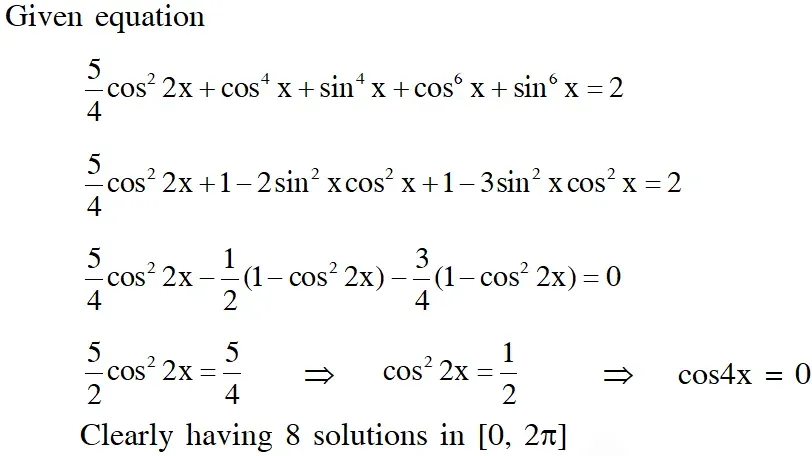
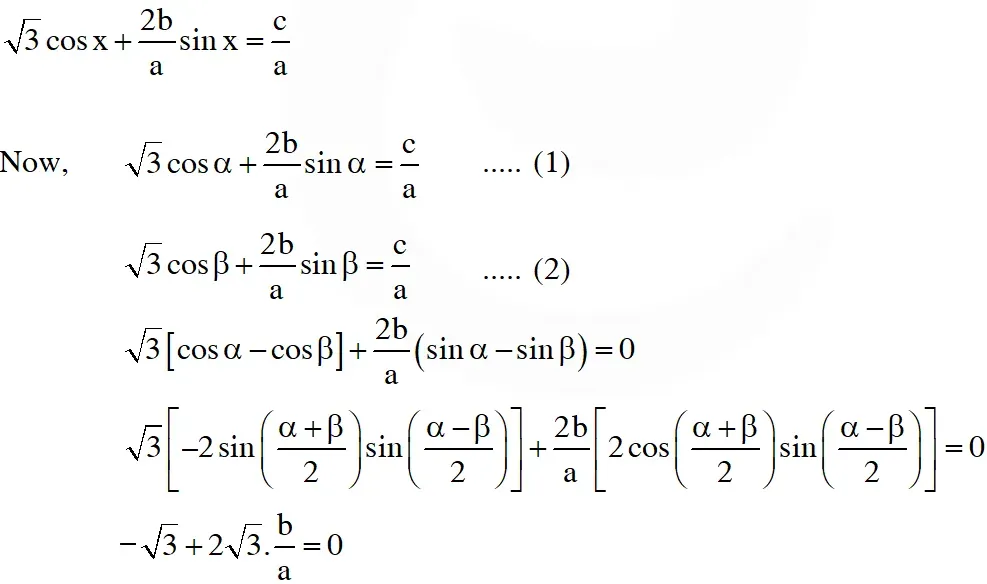
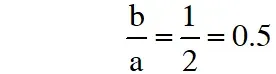
Download eSaral app for free study material and video tutorials. [esquestion] The number of values of $\theta$ in the interval $\left(\frac{-\pi}{2}, \frac{\pi}{2}\right)$ such that $\theta \neq \frac{n \pi}{5}$ for $n=0, \pm 1, \pm 2$ and $\tan \theta=\cot 5 \theta$ as well as $\sin 2 \theta=\cos 4 \theta,$ is #tag# [JEE 2010, 3] #sol# 3 [/esquestion] [esquestion] The positive integer value of n > 3 satisfying the equation $\frac{1}{\sin \left(\frac{\pi}{\mathrm{n}}\right)}=\frac{1}{\sin \left(\frac{2 \pi}{\mathrm{n}}\right)}+\frac{1}{\sin \left(\frac{3 \pi}{\mathrm{n}}\right)}$ is #tag# [JEE 2011, 4] #sol# 7 $\frac{1}{\sin \frac{\pi}{\mathrm{n}}}=\frac{1}{\sin \frac{2 \pi}{\mathrm{n}}}+\frac{1}{\sin \frac{3 \pi}{\mathrm{n}}}$ $\Rightarrow \frac{1}{\sin \frac{\pi}{\mathrm{n}}}-\frac{1}{\sin \frac{3 \pi}{\mathrm{n}}}=\frac{1}{\sin \frac{2 \pi}{\mathrm{n}}}$ $\Rightarrow \frac{\sin \frac{3 \pi}{n}-\sin \frac{\pi}{n}}{\sin \frac{\pi}{n} \sin \frac{3 \pi}{n}}=\frac{1}{\sin \frac{2 \pi}{n}}$ $\Rightarrow \frac{2 \cos \frac{2 \pi}{\mathrm{n}} \sin \frac{\pi}{\mathrm{n}}}{\sin \frac{\pi}{\mathrm{n}} \sin \frac{3 \pi}{\mathrm{n}}}=\frac{1}{\sin \frac{2 \pi}{\mathrm{n}}}$ $\Rightarrow 2 \cos \frac{2 \pi}{\mathrm{n}} \sin \frac{2 \pi}{\mathrm{n}}=\sin \frac{3 \pi}{\mathrm{n}}$ $\Rightarrow \sin \frac{4 \pi}{\mathrm{n}}=\sin \frac{3 \pi}{\mathrm{n}} \Rightarrow \frac{4 \pi}{\mathrm{n}}=\mathrm{K} \pi+(-1)^{\mathrm{K}} \frac{3 \pi}{\mathrm{n}}$ If $\mathrm{K}=2 \mathrm{m} \quad \Rightarrow \quad \frac{\pi}{\mathrm{n}}=2 \mathrm{m} \pi$ $\Rightarrow \quad n=\frac{1}{2 m} \quad \Rightarrow n=\frac{1}{2}, \frac{1}{4}, \frac{1}{6} \ldots \ldots$ If $\mathrm{K}=2 \mathrm{m}+1 \Rightarrow \frac{7 \pi}{\mathrm{n}}=(2 \mathrm{m}+1) \pi$ $\Rightarrow \mathrm{n}=\frac{7}{2 \mathrm{m}+1} \quad \Rightarrow \quad \mathrm{n}=7, \frac{7}{3}, \frac{7}{5} \ldots \ldots$ Possible value of n is 7 [/esquestion] [esquestion] Let $\theta, \varphi \in[0,2 \pi]$ be such that $2 \cos \theta(1-\sin \varphi)=\sin ^{2} \theta\left(\tan \frac{\theta}{2}+\cot \frac{\theta}{2}\right) \cos \varphi-1, \tan (2 \pi-\theta)>0$ and $-1<\sin \theta<-\frac{\sqrt{3}}{2} .$ Then $\varphi$ cannot satisfy- (A) $0<\varphi<\frac{\pi}{2}$ (B) $\frac{\pi}{2}<\varphi<\frac{4 \pi}{3}$ (C) $\frac{4 \pi}{3}<\varphi<\frac{3 \pi}{2}$ (D) $\frac{3 \pi}{2}<\varphi<2 \pi$ #tag# [JEE 2012, 4M] #sol# (A,C,D) [/esquestion] [esquestion] For $\mathrm{x} \in(0, \pi),$ the equation $\sin \mathrm{x}+2 \sin 2 \mathrm{x}-\sin 3 \mathrm{x}=3 \mathrm{has}$ (A) infinitely many solutions (B) three solutions (C) one solution (D) no solution #tag# [JEE(Advanced)-2014, 3(–1)] #sol# (D) [/esquestion] [esquestion] The number of distinct solutions of equation $\frac{5}{4} \cos ^{2} 2 x+\cos ^{4} x+\sin ^{4} x+\cos ^{6} x+\sin ^{6} x=2$ in the interval $[0,2 \pi]$ is #tag# [JEE 2015, 4M, –0M] #sol# 8 [/esquestion] [esquestion] Let $S=\left\{x \in(-\pi, \pi): x \neq 0, \pm \frac{\pi}{2}\right\} .$ The sum of all distinct solution of the equation $\sqrt{3} \sec x+\csc x+2(\tan x-\cot x)=0$ in the set $S$ is equal to $-$ (A) $-\frac{7 \pi}{9}$ (B) $-\frac{2 \pi}{9}$ (C) 0 (D) $\frac{5 \pi}{9}$ #tag# [JEE(Advanced)-2016] #sol# (C) $\sqrt{3} \sin x+\cos x=2 \cos 2 x$ $\Rightarrow \cos 2 x=\cos \left(x-\frac{\pi}{3}\right)$ $\Rightarrow 2 x=2 n \pi \pm\left(x-\frac{\pi}{3}\right)$ $\quad \quad x=(6 n-1) \frac{\pi}{3}$ or $(6 n+1) \frac{\pi}{9}$ $\Rightarrow x=-\frac{\pi}{3}, \frac{\pi}{9}, \frac{7 \pi}{9}$ and $-\frac{5 \pi}{9}$ in $(-\pi, \pi)$ $\Rightarrow \operatorname{sum}=0$ [/esquestion] [esquestion] Let $a, b, c$ be three non-zero real numbers such that the equation $\sqrt{3} a \cos x+2 b \sin x=c, \quad x$ $\in\left[-\frac{\pi}{2}, \frac{\pi}{2}\right]$ has two distinct real roots $\alpha$ and $\beta$ with $\alpha+\beta=\frac{\pi}{3} .$ Then the value of $\frac{b}{a}$ is $-$ $=$ #tag# [JEE(Advanced)-2018] #sol# 0.5 [/esquestion]
These questions test identity recall under pressure — bookmark the trigonometry formula page rather than looking things up mid-problem.
After completing Trigonometric Equations - JEE Advanced PYQs (Maths), use the JEE Advanced exam paper to review the wider question mix.
Frequently Asked Questions
How many questions from Trigonometric Equations appear in JEE Advanced each year?
JEE Advanced typically sets 0–1 question directly from Trigonometric Equations per year. Between 2010 and 2026, seven questions appeared across eight years. The topic is rarely isolated — it usually combines with trigonometric identities or inequalities. Consistent practice of PYQs is the most reliable way to prepare, as per NTA's official syllabus guidelines.
Is Trigonometric Equations important for JEE Advanced or only JEE Main?
Trigonometric Equations is important for both, but JEE Advanced tests it at a higher difficulty level. JEE Main questions typically ask for the general solution. JEE Advanced questions ask for the number of solutions in a restricted domain, the sum of solutions, or combine it with additional algebraic constraints — requiring deeper conceptual clarity.
What is the general solution formula for sinθ = sinα?
The general solution of $\sin\theta = \sin\alpha$ is $\theta = n\pi + (-1)^n\alpha$, where $n \in \mathbb{Z}$. For $\cos\theta = \cos\alpha$, it is $\theta = 2n\pi \pm \alpha$. For $\tan\theta = \tan\alpha$, it is $\theta = n\pi + \alpha$. Memorising and applying these three forms correctly is the foundation for every JEE Advanced question in this chapter.
Why did the 2014 question (sinx + 2sin2x − sin3x = 3) have no solution?
The equation has no solution because the left-hand side cannot equal 3 for any $x \in (0, \pi)$. While individual terms can each reach their maximum values (sinx=1, 2sin2x=2, −sin3x=1), these maxima occur at different values of x that cannot coincide simultaneously. The actual maximum of the combined expression in this domain is less than 3.
What is the difficulty level of Trigonometric Equations in JEE Advanced compared to JEE Main?
JEE Advanced questions are significantly harder. JEE Main asks straightforward general solution problems (difficulty: 3/10). JEE Advanced combines domain restrictions, simultaneous conditions, and identity manipulation (difficulty: 7–9/10). The 2012 question (Q3 above), which had three simultaneous constraints, is rated among the top-10 hardest maths questions from that paper by eSaral's IIT Bombay faculty.
Team eSaral
eSaral Academic and Editorial Team
Team eSaral is the collective author profile for educational content created by eSaral’s teachers and academic contributors. The team draws on expertise from IIT graduates, doctors, experienced educators and subject specialists to develop resources for JEE, NEET and school students. Our articles aim to explain concepts clearly and help students study with confidence.
Related Posts
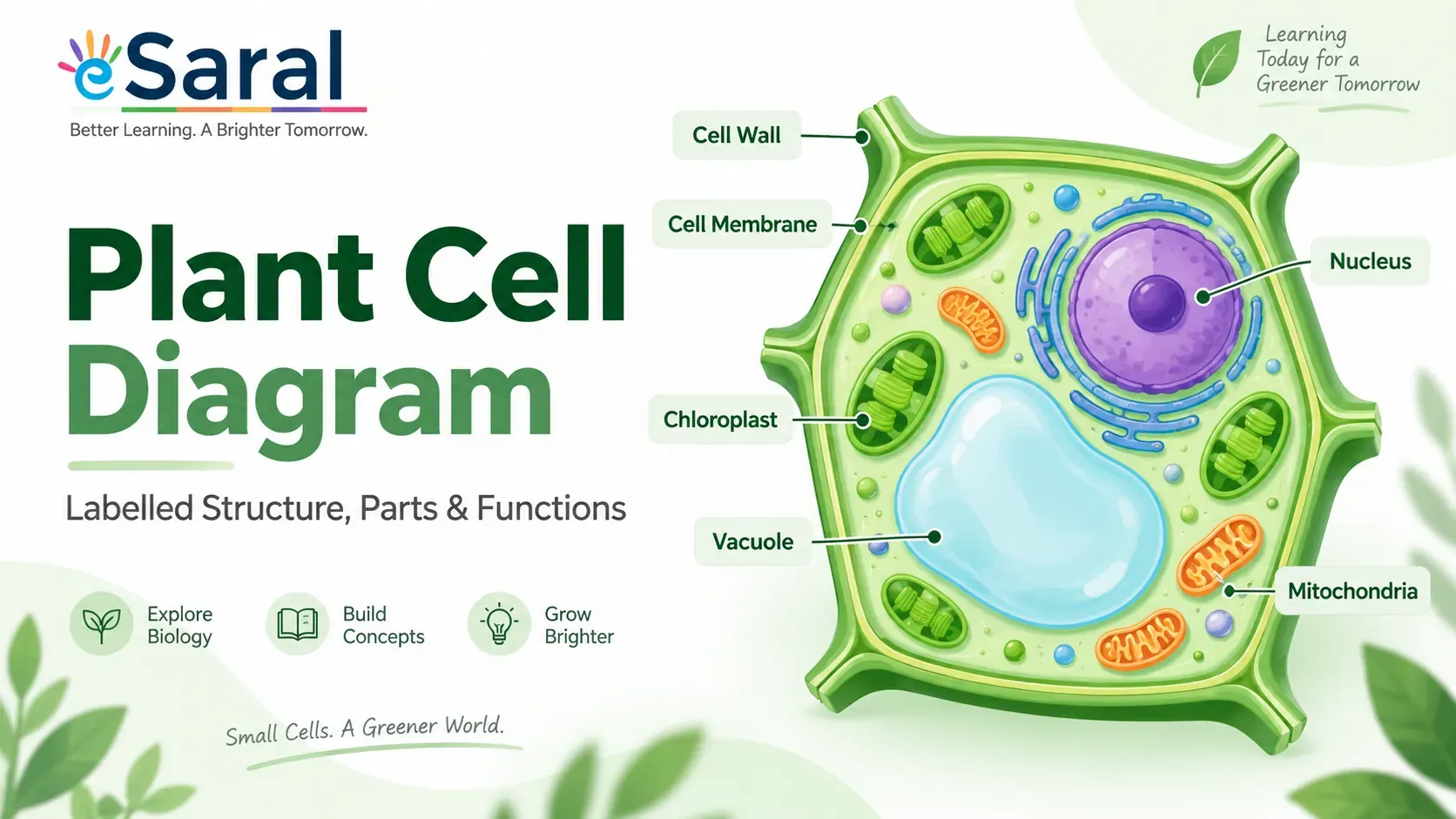
Plant Cell Diagram: Labelled Structure, Parts and Functions
Simple, labelled plant cell diagram with parts and functions. Covers plant cell structure for Class 6, 7, 8, 9, 10 and 11 students, CBSE-aligned.
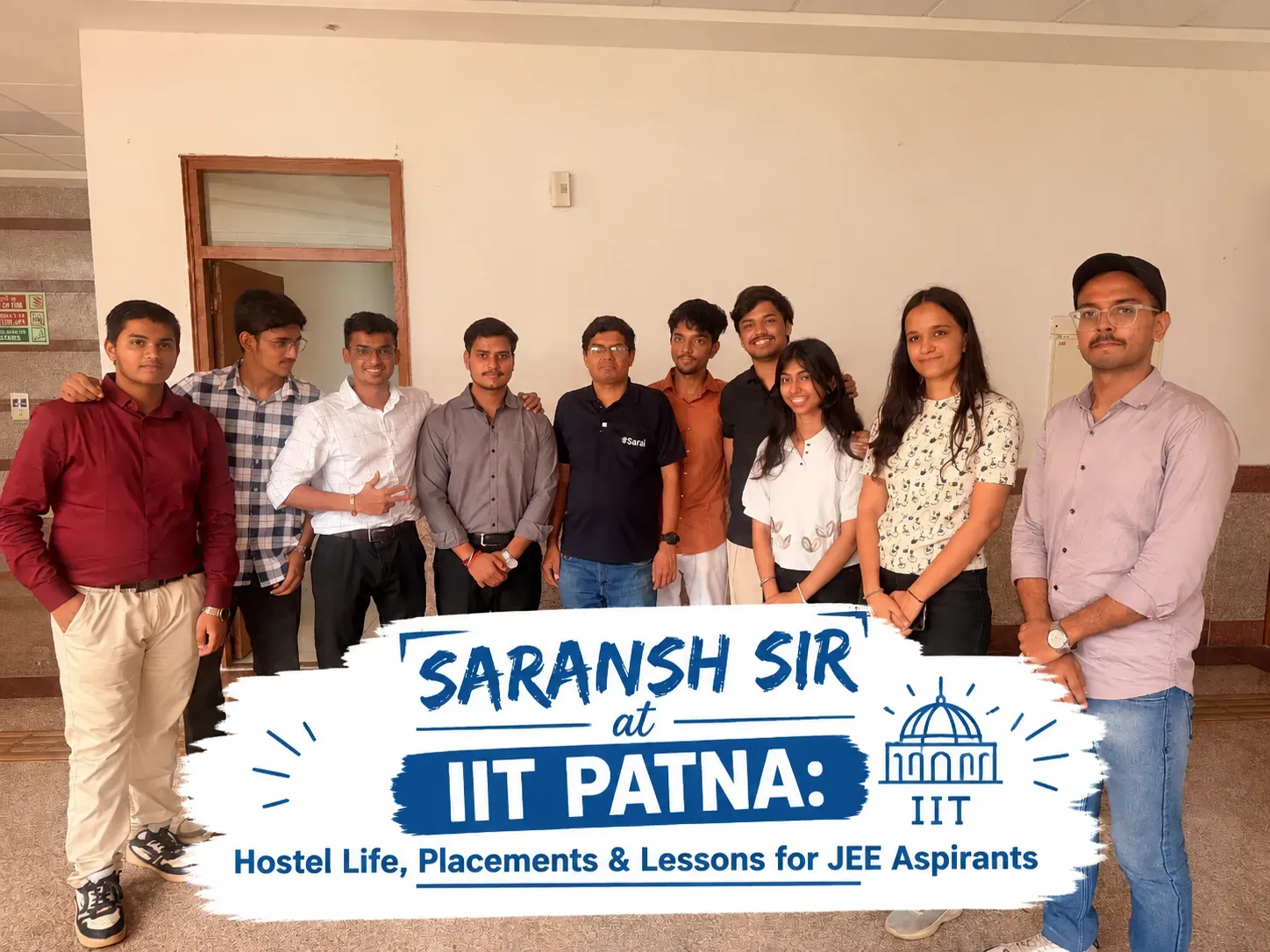
Saransh Gupta Sir's Visit to IIT Patna: Hostel Life, Placements & Lessons for JEE Aspirants
Inside Saransh Gupta Sir's IIT Patna visit — hostel life, the library, placements, internships, and real advice for JEE aspirants from students living the IIT dream.
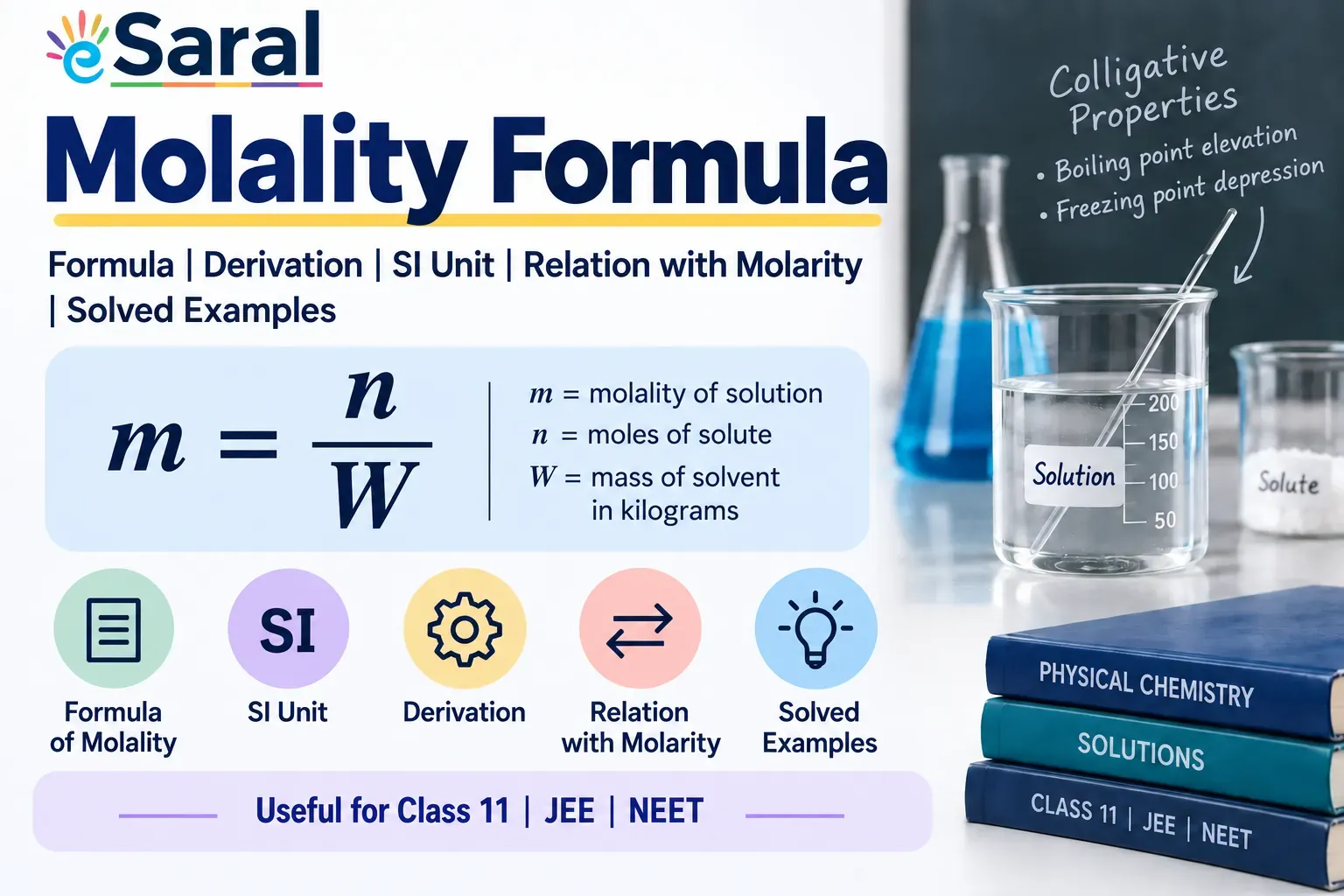
Molality Formula: Formula for Molality, Derivation & Solved Examples
Molality formula is $m = \dfrac{n}{W}$. Learn the formula of molality, its SI unit, derivation, relation with molarity, and solved examples for Class 11, JEE and NEET.
BITSAT Previous Year Question Paper PDF
Download BITSAT previous year question papers PDF. Get year-wise BITSAT PYQs, memory-based papers, exam pattern, and preparation tips to improve your BITSAT preparation.

Teachers’ Day 2026 at eSaral Gurukul: Celebrating the Bond Between Students, Teachers & Mentors
See how Teachers’ Day 2026 was celebrated at eSaral Gurukul, reflecting the bond among students, teachers, and mentors, and the role of guidance beyond academics.
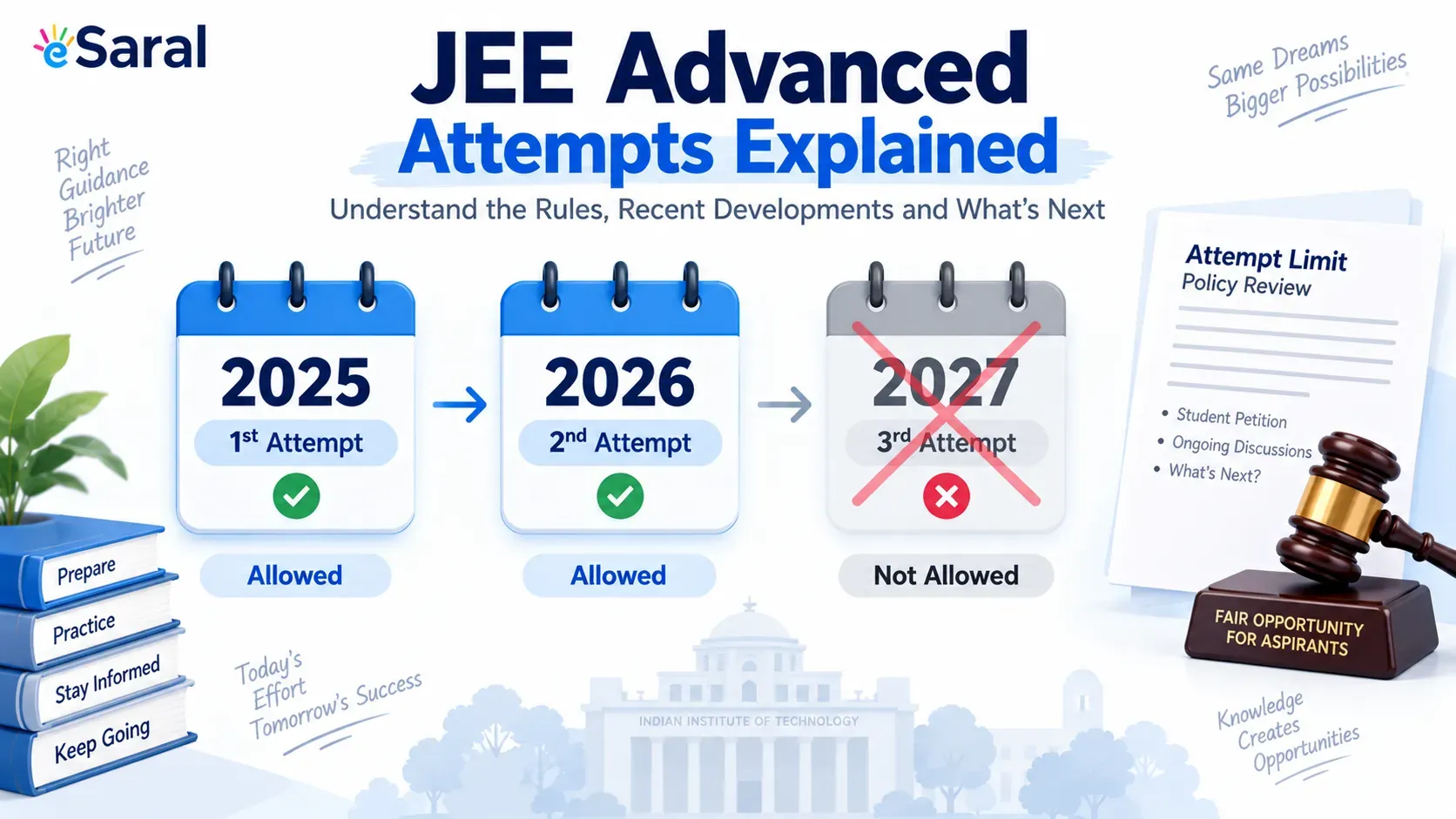
JEE Advanced Attempts: Can You Give It a Third Time? Rules Explained
JEE Advanced attempts: current rule is 2 consecutive years only: full eligibility criteria, the 2025 third-attempt controversy, and the latest 2026 petition news.

Best JEE Preparation App
Best JEE preparation app for Main & Advanced: AI mock tests, live doubt-solving, thousands of practice questions. JEE preparation app for droppers & Class 11-12.
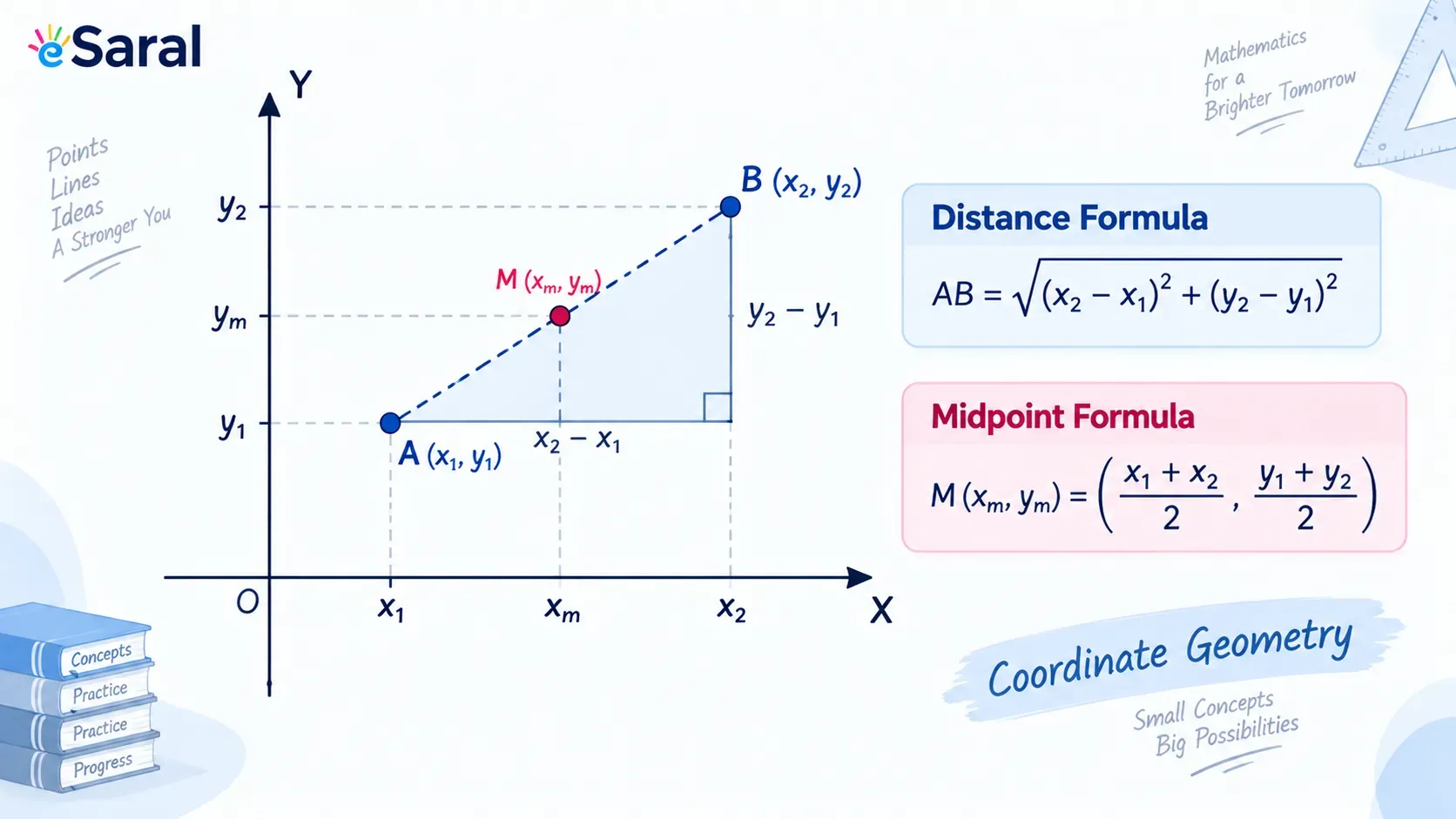
Coordinate Geometry Class 10: Formulas, Notes & Solved Examples
Coordinate geometry class 10: complete CBSE formulas — distance, section, midpoint and area of triangle — with derivation, notes and solved examples.
How to make Notes For JEE Smart Notes Strategy of an AIR 41
Learn how to make notes for JEE the way toppers do — indexing, shorthand, and smart short notes for JEE that cut revision time to just 5–7 days.
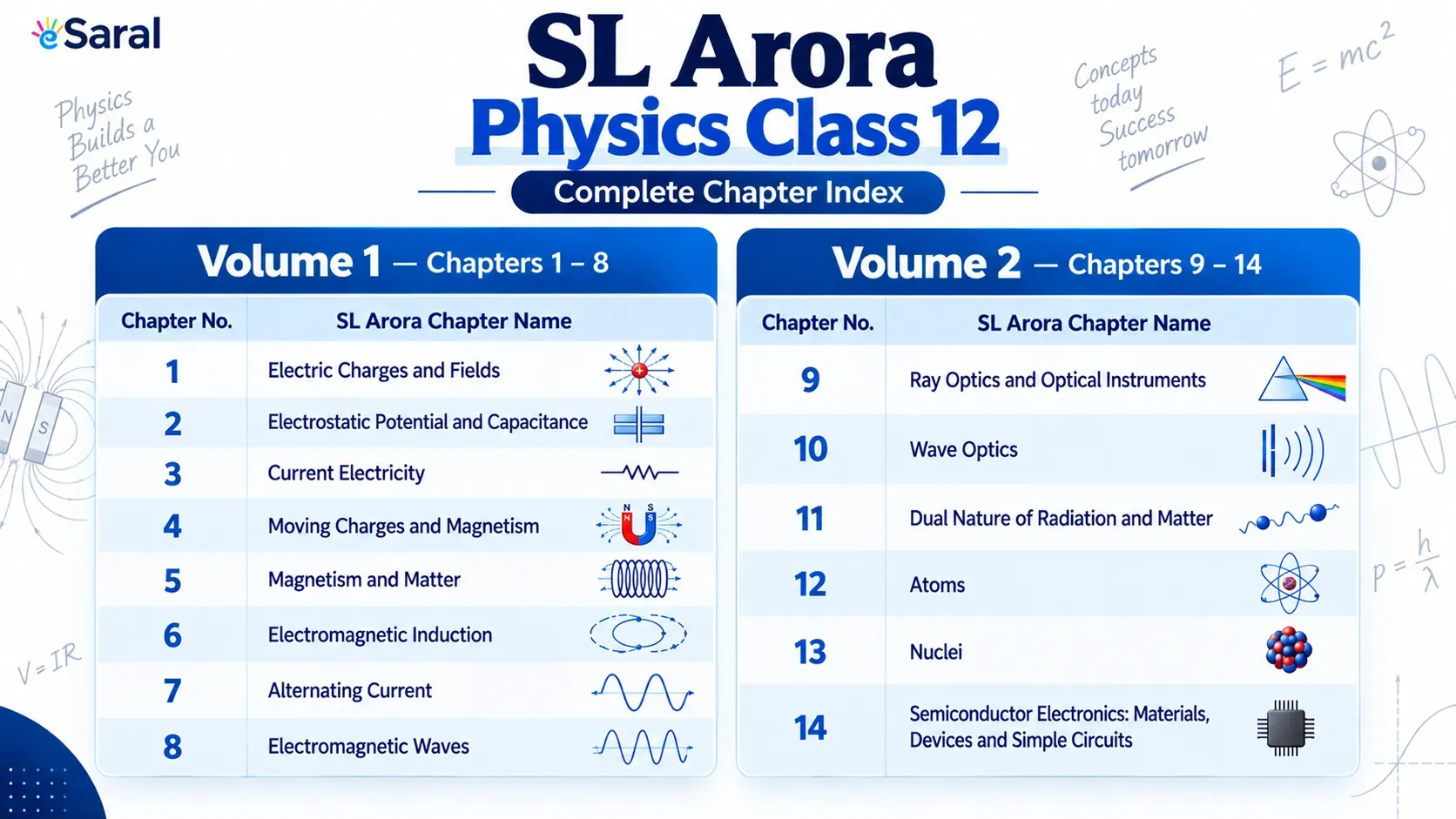
SL Arora Physics Class 12 Index – Chapter List for Volume 1 & 2
SL Arora Physics Class 12 index — complete chapter list for Volume 1 & 2, mapped to NCERT solutions for board, JEE Main, and NEET preparation.