
Wheatstone Bridge Circuit Diagram, Applications, Formula - Class 12, JEE & NEET

eSaral Academic and Editorial Team
- Wheatstone Bridge
- Principle of Wheatstone Bridge
- Balanced Wheatstone Bridge
- Unbalanced Wheatstone Bridge
- Applications of Wheatstone Bridge
- Kelvin's Double Bridge
The Wheatstone Bridge circuit is nothing more than two simple series-parallel arrangements of resistances connected between a voltage supply terminal and ground producing zero voltage difference between the two parallel branches when balanced. Here we will study about, Wheatstone Bridge, the Conditions of balanced and Unbalanced Wheatstone bridge circuit Diagram, and its applications.
It is an arrangement of four resistances devised by Charles Wheatstone which is used to measure an unknown resistance.
Principle of Wheatstone Bridge
The Wheatstone bridge principle states that if four resistances P, Q, R, and S are arranged to form a bridge with a cell and key between A and C, and a galvanometer between B and D then the bridge is said to be balanced when the galvanometer shows a zero deflection.
In balanced condition$\mathrm{I}_{9}=0 \quad$ so $\mathrm{V}_{\mathrm{B}}=\mathrm{V}_{\mathrm{D}}$ or $\frac{P}{Q}=\frac{R}{s}$. This is called condition of balance.
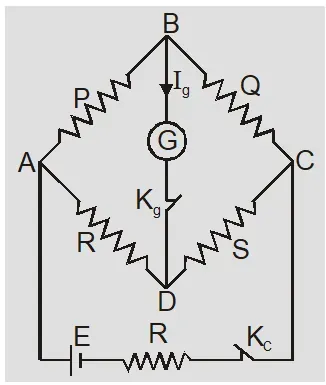
Balanced Wheatstone Bridge
The condition of balance depends on resistance P, Q, R, and S. This is independent of the emf of the battery.
In-state of balance, the cell and galvanometer can be interchanged. While performing an experiment at start press the cell key $K_{c}$ first and then the galvanometer key $\mathrm{K}_{9}$ and at end remove $\mathrm{K}_{9}$ first and then $\mathrm{K}_{\mathrm{c}}$ to avoid induced effects.
P and Q are called ratio arms, R is the known resistance arm and S is the unknown arm. BD and AC are called conjugate arms.
The resistance of a balanced Wheatstone bridge between A and C is $\frac{(P+Q)(R+S)}{P+Q+R+S}$.
The sensitivity of the bridge depends upon the value of resistances. The sensitivity is maximum when P, Q, R, and S are of the same order.
Unbalanced Wheatstone bridge

If $\frac{P}{Q}<\frac{R}{s}$ then $V_{B}>V_{D}$ so current flows from $B$ to $D .$
If $\frac{P}{Q}>\frac{R}{s}$ then $V_{B}<V_{D}$ so current flows from $D$ to $B$
Browse More Topics Related to Wheatstone Bridge
Applications of Wheatstone Bridge
The Wheatstone Bridge has many uses in electronic circuits other than comparing an unknown resistance with a known resistance. When used with Operational Amplifiers, the Wheatstone bridge circuit can be used to measure and amplify small changes in resistance, RX due.
Wheatstone bridge is not suitable for measurement of very small and very high resistances. Very low resistances are measured by Kelvin’s double bridge while very high resistances by leakage method.
For Complete Study Material and Video Tutorials for JEE & NEET Exam Preparation Download eSaral APP Also Read:
- Types and Effects of Electric Current
- Ohm’s Law and Resistance
- Combination of Resistances
- EMF and Internal Resistances of a Cell
- Cells Connected in Series, parallel and Mixed
- Kirchhoff’s Circuit Law
- Electric Currents in Conductors
- Wheatstone Bridge
- Post office Box
- Wheatstone Meter Bridge
- Moving Coil galvanometer
- Ammeter and Voltmeter
- Potentiometer Working Principle
Team eSaral
eSaral Academic and Editorial Team
Team eSaral is the collective author profile for educational content created by eSaral’s teachers and academic contributors. The team draws on expertise from IIT graduates, doctors, experienced educators and subject specialists to develop resources for JEE, NEET and school students. Our articles aim to explain concepts clearly and help students study with confidence.
Related Posts

Plant Cell Diagram: Labelled Structure, Parts and Functions
Simple, labelled plant cell diagram with parts and functions. Covers plant cell structure for Class 6, 7, 8, 9, 10 and 11 students, CBSE-aligned.

Saransh Gupta Sir's Visit to IIT Patna: Hostel Life, Placements & Lessons for JEE Aspirants
Inside Saransh Gupta Sir's IIT Patna visit — hostel life, the library, placements, internships, and real advice for JEE aspirants from students living the IIT dream.
Molality Formula: Formula for Molality, Derivation & Solved Examples
Molality formula is $m = \dfrac{n}{W}$. Learn the formula of molality, its SI unit, derivation, relation with molarity, and solved examples for Class 11, JEE and NEET.

BITSAT Previous Year Question Paper PDF
Download BITSAT previous year question papers PDF. Get year-wise BITSAT PYQs, memory-based papers, exam pattern, and preparation tips to improve your BITSAT preparation.

Teachers’ Day 2026 at eSaral Gurukul: Celebrating the Bond Between Students, Teachers & Mentors
See how Teachers’ Day 2026 was celebrated at eSaral Gurukul, reflecting the bond among students, teachers, and mentors, and the role of guidance beyond academics.

JEE Advanced Attempts: Can You Give It a Third Time? Rules Explained
JEE Advanced attempts: current rule is 2 consecutive years only: full eligibility criteria, the 2025 third-attempt controversy, and the latest 2026 petition news.

Best JEE Preparation App
Best JEE preparation app for Main & Advanced: AI mock tests, live doubt-solving, thousands of practice questions. JEE preparation app for droppers & Class 11-12.
Coordinate Geometry Class 10: Formulas, Notes & Solved Examples
Coordinate geometry class 10: complete CBSE formulas — distance, section, midpoint and area of triangle — with derivation, notes and solved examples.

How to make Notes For JEE Smart Notes Strategy of an AIR 41
Learn how to make notes for JEE the way toppers do — indexing, shorthand, and smart short notes for JEE that cut revision time to just 5–7 days.
SL Arora Physics Class 12 Index – Chapter List for Volume 1 & 2
SL Arora Physics Class 12 index — complete chapter list for Volume 1 & 2, mapped to NCERT solutions for board, JEE Main, and NEET preparation.